If you have ever confused imminent vs immanent, you are not alone. These two words look and sound remarkably similar, but they have completely different meanings.
Understanding this difference can help you avoid embarrassing spelling and vocabulary mistakes in academic, professional, religious, and everyday writing.
However, their meanings are easy to separate once you learn their origins and remember a simple association.
This guide explains the difference between imminent and immanent, provides practical examples, and shows you exactly when to use each word.
Quick Answer: Imminent vs Immanent
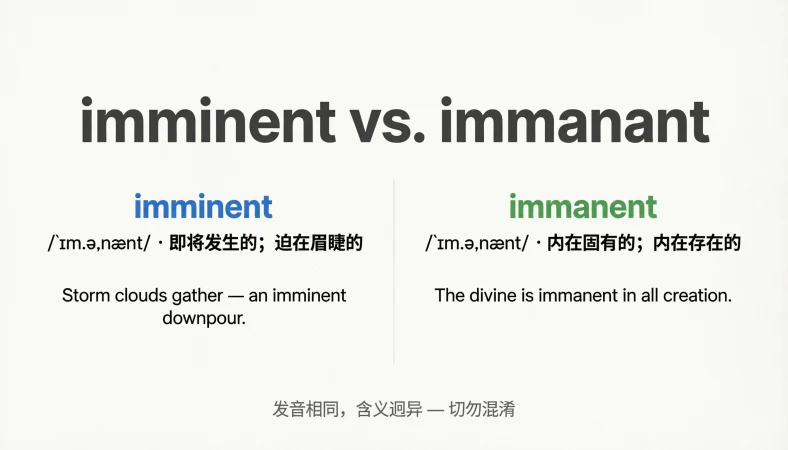
Imminent means something is about to happen very soon, such as “a storm is imminent.”
Immanent means existing, operating, or remaining within something; it is commonly used in philosophy and theology.
A simple memory trick: imminent = immediate, while immanent = within.
What Does Imminent Mean?
Imminent is an adjective used when something is expected to happen very soon. It suggests that an event is close in time and likely to occur shortly.
For example:
- The arrival of the train is imminent.
- Dark clouds suggested that rain was imminent.
- The company warned employees of an imminent announcement.
- The doctor said that labor was imminent.
The word does not necessarily mean that something is happening right now. Instead, it emphasizes that the event is approaching and may happen at any moment.
Imminent in a Sentence
Consider this sentence:
“The hikers knew that a storm was imminent.”
This means the hikers believed the storm was going to happen soon.
Other examples include:
- An economic crisis appeared imminent.
- The deadline is imminent.
- The building was evacuated because danger was imminent.
- A major announcement seems imminent.
What Does Immanent Mean?
Immanent is an adjective with a very different meaning. It describes something that exists, works, or remains within another thing rather than coming from outside it.
The word is especially common in philosophy, theology, and discussions about the nature of reality.
For example:
- Some philosophers describe goodness as immanent in human experience.
- The divine may be understood as immanent within creation.
- The principle is immanent in the system itself.
In theological writing, immanent can describe God’s presence or activity within the created world. It is often contrasted with transcendent, which refers to something existing beyond or above the ordinary physical world.
Immanent in a Sentence
Consider:
“The philosopher argued that meaning is immanent in human experience.”
Here, immanent means that meaning exists within or arises from human experience itself.
It does not mean that meaning is about to happen.
Imminent vs Immanent: The Main Difference
The easiest way to understand imminent vs immanent is to focus on the basic idea behind each word.
| Word | Meaning | Main Idea | Example |
|---|---|---|---|
| Imminent | About to happen | Near in time | A storm is imminent. |
| Immanent | Existing within | Present inside something | The quality is immanent in nature. |
The words differ by only a few letters, but they belong to different semantic categories.
Imminent concerns time and approaching events.
Immanent concerns presence within something.
Origin and History of Imminent
The word imminent comes from the Latin imminere, meaning “to project,” “overhang,” or “be near.” Over time, its meaning developed toward the idea of something approaching or threatening to happen.
Its historical sense helps explain why imminent is frequently associated with events that are close at hand.
| Word | Historical Source | Basic Historical Idea | Modern Meaning |
|---|---|---|---|
| Imminent | Latin imminere | Overhang or approach | About to happen |
| Immanent | Latin immanere | Remain within | Existing or operating within |
This distinction is useful because the different Latin roots ultimately contributed to the different meanings of the modern English words.
Origin and History of Immanent
Immanent comes from the Latin immanere, meaning “to remain in” or “to dwell within.” This origin is directly connected to its modern meaning.
The word became especially significant in philosophical and theological discussions. Writers used it to discuss principles, qualities, causes, or divine presence that exist within something rather than outside or beyond it.
That historical connection makes one memory trick particularly useful:
Immanent → in
Think of the “in” sound as a reminder that something is located or operating within.
Imminent vs Immanent in Religion and Theology
Imminent may describe an event believed to be approaching. For example, a writer might describe a coming judgment as imminent if they believe it is about to occur.
Immanent, meanwhile, is a theological concept concerning divine presence within creation.
Theological discussions sometimes distinguish between God’s immanence and God’s transcendence. Immanence emphasizes God’s presence or activity within creation, while transcendence emphasizes existence beyond creation.
It is important not to confuse immanent with imminent in religious texts. A statement about something being “imminent” concerns timing; a statement about something being “immanent” concerns presence or existence within.
Spiritual Meaning of Imminent vs Immanent
The difference between these words can also be understood symbolically.
Imminent carries a sense of expectation. It points toward something approaching. In spiritual writing, it may be used when discussing an anticipated event, coming change, or approaching moment.
Immanent carries a sense of presence. Spiritually, it can describe the idea that the divine is present or active within creation, human experience, or the world.
| Concept | Symbolic Idea | Example |
|---|---|---|
| Imminent | Expectation | Something is approaching |
| Immanent | Presence | Something exists within |
| Transcendent | Beyondness | Something exists beyond ordinary limits |
This distinction can make the vocabulary easier to remember: imminent looks forward, while immanent looks inward.
Imminent vs Immanent Examples
Examples are one of the best ways to understand the difference.
Examples of Imminent
- The arrival of the guests is imminent.
- Scientists warned that a major storm was imminent.
- The company announced that layoffs were imminent.
- With the dark clouds overhead, heavy rain seemed imminent.
- The athlete knew that the final whistle was imminent.
In every case, imminent refers to something that is expected to happen soon.
Examples of Immanent
- The philosopher believed that truth was immanent in human experience.
- The author explored the idea of an immanent divine presence.
- The principle is immanent within the natural order.
- The meaning is immanent in the work itself.
- Some theological traditions emphasize God’s immanent presence in creation.
Here, immanent refers to something existing or operating within another thing.
Common Confusions Between Imminent and Immanent
The biggest mistake is using immanent when you mean “about to happen.”
Incorrect:
“The examination is immanent.”
Correct:
“The examination is imminent.”
The first sentence suggests that the examination exists within something, which is probably not what the writer intends.
Another common error is using imminent in a philosophical or theological context where the intended meaning is “existing within.”
Incorrect:
“The divine presence is imminent in creation.”
Better:
“The divine presence is immanent in creation.”
The correct word depends entirely on the intended meaning.
How to Remember Imminent vs Immanent
A simple memory trick can eliminate most mistakes.
Imminent = Immediate
Both imminent and immediate begin with the idea of something being close in time.
Think:
Imminent → immediate → happening soon
Immanent = In
Think of:
Immanent → in → existing within
This gives you a quick mental test:
- Is something about to happen? Use imminent.
- Does something exist or operate within something else? Use immanent.
Another helpful contrast is:
Imminent = near in time
Immanent = within
Imminent vs Immanent in American and British English
There is no major difference in meaning between American and British English for these two words. Imminent means “about to happen,” and immanent refers to something existing or operating within something.
The spelling is generally the same in both varieties.
What may differ is frequency and context. Imminent is common in news, business, emergency, academic, and everyday writing. Immanent is considerably less common and is more likely to appear in philosophical, theological, or academic discussions.
| Variety | Imminent | Immanent |
|---|---|---|
| American English | Same meaning | Same meaning |
| British English | Same meaning | Same meaning |
| Spelling | Usually unchanged | Usually unchanged |
| Common context | Everyday and formal | Philosophy and theology |
Why People Search “Imminent vs Immanent”
People commonly search imminent vs immanent because the words are homophones or near-homophones for many speakers and have very similar spellings.
The confusion is particularly common when writing quickly or proofreading formal documents.
Students may encounter immanent in philosophy or theology while encountering imminent in news reports and general writing. Because both words sound similar, recognizing their context is important.
If you are unsure, replace the word mentally with a simpler phrase.
If you mean “about to happen,” choose imminent.
If you mean “existing within,” choose immanent.
Imminent vs Immanent: Quick Comparison Table
| Feature | Imminent | Immanent |
|---|---|---|
| Part of speech | Adjective | Adjective |
| Core meaning | About to happen | Existing within |
| Related idea | Nearness in time | Internal presence |
| Common contexts | Events, danger, changes | Philosophy, theology |
| Memory word | Immediate | In |
| Example | Change is imminent. | Meaning is immanent in the work. |
Is “Immanent” the Opposite of “Transcendent”?
Immanent generally describes something present or operating within a particular reality or system. Transcendent refers to something that goes beyond or exists outside ordinary limits.
However, they are not simple opposites in every context. Their precise meanings can vary according to the philosophical or theological framework being discussed.
This is another reason immanent tends to appear more often in specialized writing than in casual conversation.
Final Summary: Imminent vs Immanent
The difference between imminent vs immanent becomes much easier once you focus on their central meanings.
Imminent means that something is about to happen or is approaching soon. Immanent means that something exists, remains, or operates within another thing.
Remember the simple rule: imminent = immediate, while immanent = in. If a storm, deadline, announcement, or event is coming soon, use imminent.
If you are discussing a quality, principle, or divine presence that exists within something, use immanent.
Final Thought
Although imminent and immanent look almost alike, their meanings are separated by a clear distinction.
One deals with something approaching in time, while the other describes something existing or operating within something else.
Once you connect imminent with “immediate” and immanent with “in,” the difference becomes much easier to remember.
The best way to master these words is to notice how they are used in context. When you see “imminent,” think about an approaching event.
When you see “immanent,” think about an internal presence or quality. With this simple distinction, you can confidently choose the correct word in everyday, academic, professional, and theological writing.
FAQs About Imminent vs Immanent
1. What is the difference between imminent and immanent?
Imminent means about to happen soon, while immanent means existing or operating within something.
2. Is it “imminent danger” or “immanent danger”?
The correct phrase is “imminent danger” when you mean danger that is about to occur or is very close.
3. What is an example of imminent?
“The arrival of the storm is imminent.” This means the storm is expected to arrive soon.
4. What is an example of immanent?
“The philosopher argued that meaning is immanent in human experience.” Here, immanent means existing within.
5. Is immanent a religious word?
It can be. Immanent is frequently used in theology to discuss divine presence or activity within creation, although it is also used in philosophy.
6. How can I remember imminent vs immanent?
Remember imminent = immediate, meaning something is about to happen. Remember immanent = in, meaning something exists within.
7. Is imminent more common than immanent?
Yes. Imminent is much more common in everyday and general formal English, while immanent is more specialized and frequently appears in philosophical and theological contexts.

John Robert is a passionate author and faith-driven writer who contributes insightful and inspiring biblical content to Biblenast. With a strong commitment to sharing God’s Word, he focuses on creating meaningful messages that encourage spiritual growth, reflection, and daily guidance. His work aims to connect readers with the timeless teachings of the Bible.