
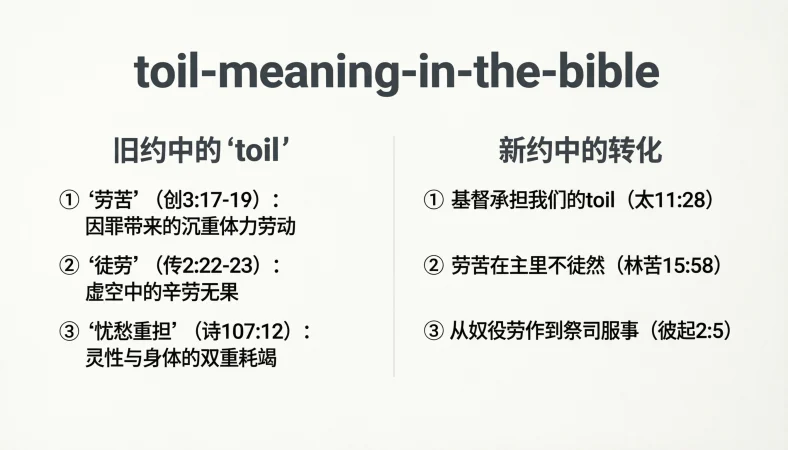
The toil meaning in the Bible is closely connected with hard work, labor, weariness, and the difficulties people experience while accomplishing their responsibilities.
Throughout Scripture, toil is not presented simply as physical work. It can also describe exhausting labor, the struggles that accompany life in a fallen world, and the effort required to provide for oneself and others.
From Genesis to the New Testament, biblical writers use the idea of toil to address work, suffering, perseverance, and dependence on God.
Understanding the toil meaning in the Bible can help readers see an important balance in Scripture: work itself is valuable, but human effort can become painful and exhausting.
The Bible encourages people to work faithfully while remembering that lasting fruit and ultimate security come from God.
The biblical concept of toil therefore carries both a practical and spiritual message about responsibility, perseverance, humility, and trust.
Quick Answer: What Does Toil Mean in the Bible?
In the Bible, toil generally means difficult, exhausting, or burdensome labor. It can describe physical work, daily struggles, or the weariness associated with life. Scripture teaches that toil became especially burdensome after humanity’s fall, yet faithful work remains valuable and can be offered to God.
What Does Toil Mean in the Bible?
The word toil usually refers to strenuous work that requires considerable effort. It often carries an additional sense of weariness, hardship, or trouble.
Biblically, toil is different from the simple idea of productive work. Work can be good and meaningful, while toil often emphasizes the difficult side of labor. A person may work hard, become tired, face obstacles, and still continue faithfully.
This distinction is important because the Bible does not teach that all work is a punishment. Work existed before the fall of humanity. In Genesis, Adam was given responsibility to cultivate and care for the garden. However, after sin entered the world, human labor became associated with frustration, difficulty, and painful effort.
| Biblical idea | Meaning |
|---|---|
| Work | Productive activity and responsibility |
| Toil | Difficult or exhausting labor |
| Labor | Physical or mental effort |
| Weariness | Tiredness resulting from effort |
| Fruitfulness | Positive results produced through effort and blessing |
The Origin and Biblical Background of Toil
The concept of toil appears throughout Scripture, especially in passages dealing with work and human suffering.
One of the clearest examples appears in Genesis 3:17, where God tells Adam that the ground will produce food through painful labor. The passage connects the hardship of cultivation with humanity’s disobedience and the consequences of the fall.
This does not mean that work itself began as a curse. Rather, the frustration and painful difficulty associated with work became part of human experience after sin.
The Old Testament repeatedly returns to this theme. Ecclesiastes, in particular, reflects deeply on human labor and the exhaustion people can experience when they work without recognizing God’s place in their lives.
Toil in the Old Testament
The Old Testament presents toil in several different ways. Sometimes it describes ordinary physical labor. At other times, it emphasizes the frustration of working hard without enjoying lasting results.
Ecclesiastes is especially important because it asks what people ultimately gain from all their labor. The writer observes that people can spend years working, accumulating possessions, and pursuing achievements, yet still experience emptiness.
This is not necessarily an argument against work. Instead, it challenges the belief that work, wealth, or achievement alone can provide ultimate meaning.
| Old Testament theme | Connection to toil |
|---|---|
| Genesis | Painful labor after the fall |
| Psalms | Human effort and dependence on God |
| Proverbs | Diligence and productive labor |
| Ecclesiastes | The frustration and temporary nature of earthly work |
| Exodus | Hard labor and oppression |
Toil in the New Testament
The New Testament also uses the idea of toil when discussing Christian responsibility, ministry, and perseverance.
Paul frequently described his ministry as demanding significant effort. In passages such as 1 Corinthians 15:58, believers are encouraged to remain steadfast because their labor in the Lord is not meaningless.
This provides an important contrast with some Old Testament reflections on meaningless or frustrating labor. Christian toil can have eternal significance when it is connected with faithful service to God.
Therefore, biblical toil can involve exhaustion, but faithful effort is not automatically wasted.
The Spiritual Meaning of Toil
The spiritual meaning of toil goes beyond simply being tired from work. It can symbolize the reality of living in a broken world while continuing to pursue what is good.
Toil can remind believers that human strength has limitations. People can work diligently and still encounter circumstances they cannot control. Crops can fail, plans can change, businesses can struggle, and personal efforts may not produce immediate results.
This teaches dependence on God.
The spiritual lesson is not, “Stop working because life is difficult.” Instead, Scripture encourages faithful effort while recognizing that people are not ultimately in control of the results.
Toil can therefore symbolize:
- Perseverance when circumstances are difficult
- Humility because human strength has limits
- Dependence on God rather than self-sufficiency
- Faithfulness in responsibilities
- Patience when results take time
- Hope that labor done for God has lasting value
Is Toil a Punishment According to the Bible?
This is one of the most common questions about the biblical concept of toil.
The answer requires some nuance. The Bible connects painful toil with the consequences of humanity’s fall, particularly in Genesis 3. However, Scripture does not teach that every form of work is inherently sinful or that working hard is always a divine punishment.
So, toil can be understood as the burdensome side of work in a fallen world, rather than work itself being evil.
Toil vs. Work: What Is the Difference?
Although the words can overlap, they emphasize different aspects of human effort.
Work can be productive, satisfying, creative, and purposeful. Toil usually draws attention to the difficulty and weariness involved.
For example, a person may enjoy gardening as meaningful work. But when the soil is hard, the weather is harsh, and the labor becomes exhausting, that work may feel like toil.
| Work | Toil |
|---|---|
| Can emphasize productivity | Emphasizes difficulty |
| May be enjoyable | Often involves weariness |
| Can be creative | Often highlights strenuous effort |
| Was part of God’s original design | Associated strongly with fallen-world hardship |
| Can bring satisfaction | May bring frustration or exhaustion |
What Does Toil Teach Christians Today?
The biblical teaching about toil remains relevant because modern life is filled with demanding responsibilities.
People toil in offices, businesses, schools, farms, homes, and ministries. Some labor physically, while others experience mental and emotional exhaustion.
The Bible offers several practical lessons.
First, hard work has value. Proverbs frequently praises diligence and warns against laziness.
Third, Christians are encouraged to persevere. Galatians 6:9 teaches believers not to become weary in doing good.
Finally, Scripture points people toward rest and dependence on God. Human beings are not designed to carry every burden through their own strength.
Toil, Perseverance, and Faith
One of the most encouraging aspects of the biblical teaching is that difficult labor does not necessarily mean failure.
Sometimes faithfulness looks ordinary. A parent caring for children, a worker completing responsibilities, a student studying diligently, or a believer serving others may not see immediate results.
Yet Scripture repeatedly emphasizes faithfulness.
The goal is not to glorify exhaustion. Rather, it is to remain faithful without believing that personal effort alone determines the outcome.
Common Misconceptions About Toil in the Bible
Several misunderstandings can arise when people study this word.
Misconception 1: Toil means all work is sinful.
This is incorrect. Scripture presents purposeful work as part of God’s creation. Toil highlights the burdensome aspect of labor.
Misconception 2: God wants people to suffer through endless work.
The Bible does not glorify unnecessary exhaustion. Scripture contains principles of rest, Sabbath, wisdom, and dependence on God.
Misconception 3: Hard work always produces immediate success.
The Bible does not promise that every effort will produce visible results. Ecclesiastes recognizes the uncertainty of earthly outcomes.
Misconception 4: Toil has no spiritual value.
The New Testament teaches that labor performed faithfully for the Lord can have lasting significance.
Why Do People Search for the Toil Meaning in the Bible?
People often encounter the word toil while reading older Bible translations, devotional material, or passages from books such as Genesis and Ecclesiastes.
Others search for its meaning because they are experiencing difficult work or a season of exhaustion and want to understand what Scripture says about it.
The concept can be especially meaningful for someone asking questions such as:
- Why does work sometimes feel so difficult?
- Is hard labor part of God’s plan?
- Why do my efforts not always produce results?
- What does the Bible say about being tired?
- How can faith help me persevere?
Studying biblical toil can provide perspective without suggesting that every hardship has a simple explanation.
Cultural and Modern Understanding of Toil
In modern English, “toil” is still commonly associated with hard and exhausting work. However, it can sound more literary or formal than words such as “work” or “labor.”
For example, someone might say, “After years of toil, she finally achieved her goal.” The word emphasizes the effort and difficulty involved in reaching that achievement.
The biblical use has a similar emotional dimension. It can communicate not merely that someone worked, but that the work required endurance and involved hardship.
A Spiritual Perspective on Difficult Work
When work becomes exhausting, the biblical concept of toil can encourage a balanced perspective.
You can acknowledge that the struggle is real without assuming that your work has no value. You can also recognize your limitations instead of measuring your worth entirely by productivity.
Scripture encourages believers to work faithfully, seek wisdom, care for others, and trust God with outcomes.
In this sense, the toil meaning in the Bible points toward a deeper truth: human beings are called to meaningful responsibility, but they are not expected to be their own source of strength.
Final Summary: What Does Toil Mean in the Bible?
The toil meaning in the Bible centers on difficult, strenuous, and sometimes exhausting labor. Genesis connects painful toil with the consequences of humanity’s fall, while books such as Ecclesiastes explore the frustration and temporary nature of human effort. The New Testament, however, also presents faithful labor as meaningful, especially when it is done in service to God and others.
Final Thought
The biblical idea of toil speaks honestly about one of life’s most familiar experiences: working hard and becoming tired. Scripture does not pretend that every effort will be easy or that result appear immediately.
Instead, it encourages people to recognize the difficulty of life while continuing to act faithfully. Toil can remind us that human strength is limited and that success ultimately depends on more than personal effort.
For Christians, this perspective can transform the way difficult work is viewed. Rather than seeing every struggle as meaningless, believers can approach their responsibilities with diligence, patience, prayer, and trust in God.
The lesson of biblical toil is not simply to work harder, but to work faithfully while remembering where true strength and lasting purpose come from.
FAQs About Toil Meaning in the Bible
1. What does toil mean in the Bible?
Toil means difficult, strenuous, or exhausting labor. It often emphasizes the hardship and weariness associated with work.
2. Where is toil first mentioned in the Bible?
The concept is prominently introduced in Genesis 3, where painful labor becomes part of humanity’s experience after the fall.
3. Is toil a punishment from God?
Genesis connects painful toil with the consequences of sin, but work itself is not presented as inherently evil. Meaningful work existed before the fall.
4. What is the spiritual meaning of toil?
Spiritually, toil can symbolize perseverance, human limitation, humility, dependence on God, and faithfulness during difficult circumstances.
5. What is the difference between work and toil?
Work generally emphasizes productive activity, while toil emphasizes the difficult, strenuous, or exhausting nature of that activity.
6. Does the Bible say that hard work is valuable?
Yes. Scripture frequently encourages diligence and faithful labor. The New Testament particularly emphasizes that labor done faithfully for the Lord is not worthless.
7. What can Christians learn from biblical toil?
Christians can learn to work diligently, avoid making productivity an idol, accept human limitations, persevere through difficulty, and trust God with the results.

Michael James is the administrator and a dedicated author at Biblenast, responsible for managing the platform and ensuring quality content. Alongside his administrative role, he writes insightful biblical articles that inspire faith, reflection, and spiritual growth. His work supports the mission of making God’s Word accessible and meaningful.