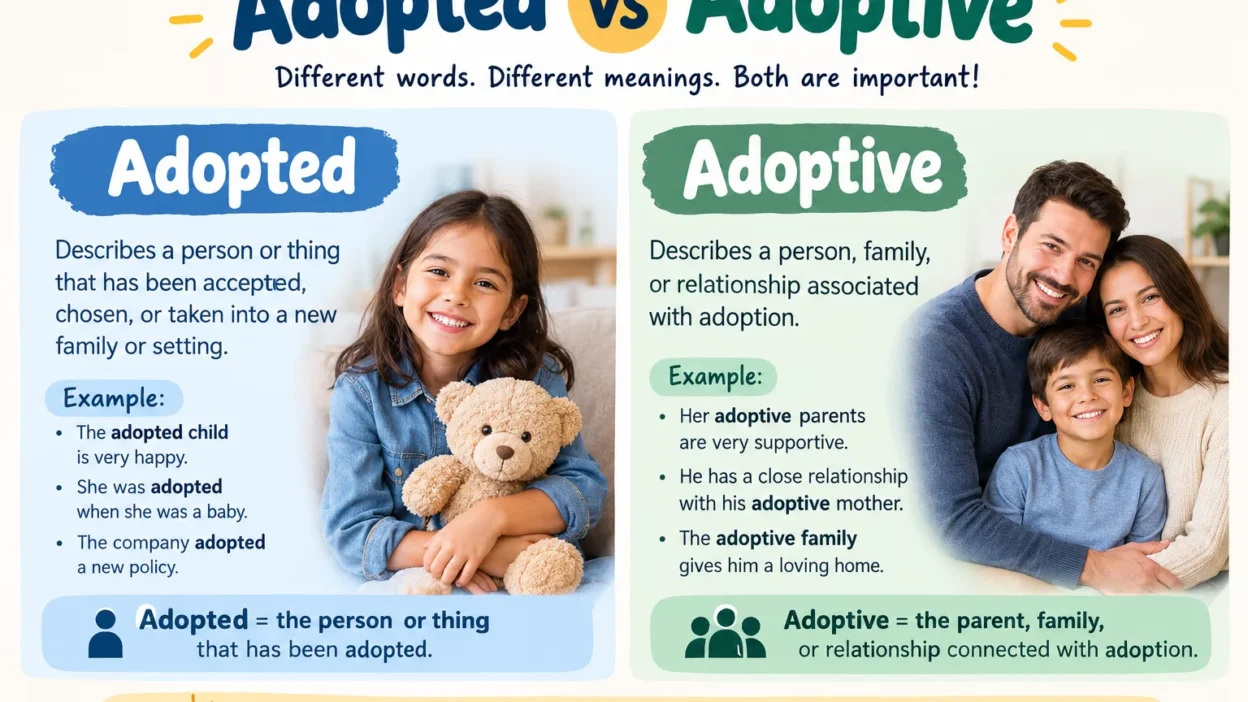
Understanding the difference between adopted vs adoptive can help you choose the right word when discussing family relationships, legal adoption, parenting, and personal identity.
Although both words are connected to adoption, they serve different grammatical purposes and communicate different ideas. Using them correctly makes your writing clearer, more natural, and easier for readers to understand.
For example, an adopted child is a child who has been legally or formally taken into a family, while an adoptive parent is someone who has adopted a child. Learning these distinctions.
Quick Answer: Adopted vs Adoptive
Adopted describes someone or something that has been accepted, chosen, or taken into a new family or setting. Adoptive describes a person or relationship connected with adoption, particularly a parent or family that adopts a child.
- Adopted child: A child who has been adopted.
- Adoptive parent: A parent who has adopted a child.
- Adopted name: A name that someone has chosen or taken.
- Adoptive family: A family formed through adoption.
What Does Adopted Mean?
Adopted is the past tense and past participle of the verb adopt. It can also function as an adjective describing someone or something that has been adopted.
In family relationships, the word commonly refers to a child who has become part of a family through adoption. It may also describe an adult who was adopted as a child.
For example:
- Sarah is an adopted child who grew up in a loving family.
- He was adopted when he was six months old.
- The adopted daughter recently met her birth parents.
- The organization adopted a new policy last year.
Notice that adopted has uses beyond family relationships. A government can adopt a law, a company can adopt a strategy, and a person can adopt a different approach to a problem.
Examples of Adopted in Sentences
- The adopted boy enjoys spending time with his siblings.
- My friend was adopted by a caring couple.
- The school adopted a new reading program.
- She adopted a healthier lifestyle.
- The committee adopted the proposal unanimously.
In each sentence, the word communicates that someone or something has been taken in, accepted, or chosen.
What Does Adoptive Mean?
Adoptive is an adjective. It describes a person, family, or relationship associated with adoption.
It is especially common in expressions such as adoptive mother, adoptive father, adoptive parents, and adoptive family.
For example, an adoptive mother is a woman who has adopted a child. An adoptive father is a man who has adopted a child. An adoptive family is a family formed through adoption.
The word identifies the relationship or role rather than simply stating that someone has been adopted.
Examples of Adoptive in Sentences
- Her adoptive parents supported her education.
- He maintains a close relationship with his adoptive mother.
- The child feels comfortable in his adoptive family.
- She thanked her adoptive father for his encouragement.
- The couple attended an adoptive parenting workshop.
The word adoptive is generally used before a noun to describe the person, family, or relationship connected with adoption.
Adopted vs Adoptive: Key Differences
The main difference is grammatical and semantic: adopted describes the result of adoption, while adoptive describes a person or relationship associated with adopting.
| Feature | Adopted | Adoptive |
|---|---|---|
| Part of speech | Past participle; often an adjective | Adjective |
| Main meaning | Taken into a family or accepted | Connected with adoption |
| Common expression | Adopted child | Adoptive parent |
| Focus | The person or thing adopted | The adopting person or family |
| Example | The adopted child smiled. | Her adoptive mother smiled. |
| Other uses | Adopted policy, adopted name | Adoptive family, adoptive relationship |
A simple way to remember the distinction is to ask who or what was adopted and who or what is associated with the act of adopting.
Adopted vs Adoptive: Examples Side by Side
Comparing the words in similar sentences makes their different meanings easier to understand.
| Adopted example | Adoptive example |
|---|---|
| The adopted child started school. | The adoptive parents attended the meeting. |
| He introduced his adopted daughter. | He introduced his adoptive mother. |
| The adopted boy loves his family. | The adoptive family welcomed the boy. |
| She is an adopted daughter. | She appreciates her adoptive father. |
| The adopted child asked a question. | The adoptive parent answered kindly. |
The distinction becomes clear when you look at the role each person plays in the relationship.
An adopted child is the person who has been adopted. An adoptive parent is the person who has adopted the child.
When Should You Use Adopted?
Use adopted when describing a person or thing that has been taken into a family, accepted, or formally chosen.
Common situations include:
1. Describing a child
- The adopted child has two loving siblings.
- Their adopted son graduated from university.
2. Describing a family relationship
- She is their adopted daughter.
- My brother was adopted as an infant.
3. Describing decisions or policies
- The company adopted a new procedure.
- Parliament adopted the proposed legislation.
4. Describing a chosen identity or name
- He used an adopted surname.
- The writer published the book under an adopted name.
In each case, adopted emphasizes the person or thing that has been accepted or chosen.
When Should You Use Adoptive?
Use adoptive when describing someone who adopts a child or a family relationship formed through adoption.
Common expressions include:
- Adoptive mother
- Adoptive father
- Adoptive parents
- Adoptive family
- Adoptive home
- Adoptive relationship
Examples:
- My adoptive parents encouraged me to follow my dreams.
- The child enjoys visiting his adoptive grandparents.
- They created a welcoming adoptive home.
- Her adoptive family celebrates her achievements.
Remember that an adoptive parent is not necessarily a biological parent. The term specifically identifies a parental relationship formed through adoption.
Common Mistakes When Using Adopted and Adoptive
Although these words are related, they cannot always replace each other. The following mistakes are common among English learners.
Mistake 1: Saying “My Adoptive Child”
This phrase is generally incorrect when you mean a child who has been adopted by you.
Incorrect: My adoptive child started school today.
Better: My adopted child started school today.
The usual expression is adopted child because the child is the person who has been adopted.
Mistake 2: Saying “My Adopted Mother”
If you mean a mother who adopted you, the standard expression is adoptive mother.
Incorrect: My adopted mother helped me with my homework.
Better: My adoptive mother helped me with my homework.
The first expression may be understood in context, but it does not clearly communicate the intended relationship.
Mistake 3: Using Adoptive for Policies
Incorrect: The government made an adoptive decision.
Better: The government adopted a decision or policy.
Use the verb adopted to describe the action of accepting a policy or proposal. Adoptive is not the normal adjective for a decision made through adoption in this sense.
Mistake 4: Assuming Adopted Always Refers to Children
The word has several meanings. Organizations adopt procedures, governments adopt laws, and individuals adopt habits or names.
Always consider the context before deciding which meaning applies.
Are Adopted and Adoptive Different in American and British English?
The distinction between adopted and adoptive is essentially the same in American and British English.
Both varieties commonly use adopted child, adoptive parents, adoptive mother, and adoptive family. Neither variety generally substitutes one word for the other.
| Expression | American English | British English |
|---|---|---|
| Adopted child | Standard | Standard |
| Adoptive parents | Standard | Standard |
| Adoptive mother | Standard | Standard |
| Adoptive family | Standard | Standard |
| Adopted a policy | Standard | Standard |
Differences may arise in legal terminology, adoption procedures, or the language preferred by particular families and organizations. However, the basic vocabulary distinction remains consistent.
When writing for an international audience, choose the term that accurately describes the relationship and follow any terminology preferred by the people involved.
Related Words: Adoption, Adopt, and Adopter
Understanding related words can improve your vocabulary and help you use the terms correctly.
| Word | Part of speech | Meaning | Example |
|---|---|---|---|
| Adopt | Verb | To take in or accept | They decided to adopt a child. |
| Adopted | Past participle/adjective | Taken in or accepted | Their adopted son is happy. |
| Adoptive | Adjective | Connected with adoption | Her adoptive father is supportive. |
| Adoption | Noun | The act or process of adopting | The adoption was finalized. |
| Adopter | Noun | A person or organization that adopts | The early adopter tested the software. |
These words share the same root but have different grammatical functions. Learning the word family makes it easier to select the appropriate form in conversation and writing.
Why Do People Confuse Adopted and Adoptive?
The confusion is understandable because both words come from adopt and appear frequently in discussions of family relationships.
The endings provide a useful clue. The ending -ed often indicates an action that has happened or a resulting state. The ending -ive commonly forms adjectives that describe a quality, role, or relationship.
For instance, an adopted child has experienced adoption, while an adoptive parent occupies a parental role created through adoption.
How to Choose the Correct Word
When deciding between the two words, use this simple process:
- Identify the person or thing. Is it the child who was adopted or the parent who adopted the child?
- Check the meaning. Use adopted for the person or thing taken in or accepted.
- Describe the relationship. Use adoptive for the parent, family, or relationship associated with adoption.
- Read the sentence aloud. Choose the phrase that communicates your intended meaning naturally.
For example, if you want to explain that a couple welcomed a child through adoption, write, “The adopted child lives with his adoptive parents.”
This sentence uses both words correctly because each describes a different part of the same relationship.
Frequently Asked Questions
1. What is the difference between adopted and adoptive?
Adopted describes someone or something that has been adopted. Adoptive describes a person, family, or relationship connected with adoption.
2. Is it adopted parents or adoptive parents?
Adoptive parents is the standard expression for parents who have adopted a child. Adopted parents is generally not the appropriate choice when describing this relationship.
3. Is it an adopted child or an adoptive child?
Adopted child is the standard expression for a child who has been adopted. Adoptive child is not the usual term for that relationship.
4. Is it an adopted mother or an adoptive mother?
Adoptive mother is the usual term for a woman who has adopted a child. If the mother herself was adopted, other wording may be needed to explain that history clearly.
5. Can adopted be used for things other than children?
Yes. A person can adopt a new name, a business can adopt a policy, and an organization can adopt a new strategy. The word is not limited to family relationships.
6. Do American and British English use these words differently?
No significant difference exists in their basic meanings. Both varieties use adopted child and adoptive parents in the same general way.
7. Is adoptive a noun or an adjective?
Adoptive is an adjective. It describes nouns in expressions such as adoptive family, adoptive father, and adoptive parents.
Final Summary
The difference between adopted and adoptive is simple once you understand the role each word plays. Adopted describes a person or thing that has been accepted or taken into a family or setting.
Adoptive describes a person, family, or relationship associated with adoption. For example, a child can be adopted, while the parents who adopt that child are adoptive parents.
This simple distinction can prevent common grammatical mistakes and help you write more naturally about family relationships. When discussing adoption in personal or sensitive situations.
Final Thought
Learning the difference between adopted and adoptive is a small but valuable step toward clearer English. Although the words share the same root, they describe different sides of adoption.
One identifies the person or thing that has been adopted, while the other describes the parent, family, or relationship connected with adoption. By remembering common phrases and practicing with simple examples.
Most importantly, accurate language helps you express family relationships with clarity and sensitivity. Whenever you are unsure, return to the basic distinction: the child is adopted, and the parent is adoptive.

Patricia Mary is a devoted writer and contributor at Biblenast, passionate about sharing the message of faith through meaningful biblical content. She focuses on creating inspiring and thoughtful writings that encourage spiritual growth, reflection, and a deeper connection with God’s Word in everyday life.