Have you ever wondered whether a serpent is different from a snake? Although these two words are often used interchangeably, they can create different impressions depending on the context.
Understanding serpent vs snake is easier than you might expect. Both words can refer to the same type of reptile, but they differ in tone, associations, and typical usage.
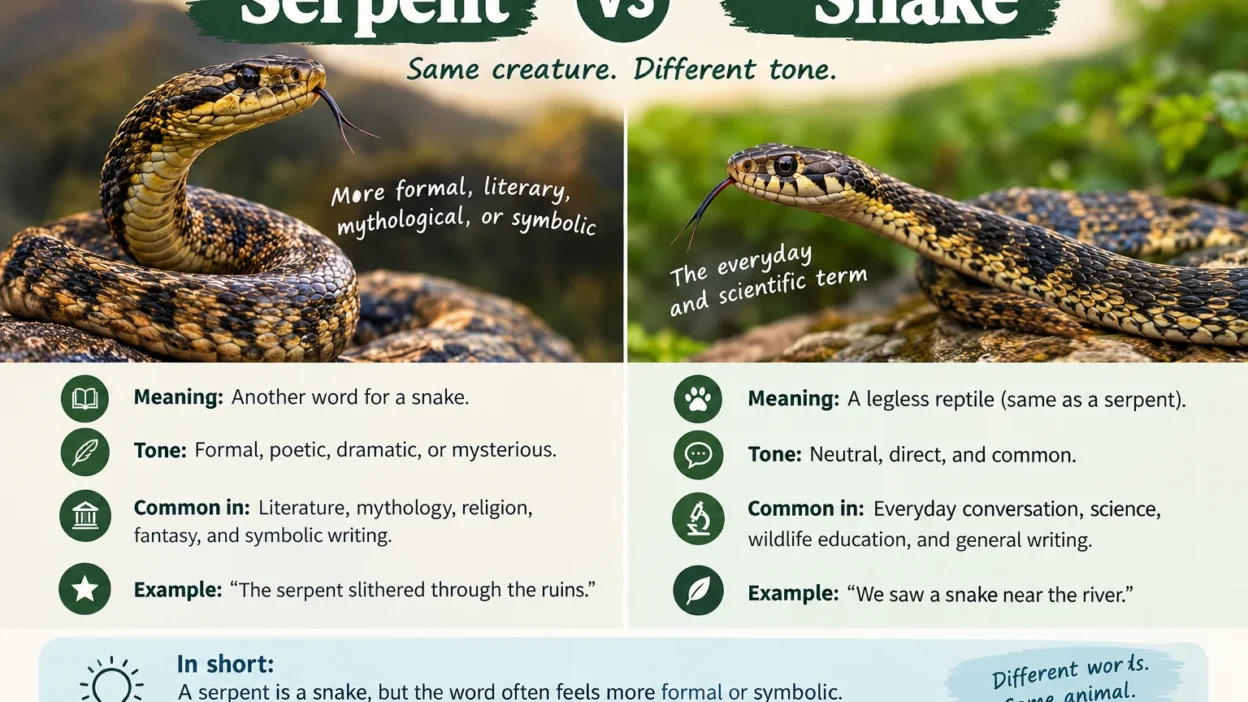
The word snake is the standard everyday term, while serpent often sounds more formal, literary, symbolic, or dramatic.
In this guide, you will learn their meanings, explore practical examples, understand their use in American and British English, and discover when each word is the better choice.
Quick Answer: Serpent vs Snake
A snake is a legless reptile belonging to the suborder Serpentes. A serpent is another word for a snake, but it often carries a more formal, literary, mythological, or symbolic tone.
- Snake: The common word used in everyday speech and scientific contexts.
- Serpent: A more elevated or dramatic word frequently used in literature, mythology, and religious writing.
- Main difference: The distinction is usually about tone and context, not biological classification.
What Does Snake Mean?
A snake is a legless, elongated reptile belonging to the suborder Serpentes. Snakes are found in many environments, including forests, grasslands, deserts, wetlands, and oceans.
They vary greatly in size, color, behavior, and diet. Some species are venomous, while many others are nonvenomous. Snakes generally move by using their muscles and scales to travel across the ground, climb, swim, or move through vegetation.
The word snake is the most familiar and widely used term for these animals.
Examples of Snake in Sentences
- We saw a snake resting on a rock during our hike.
- The wildlife expert explained how snakes hunt their prey.
- Some snakes use camouflage to avoid predators.
- A snake entered the garden after heavy rainfall.
- The zoo has a collection of snakes from different parts of the world.
In each sentence, snake refers directly to the animal. It is clear, neutral, and appropriate for everyday conversation.
The word can also describe a dishonest or untrustworthy person figuratively. For example, “He turned out to be a snake” suggests that someone behaved deceptively.
What Does Serpent Mean?
A serpent is another word for a snake. However, it often sounds more formal, poetic, mysterious, or dramatic than the ordinary word snake.
The term appears frequently in ancient stories, religious texts, mythology, poetry, fantasy literature, and historical descriptions. Writers may choose it to create a particular atmosphere or give an animal a symbolic meaning.
For example:
- A serpent slithered through the ancient temple.
- The legend described a giant serpent guarding a hidden treasure.
- The poet compared the winding river to a silver serpent.
- In the story, a serpent represented temptation and deception.
The word does not automatically mean that the animal is enormous, poisonous, supernatural, or evil. Those associations depend on the story or context in which it appears.
Is a Serpent a Real Animal?
Yes. Serpent can describe an ordinary, real snake. It is not the name of a separate biological group.
For example, a writer might describe a python as a serpent to create a more literary tone. A zoologist would generally use snake when explaining the animal’s biology.
The same creature can therefore be called either a snake or a serpent without its biological identity changing.
Serpent vs Snake: Key Differences
The most useful way to understand these words is to compare their meanings, tone, and common settings.
| Feature | Snake | Serpent |
|---|---|---|
| Basic meaning | A legless reptile | Another word for a snake |
| Everyday usage | Very common | Less common |
| Tone | Neutral and direct | Often formal, literary, or dramatic |
| Scientific writing | Standard term | Less commonly used |
| Religious texts | Used in some translations and contexts | Common in many traditional or literary passages |
| Mythology and fantasy | Common | Often used for a mysterious or legendary creature |
| Symbolic meaning | Depends on context | Frequently associated with symbolism |
| Describes a separate animal group? | No | No |
The key takeaway: Every serpent described in the ordinary sense is a snake, but writers may prefer serpent when they want a more evocative or symbolic effect.
Origin and History of the Words
The words snake and serpent have different linguistic histories.
Snake developed from Old English snaca, a word referring to a snake or serpent. Its roots are associated with older Germanic language forms. Over time, it became the ordinary English word for the animal.
Serpent entered English through Old French, from Latin serpens, meaning a creeping creature. The Latin term is related to serpere, meaning to creep or crawl.
These origins help explain why serpent can sound more formal or traditional. It came into English through classical and literary language, while snake developed from an older everyday English word.
| Word | Historical origin | Modern role |
|---|---|---|
| Snake | Old English snaca | Everyday and scientific term |
| Serpent | Old French and Latin serpens | Literary, formal, religious, and descriptive term |
| Serpentine | Related to Latin serpens | Describes something winding or snake-like |
The related adjective serpentine is often used for winding roads, curved shapes, or movements resembling those of a snake.
For example: “The serpentine road twisted through the mountains.”
Serpent vs Snake in Science and Biology
In scientific writing, snake is generally the preferred common name. Snakes belong to the suborder Serpentes within the reptile order Squamata.
They have elongated bodies, no external limbs, and specialized skulls that allow many species to consume prey larger than their heads. Depending on the species, they may feed on rodents, birds, eggs, amphibians, fish, insects, or other reptiles.
The term serpent may appear in general descriptions or historical sources, but it is not a separate taxonomic category.
For example:
- Scientific style: “The snake belongs to the suborder Serpentes.”
- Literary style: “The serpent moved silently through the grass.”
Both sentences can describe the same animal. The difference lies in the writer’s choice of language, not in the creature’s classification.
It is also important not to assume that all snakes are dangerous. Many species are harmless to humans, and even venomous species usually do not seek out people. If you encounter a snake in the wild, keep your distance and avoid attempting to handle or identify it at close range.
Serpent vs Snake in American and British English
There is no major difference between American and British English in the basic meanings of serpent and snake. Both varieties use snake as the ordinary word and recognize serpent as a more formal or literary alternative.
| Context | American English | British English |
|---|---|---|
| Everyday conversation | Snake | Snake |
| Wildlife education | Snake | Snake |
| Poetry and literature | Serpent may be used | Serpent may be used |
| Religious writing | Both terms appear, depending on the translation | Both terms appear, depending on the translation |
| Symbolic description | Serpent is common in literary contexts | Serpent is common in literary contexts |
The choice usually depends on the text, audience, and intended tone rather than the speaker’s nationality.
For example, an American wildlife presenter and a British wildlife presenter would both naturally say, “The snake lives in this habitat.”
A novelist in either country might choose serpent to make a scene feel ancient, mysterious, or threatening.
Serpent vs Snake in the Bible and Religion
The word serpent is particularly familiar to readers of religious literature, including the Bible. In the Book of Genesis, a serpent speaks to Eve in the Garden of Eden and plays a central role in the account of temptation and disobedience.
Many readers associate this serpent with deception, temptation, or evil. Later Christian interpretations connect the serpent with Satan, although the exact wording and interpretation vary across biblical passages and religious traditions.
The term’s literary tone can make a passage feel more traditional or symbolic. However, the word itself does not always mean an evil creature. In other contexts, serpent can simply refer to a snake.
Symbolic Meaning of Serpent and Snake
Both words can be used symbolically, but serpent often appears in stories where the animal represents an idea or spiritual concept.
Common symbolic associations include:
- Temptation: The serpent in the Garden of Eden is associated with the temptation of Eve.
- Wisdom: In some traditions and stories, snakes represent knowledge, insight, or cleverness.
- Transformation: Because snakes shed their skin, they may symbolize renewal, change, or a fresh beginning.
- Danger: A snake or serpent may represent a threat, hidden risk, or fear.
- Healing: Serpent imagery appears in some medical and cultural traditions, including the rod of Asclepius in ancient Greek symbolism.
These meanings are not universal. A snake can symbolize protection in one tradition and danger in another. Likewise, a serpent in a fantasy novel may be a guardian rather than a villain.
The surrounding story determines the intended interpretation.
Common Mistakes When Using Serpent and Snake
Although the two words are closely related, a few common misunderstandings are worth avoiding.
1. Assuming a Serpent Is a Different Species
A serpent is not a separate scientific group of reptiles. In ordinary English, it is another word for a snake.
2. Assuming Every Serpent Is Evil
Religious stories and myths sometimes portray serpents negatively, but the word itself does not mean evil. Its symbolic meaning depends on context.
3. Thinking Every Snake Is Venomous
Many snakes are nonvenomous, and species differ widely in their behavior and risk to humans. Neither snake nor serpent tells you whether an animal is venomous.
4. Using Serpent in Every Everyday Sentence
Although grammatically correct in many contexts, serpent can sound unnecessarily dramatic in ordinary conversation.
Instead of saying, “A serpent was crossing the road,” most speakers would simply say, “A snake was crossing the road.”
5. Treating the Words as Perfect Stylistic Substitutes
The words overlap in meaning, but they do not always create the same impression. Replacing snake with serpent in a children’s story, scientific report, or casual conversation can change the tone.
Which Word Should You Use?
Choose the word that best fits your purpose.
Use snake when you are:
- Talking about wildlife in everyday conversation.
- Writing a scientific or educational explanation.
- Describing an actual animal without a special literary effect.
- Giving practical information about snake behavior or safety.
Use serpent when you are:
- Writing poetry, fiction, or historical descriptions.
- Discussing religious or mythological stories.
- Creating a mysterious, dramatic, or ancient atmosphere.
- Describing something in a figurative or symbolic way.
For most ordinary situations, snake is the clearest choice. For literature, mythology, and symbolic writing, serpent can add depth and atmosphere.
Frequently Asked Questions
1. Is a serpent the same as a snake?
Yes. In ordinary English, serpent is another word for a snake. The main difference is that serpent often sounds more formal, literary, or symbolic.
2. Which word is more common, serpent or snake?
Snake is much more common in everyday conversation and scientific explanations. Serpent appears more frequently in literature, mythology, religious writing, and dramatic descriptions.
3. Is a serpent always dangerous?
No. The word does not indicate whether an animal is venomous or dangerous. Its meaning depends on the species and the context in which it is described.
4. Why does the Bible use the word serpent?
Some Bible translations use serpent as a traditional term for the snake in the Garden of Eden and in other passages. The word can carry symbolic associations with temptation and deception.
5. Is serpent a scientific term?
Serpent is a valid English word for a snake, but snake is generally preferred in modern scientific and educational writing. Serpentes is the scientific name of the snake suborder.
6. Is there a difference between serpent and snake in British English?
Not in their basic meanings. British English uses snake as the ordinary term and serpent as a more formal or literary alternative, just as American English does.
7. Can serpent be used as a metaphor?
Yes. Writers may use serpent to suggest deception, temptation, danger, mystery, or a winding shape. The intended meaning depends on the surrounding text.
Final Summary
The difference between serpent and snake is mainly a matter of language, tone, and context. Both words can describe the same legless reptile, and neither identifies a separate biological group.
Snake is the everyday, widely used term, while serpent often sounds more formal, poetic, mythological, or symbolic. Although religious stories frequently associate serpents with temptation or deception, the word does not automatically carry a negative meaning.
Final Thought
Words can describe the same thing while creating very different impressions. Snake is straightforward and familiar, making it ideal for everyday communication.
if you are writing an academic explanation, exploring a biblical passage, or creating a fictional scene, knowing this distinction helps you communicate more precisely.
The next time you encounter a serpent in a story or a snake in the garden, you will understand both the shared meaning and the difference in tone.

John Robert is a passionate author and faith-driven writer who contributes insightful and inspiring biblical content to Biblenast. With a strong commitment to sharing God’s Word, he focuses on creating meaningful messages that encourage spiritual growth, reflection, and daily guidance. His work aims to connect readers with the timeless teachings of the Bible.