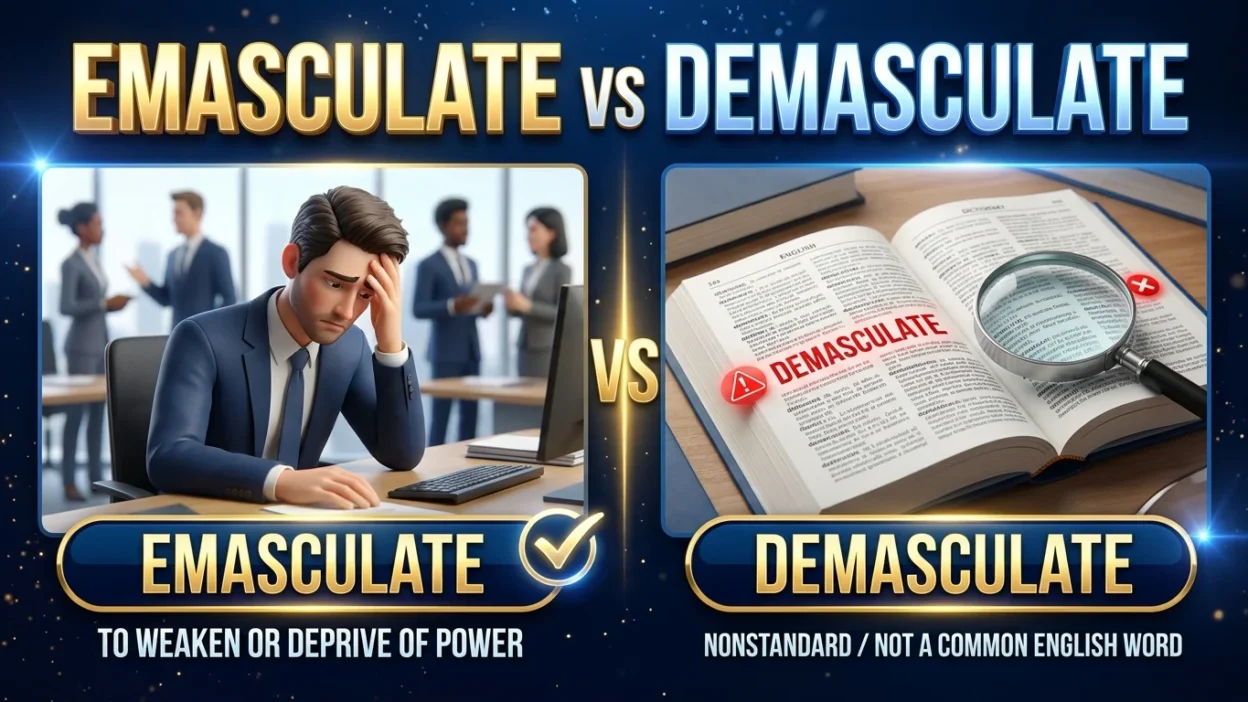
The words emasculate vs demasculate may look similar, but they are not equally common or interchangeable in English. If you have encountered these terms while reading, writing, or studying English vocabulary, you may wonder whether both are correct and what makes them different. Understanding their meanings can help you choose the right word and avoid mistakes.
Emasculate is an established English verb that means to deprive someone or something of strength, power, confidence, or traditionally masculine qualities. It can also have a literal meaning related to castration. Demasculate, on the other hand, is not a standard, widely recognized English word. It is sometimes used as an attempted alternative to emasculate, but it is generally better to avoid it in formal and everyday writing. Knowing this distinction will help you communicate more naturally and accurately.
Quick Answer
Emasculate is the correct, established English word. It means to weaken someone’s strength, authority, confidence, or traditionally masculine identity. Demasculate is not a standard dictionary word and is generally considered an incorrect or nonstandard alternative. Use emasculate in both formal and informal writing.
Why Do People Confuse Emasculate and Demasculate?
People often confuse these words because they share similar spelling patterns and appear to have related meanings.
There are a few reasons for this confusion:
- Both words contain the word-like element masculate, which suggests masculinity.
- The prefix de- often means to remove or reverse something.
- The prefix e- in emasculate may be unfamiliar to English learners.
- People sometimes create words by applying familiar prefixes to existing vocabulary.
However, a word that looks grammatically possible is not necessarily accepted in standard English.
First Word: Emasculate
Emasculate is a standard English verb meaning to make someone feel less powerful, confident, strong, or traditionally masculine.
It can describe the loss of authority, influence, independence, or personal confidence. It may also refer literally to removing the male reproductive organs, although this usage is much less common in everyday conversation.
Meanings of Emasculate
- To weaken someone’s power: To reduce a person’s authority or influence.
- To undermine confidence: To make someone feel less capable or powerful.
- To undermine traditional masculinity: To make someone feel that their masculine identity or qualities are being challenged.
- Literal meaning: To castrate or remove male reproductive organs.
Examples of Emasculate
- The manager’s constant criticism made him feel emasculated.
- Nobody should emasculate another person to gain control.
- The new rules emasculated the committee by removing its authority.
- He felt emasculated when his colleagues ignored his decisions.
- The unfair treatment seemed designed to emasculate the entire team.
Word Forms
- Base form: Emasculate
- Past tense: Emasculated
- Present participle: Emasculating
- Noun: Emasculation
- Related adjective: Emasculated
Second Word: Demasculate
Demasculate is not a standard, widely accepted English verb. It does not have the same established dictionary status as emasculate.
Some writers may use demasculate because they believe the prefix de- means removing masculinity or strength. However, creating a word using a familiar prefix does not automatically make it correct or widely accepted.
If you want to express the idea of weakening someone’s confidence, authority, strength, or traditionally masculine identity, use emasculate instead.
Examples of Incorrect or Nonstandard Usage
- Nonstandard: The manager tried to demasculate his employee.
- Standard: The manager tried to emasculate his employee.
- Nonstandard: His comments demasculated the young man.
- Standard: His comments emasculated the young man.
- Nonstandard: The policy demasculated the organization.
- Standard: The policy emasculated the organization.
Emasculate vs Demasculate: Comparison Table
| Feature | Emasculate | Demasculate |
| Word status | Standard English | Nonstandard |
| Part of speech | Verb | Attempted verb |
| Meaning | To weaken or deprive of strength or masculinity | Intended to suggest removing masculinity |
| Dictionary recognition | Established | Not widely recognized |
| Formal writing | Appropriate when relevant | Avoid |
| Everyday English | Recognized | Uncommon |
| Correct choice | Yes | Generally no |
When to Use Each Word
When Should You Use Emasculate?
Use emasculate when you want to describe someone or something losing strength, confidence, authority, or traditionally masculine qualities.
For example:
- When someone loses decision-making power.
- When a person’s confidence is deliberately undermined.
- When an organization loses its authority.
- When someone feels that their masculine identity is being challenged.
Example: The new restrictions emasculated the department by taking away its independence.
When Should You Use Demasculate?
In standard English, you should generally avoid using demasculate. Although someone might understand what you intend to say, the word is not an established alternative to emasculate.
Instead, choose an accepted expression that communicates your intended meaning.
For example:
- Use weaken for reducing strength.
- Use undermine for damaging confidence or authority.
- Use disempower for taking away someone’s power.
- Use emasculate when the specific meaning involves traditionally masculine qualities or the established figurative sense.
12 Examples of Emasculate vs Demasculate in Sentences
Here are practical examples to help you understand the difference.
- Correct: His colleagues tried to emasculate him during the meeting.
- Nonstandard: His colleagues tried to demasculate him during the meeting.
- Correct: The decision emasculated the local leadership.
- Nonstandard: The decision demasculated the local leadership.
- Correct: Constant criticism can make someone feel emasculated.
- Nonstandard: Constant criticism can make someone feel demasculated.
- Correct: The new regulations emasculated the committee.
- Nonstandard: The new regulations demasculated the committee.
- Correct: He believed the public criticism was intended to emasculate him.
- Nonstandard: He believed the public criticism was intended to demasculate him.
- Correct: The organization lost much of its authority after the changes.
- Correct: The unfair treatment undermined his confidence.
These examples show that emasculate is the established word, while other accepted verbs may sometimes communicate the intended meaning more clearly.
Common Mistakes
English learners and even experienced writers can make mistakes when choosing between these terms.
1. Treating Both Words as Equally Correct
Incorrect: Both emasculate and demasculate are standard English words.
Correct: Emasculate is the established English word.
2. Assuming the Prefix De- Makes Demasculate Correct
The prefix de- can indicate removal or reversal, but that does not mean every newly formed word is accepted in standard English.
3. Using Emasculate Without Understanding Its Context
The word can carry a strong emotional meaning, particularly when describing masculinity or personal confidence. Choose it carefully.
4. Confusing Emasculate With Ordinary Weakening
If you simply mean that something became weaker, weaken or undermine may be more natural.
Memory Trick: How to Remember the Correct Word
A simple way to remember the difference is:
EMASCULATE = ESTABLISHED ENGLISH WORD
Remember the letter E at the beginning of emasculate. It is the form you should use when discussing the loss of strength, power, or traditionally masculine qualities.
Avoid creating demasculate as an alternative.
American vs British English
There is no important American-versus-British spelling difference between these words.
Emasculate is the established spelling in both American and British English.
| English Variety | Correct Spelling |
| American English | Emasculate |
| British English | Emasculate |
| Australian English | Emasculate |
| Canadian English | Emasculate |
The spelling and basic meaning remain the same across these varieties. Demasculate is not a standard regional alternative.
Similar Words to Emasculate
Several English words have meanings related to weakening, reducing power, or damaging confidence.
| Word | Meaning |
| Weaken | To make something less strong |
| Undermine | To gradually damage confidence or authority |
| Disempower | To take away someone’s power |
| Castrate | To remove male reproductive organs |
| Enfeeble | To make someone or something weak |
| Humiliate | To make someone feel ashamed |
| Neutralize | To make something ineffective |
| Diminish | To reduce importance, strength, or value |
These words are not exact synonyms in every situation. Choose the one that best expresses your intended meaning.
Final Verdict: Emasculate vs Demasculate
The difference between emasculate and demasculate is mainly about standard English usage.
- Emasculate: Correct, established English verb meaning to weaken or deprive someone or something of strength, power, or traditionally masculine qualities.
- Demasculate: Nonstandard and generally not recommended in formal or everyday English.
If you are writing an article, email, academic assignment, or professional document, choose emasculate when it expresses your intended meaning.
Frequently Asked Questions:
1. Is Emasculate a Correct English Word?
Yes. Emasculate is a correct English verb. It means to weaken someone’s strength, confidence, authority, or traditionally masculine qualities. It can also have a literal meaning related to castration.
2. Is Demasculate a Real Word?
Demasculate is occasionally used as a nonstandard word, but it is not an established alternative to emasculate in standard English. It is best avoided in formal writing.
3. What Is the Difference Between Emasculate and Demasculate?
Emasculate is an established English word meaning to weaken or deprive someone of power or traditionally masculine qualities. Demasculate is a nonstandard formation that people sometimes use with a similar intended meaning.
4. What Does Emasculate Mean in Simple English?
In simple English, emasculate means to make someone feel less powerful, confident, or strong. It can also describe taking away someone’s authority or influence.
5. What Is the Past Tense of Emasculate?
The past tense of emasculate is emasculated.
Example: The criticism emasculated him in front of his colleagues.
6. Is Emasculate a Negative Word?
It often has a negative meaning because it describes weakening someone’s confidence, authority, or strength. However, its exact tone depends on the context in which it is used.
7. What Are Better Alternatives to Emasculate?
Depending on your meaning, you can use weaken, undermine, disempower, humiliate, or diminish. These words can sound more natural when you are not specifically discussing masculinity.
Remember This
- Emasculate = Correct and established English word.
- Demasculate = Nonstandard and generally best avoided.
- Emasculated = Past tense of emasculate.
- Emasculation = Noun form.
- Weaken and undermine = Useful alternatives in many contexts.
Conclusion:
Understanding emasculate vs demasculate is easier when you remember that similar-looking words are not always equally correct. Emasculate is the established English verb used to describe weakening someone’s power, confidence, authority, or traditionally masculine qualities. It is appropriate when the context supports its meaning.
On the other hand, demasculate is not a standard alternative and should generally be avoided in formal and everyday writing. If you want to improve your English vocabulary and write more accurately, remember to use emasculate or choose a clearer alternative such as weaken, undermine, or disempower.

Patricia Mary is a devoted writer and contributor at Biblenast, passionate about sharing the message of faith through meaningful biblical content. She focuses on creating inspiring and thoughtful writings that encourage spiritual growth, reflection, and a deeper connection with God’s Word in everyday life.