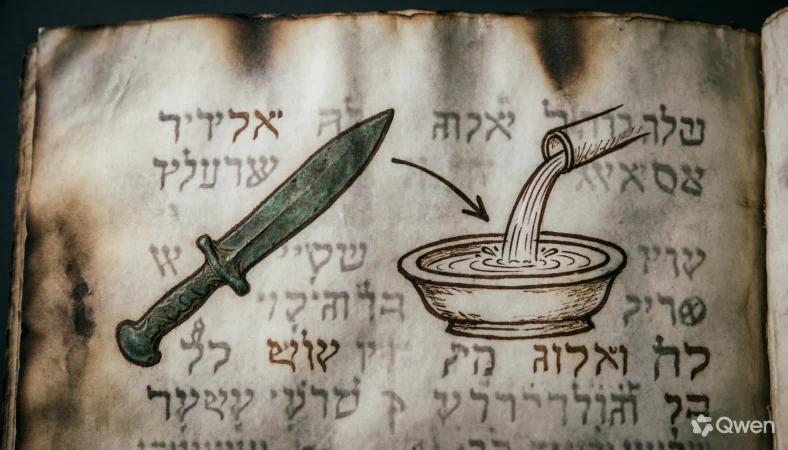
The circumcised meaning in the Bible is closely connected with covenant, obedience, identity, and dedication to God. In the Old Testament, circumcision was a physical sign of the covenant God made with Abraham and his descendants.
It marked God’s people as belonging to Him and reminded them of their responsibility to live according to His commands.
Circumcision therefore carried much more meaning than a physical practice; it represented a person’s relationship with God and the covenant community.
In the New Testament, the meaning develops further. While physical circumcision remained part of Jewish tradition, Scripture increasingly emphasizes the importance of having a transformed heart.
The circumcised meaning in the Bible can therefore be understood on both physical and spiritual levels. Biblical writers use the idea of circumcision to describe removing sin, becoming obedient to God, and giving one’s heart completely to Him.
Quick Answer: What Does Circumcised Mean in the Bible?
In the Bible, circumcised means physically removing the foreskin as a sign of God’s covenant with Abraham and his descendants.
Spiritually, circumcision also symbolizes obedience, separation from sin, and dedication to God.
The New Testament emphasizes “circumcision of the heart,” meaning inward spiritual transformation rather than merely an outward ritual.
What Does Circumcised Mean in the Bible?
The word circumcised refers literally to the removal of the foreskin of the male reproductive organ. In biblical times, however, the practice had deep religious significance.
God introduced circumcision as a covenant sign when He established His covenant with Abraham. Genesis 17 describes circumcision as a lasting sign of the covenant between God, Abraham, and his descendants.
The physical act represented belonging to God’s covenant people. It was also connected with obedience because Abraham was commanded to circumcise himself, his household, and future generations.
| Biblical Aspect | Meaning |
|---|---|
| Physical act | Removal of the foreskin |
| Covenant sign | Identification with God’s covenant |
| Obedience | Following God’s command |
| Identity | Belonging to God’s covenant people |
| Spiritual symbolism | Dedication and inward transformation |
Thus, the biblical meaning cannot be reduced simply to a medical procedure. Its importance came from what the act represented in the relationship between God and His people.
The Origin and History of Circumcision in Scripture
Circumcision appears prominently in the story of Abraham. In Genesis 17, God changed Abram’s name to Abraham and established a covenant with him. Circumcision was given as the physical sign of that covenant.
Abraham was instructed to circumcise himself, his son Ishmael, and the males in his household. Future generations were also expected to observe the practice.
For the Israelites, circumcision became an important marker of covenant identity. It distinguished them from surrounding nations and reminded them of their relationship with God.
The practice continued throughout Israel’s history. Moses, Joshua, the prophets, and later Jewish communities all lived within a tradition in which circumcision had significant religious and cultural importance.
| Period | Significance of Circumcision |
|---|---|
| Abraham | Sign of God’s covenant |
| Israelite history | Mark of covenant identity |
| Law of Moses | Religious obligation |
| Prophets | Symbol connected with spiritual obedience |
| New Testament | Physical practice contrasted with heart transformation |
Circumcision and God’s Covenant With Abraham
One of the most important biblical connections is the covenant with Abraham.
Genesis 17 presents circumcision as a sign of God’s covenant. Every male within Abraham’s household was expected to receive the sign. The practice was therefore connected with God’s promises concerning Abraham’s descendants.
This helps explain why circumcision was so important in biblical Judaism. It was not simply a personal decision. It was a visible sign associated with membership in the covenant community.
Understanding this background is essential when studying the circumcised meaning in the Bible, because the practice was fundamentally connected to covenant relationship and faithfulness.
Circumcision in the Old Testament
First, it was a covenant sign. Genesis 17 is the foundational passage.
Second, it was connected with Israel’s national identity. Circumcision helped distinguish God’s covenant people from other nations.
Third, it was associated with obedience. Israelites were expected to follow the command as part of their covenant responsibilities.
This metaphor becomes particularly important when considering the spiritual meaning of circumcision.
What Is the Spiritual Meaning of Circumcision?
The spiritual meaning of circumcision is one of the most significant themes associated with the subject.
The Bible uses circumcision as an image of removing spiritual hardness and becoming fully devoted to God. Physical circumcision affects the body, while spiritual circumcision concerns the heart.
Deuteronomy 10:16 calls God’s people to “circumcise” their hearts. Jeremiah similarly uses the language of circumcision to challenge people whose outward religious identity was not matched by genuine obedience.
Spiritually, the symbolism can include:
- Removing hardness of heart
- Turning away from sin
- Becoming obedient to God
- Separating oneself from ungodly practices
- Living faithfully under God’s covenant
- Allowing God to transform one’s inner character
This symbolic interpretation is important because biblical faith is repeatedly presented as something deeper than external religious actions.
Circumcision of the Heart in the Bible
The phrase circumcision of the heart describes an inward spiritual transformation.
A person can perform an outward religious practice while remaining spiritually disobedient. The biblical writers therefore emphasize that God wants genuine faith and obedience rather than empty outward rituals.
The central lesson is that God looks beyond outward appearances. Genuine devotion should affect a person’s thoughts, attitudes, decisions, and behavior.
Circumcision and the New Testament
The New Testament discusses circumcision extensively because the early Christian church included both Jewish and Gentile believers.
Acts 15 records the Jerusalem Council, where the apostles and church leaders considered whether Gentile believers were required to undergo circumcision and keep the Law of Moses.
The council ultimately did not require Gentile Christians to be circumcised as a condition of salvation.
Paul also strongly emphasized that faith in Christ should not be reduced to an external physical requirement.
In Colossians 2:11, Paul uses the language of a spiritual circumcision connected with Christ. The emphasis is on an inward work rather than simply a physical procedure.
Circumcised vs. Uncircumcised in Biblical Language
The Bible frequently uses “circumcised” and “uncircumcised” as contrasting terms.
For example, the Philistines are repeatedly described as uncircumcised in the Old Testament. The term could therefore carry an identity-related meaning in addition to its literal sense.
| Term | Literal Meaning | Biblical Context |
|---|---|---|
| Circumcised | Foreskin removed | Covenant identity |
| Uncircumcised | Foreskin not removed | Outside the covenant sign |
| Circumcised heart | Spiritual transformation | Genuine devotion to God |
| Uncircumcised heart | Spiritual resistance | Disobedience or hardness |
This distinction prevents readers from assuming that every use of “circumcised” in Scripture is referring only to the physical act.
What Does Being Circumcised Symbolize Spiritually?
Symbolically, being circumcised can represent belonging, obedience, separation, and commitment.
The original covenant sign reminded Abraham’s descendants that they were connected to God’s promises. In the broader biblical message, the image also points toward the need for inner change.
The spiritual symbolism can be summarized as cutting away what separates a person from faithful obedience to God.
This should not be interpreted as teaching that a physical procedure itself guarantees salvation or spiritual maturity. Scripture repeatedly emphasizes faith, obedience, repentance, and the condition of the heart.
The deeper lesson is that an outward sign should correspond with an inward commitment.
Circumcised Meaning in the Bible and Christian Faith
For Christians, circumcision is generally understood in light of the New Testament’s teaching about faith in Christ.
Paul argues that physical circumcision is not what determines a person’s standing before God. Galatians, Romans, and Colossians all develop this theme in different ways.
Christian teaching therefore focuses on spiritual transformation rather than requiring physical circumcision as a condition of salvation.
Common Misconceptions About Biblical Circumcision
One common misconception is that circumcision automatically made someone righteous before God. The Bible does not teach that a physical act alone makes a person spiritually faithful.
Another misconception is that circumcision has only a medical meaning in Scripture. In the biblical context, it was strongly connected with covenant identity and obedience.
A third misconception is that “circumcision of the heart” refers to a literal physical procedure. It is a metaphor describing inward spiritual change.
Finally, it is incorrect to assume that the New Testament requires every Christian male to be circumcised. The early church explicitly addressed this question, particularly regarding Gentile believers.
Circumcision vs. Circumcision of the Heart
| Physical Circumcision | Circumcision of the Heart |
|---|---|
| Physical act | Spiritual transformation |
| Connected with Abraham’s covenant | Emphasized as inward devotion |
| Visible outward sign | Invisible inward change |
| Involves the body | Involves character and faith |
| Marks covenant identity | Reflects genuine obedience |
This comparison helps explain why the Bible can discuss circumcision in both literal and symbolic ways.
Why Do People Search for Circumcised Meaning in the Bible?
People often search for circumcised meaning in the Bible because the word appears in many passages and its significance is not always obvious to modern readers.
Readers may encounter the word while studying Genesis, Deuteronomy, Joshua, Romans, Galatians, Acts, or Colossians.
The answer becomes clearer when circumcision is studied within its covenant context.
It was a physical sign that communicated belonging and obedience, while later biblical writers used the concept to teach about the condition of the heart.
Final Summary: What Does Circumcised Mean Biblically?
The circumcised meaning in the Bible begins with God’s covenant with Abraham. Circumcision was a physical sign of belonging to that covenant and became an important part of Israelite religious identity.
Ultimately, circumcision in Scripture teaches an important principle: outward religious identity should be accompanied by inward transformation. God desires a heart that is faithful, obedient, and sincerely committed to Him.
Final Thought
The circumcised meaning in the Bible carries both historical and spiritual significance. Historically, circumcision served as the covenant sign God gave to Abraham and his descendants.
It identified God’s people and reminded them of His promises. Spiritually, Scripture takes the image further by speaking about the circumcision of the heart.
This points to the removal of spiritual hardness and a sincere willingness to follow God. For Christians, the New Testament places the emphasis on faith and inward transformation rather than treating physical circumcision as a requirement for salvation.
The broader lesson remains powerful: genuine relationship with God is not merely about outward signs. It involves a transformed heart, faithful obedience, and a life increasingly aligned with God’s will.
FAQs About Circumcised Meaning in the Bible
1. What does circumcised mean in the Bible?
It literally means that the foreskin has been removed. Biblically, circumcision was also a sign of God’s covenant with Abraham and his descendants.
2. What does circumcision symbolize spiritually?
Spiritually, circumcision can symbolize removing hardness of heart, separating from sin, obedience, and complete dedication to God.
3. What is circumcision of the heart?
Circumcision of the heart is a biblical metaphor for inward spiritual transformation. It describes a heart that turns toward God and becomes willing to obey Him.
4. Why did God require Abraham to be circumcised?
Circumcision was given to Abraham as a sign of the covenant God established with him and his descendants, as described in Genesis 17.
5. Do Christians have to be circumcised according to the Bible?
The New Testament does not require Gentile Christians to undergo physical circumcision as a condition of salvation. Acts 15 addresses this question directly.
6. Is circumcision connected to salvation?
Physical circumcision itself is not presented as a means of salvation. The New Testament emphasizes faith, God’s grace, and spiritual transformation.
7. What is the main spiritual lesson of circumcision?
The central spiritual lesson is that outward religious identity should be matched by inward obedience. God desires a transformed heart, not merely an external religious sign.

John Robert is a passionate author and faith-driven writer who contributes insightful and inspiring biblical content to Biblenast. With a strong commitment to sharing God’s Word, he focuses on creating meaningful messages that encourage spiritual growth, reflection, and daily guidance. His work aims to connect readers with the timeless teachings of the Bible.