
If you have ever wondered about wear vs were vs where, you are not alone. These three words sound similar in everyday speech, but they have completely different meanings and grammatical functions.
Using the wrong one can change the meaning of an entire sentence, especially in writing, emails, schoolwork, and professional communication. Learning the difference is easier once you connect each word with a simple idea.
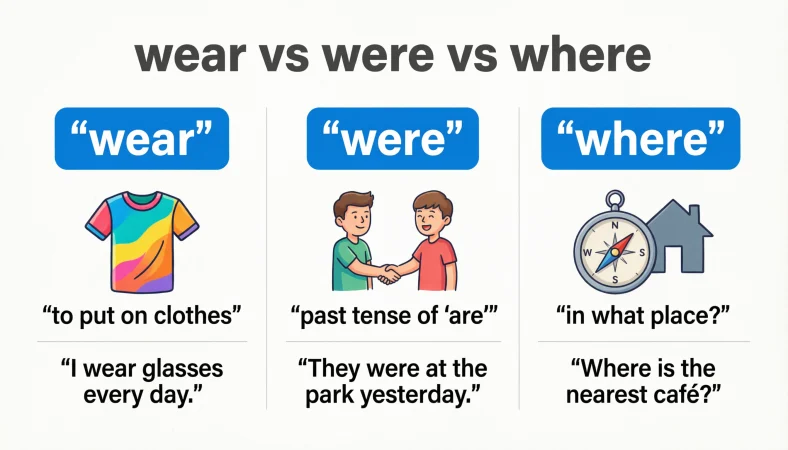
The key to understanding wear vs were vs where is to remember that wear is usually connected with clothing or using something, were is a past form of the verb “be,” and where refers to a place or location.
Although they are commonly confused because of their similar pronunciation, their meanings are easy to separate.
This guide explains each word, gives clear examples, compares them in tables, and provides simple memory tricks to help you choose the correct word every time.
Quick Answer: Wear vs Were vs Where
Wear means to have clothing, jewelry, or something else on your body, or to use something until it becomes damaged.
Were is the past tense of “are” and is used with you, we, they, and plural subjects.
Where refers to a place, location, or position and is often used to ask or describe where something is.
What Does “Wear” Mean?
Wear is primarily a verb associated with clothing and things that are placed on the body. You can wear a shirt, jacket, hat, shoes, glasses, watch, or jewelry.
For example:
- I wear glasses when I read.
- She likes to wear blue dresses.
- They wear uniforms at school.
- He decided to wear his new shoes.
Wear can also describe using something repeatedly until it becomes damaged, thinner, weaker, or less effective.
For example:
- The carpet began to wear after years of use.
- Constant washing can wear out your clothes.
- The tires are starting to wear down.
The word can also appear in expressions such as wear out, wear down, and wear away.
Wear as a Noun
Although “wear” is most commonly used as a verb, it can also function as a noun in certain contexts.
For example:
- The machine shows signs of wear.
- The furniture suffered normal wear and tear.
The phrase “wear and tear” refers to ordinary damage caused by regular use.
What Does “Were” Mean?
Were is a past-tense form of the verb “to be.” It commonly appears with you, we, they, and plural nouns.
Examples include:
- You were late.
- We were excited.
- They were at home.
- The children were tired.
- My friends were happy.
Compare the present and past forms:
| Present | Past |
|---|---|
| You are | You were |
| We are | We were |
| They are | They were |
| The boys are | The boys were |
“Were” can also be used in hypothetical or unreal situations.
For example:
- If I were you, I would apologize.
- If she were here, she could help us.
- I wish he were more careful.
This special use is sometimes called the subjunctive mood.
What Does “Where” Mean?
Where is generally connected with place or location. It can be used to ask questions, provide information, or connect two parts of a sentence.
Examples:
- Where do you live?
- Where are my keys?
- Do you know where she went?
- This is the house where I grew up.
Whenever you are talking about a location, where is often the word you need.
A useful question to remember is:
Where = What place?
If your sentence is asking or describing a location, “where” is probably correct.
Wear vs Were vs Where: Comparison Table
| Word | Main Meaning | Grammar | Example |
|---|---|---|---|
| Wear | Put on/use clothing or something repeatedly | Verb/noun | I wear glasses. |
| Were | Past form of “be” | Verb | They were tired. |
| Where | Place or location | Adverb/conjunction/pronoun | Where are you? |
This table provides the simplest way to understand wear vs were vs where. Their pronunciation can be confusing, but their meanings are distinct.
Origin and History of Wear, Were, and Where
The three words have different histories, even though their modern pronunciations can sound similar.
Wear comes from Old English werian, meaning to carry, dress, or have something on the body. Over time, its meaning developed into the modern sense of having clothing or accessories on your body.
Were has roots in Old English forms of the verb meaning “to be.” It developed as one of the past forms of the verb “be.”
Where also comes from Old English, from a word meaning “at what place” or “in what place.”
| Word | Historical Root | Modern Meaning |
|---|---|---|
| Wear | Old English werian | Have clothing/accessories on |
| Were | Old English forms of “be” | Past form of “are” |
| Where | Old English location word | At or in what place |
Their similar sounds are therefore a coincidence of English pronunciation rather than evidence that they have related meanings.
Is There a Biblical or Religious Connection?
There is no special biblical meaning shared by wear, were, and where. They are ordinary English words that can appear in Bible translations depending on the wording of a particular translation.
Therefore, these words should be understood according to their English grammar and context, rather than treated as words with special religious meanings.
Spiritual Meaning and Symbolic Interpretation
Although wear vs were vs where is primarily a grammar question, the individual concepts can sometimes inspire symbolic reflection
Were points to the past. In a spiritual context, the idea of what someone “was” can remind readers of personal history, transformation, and growth.
Where relates to location. Symbolically, it can encourage reflection on where a person is in life, where they are going, and where they believe they are being led.
Why Do People Confuse Wear, Were, and Where?
The main reason people confuse these words is pronunciation. In many varieties of English, wear, were, and where can sound very similar, particularly in fast conversation.
Another reason is that English spelling does not always provide an obvious clue about pronunciation.
A person may know what a word means when hearing it but still choose the wrong spelling when writing.
Ask yourself:
- Am I talking about clothing or using something? → wear
- Am I talking about something that happened in the past? → were
- Am I talking about a place? → where
Common Mistakes With Wear, Were, and Where
Here are some frequent mistakes:
Incorrect: Where your jacket today.
Correct: Wear your jacket today.
Incorrect: They where very happy.
Correct: They were very happy.
Incorrect: Were do you live?
Correct: Where do you live?
Another common mistake occurs when writers choose “where” simply because it sounds natural in speech.
For example:
Incorrect: I don’t know were he lives.
Correct: I don’t know where he lives.
The correct word depends on the sentence’s meaning.
Easy Memory Tricks to Remember the Difference
A few simple associations can make these words much easier to remember.
Wear = Clothing
Think of wearing something:
Wear your shoes.
If you can put it on your body, “wear” may be the correct choice.
Were = Past
Think:
We were there yesterday.
If you are describing something that happened in the past, “were” may fit.
Where = Place
Think:
Where is the restaurant?
If the sentence involves a location, choose “where.”
An especially useful trick is to associate where with here and there, because all three relate to location.
Wear vs Were vs Where in Everyday Sentences
Understanding the words individually is helpful, but seeing them in natural sentences makes the distinction clearer.
| Sentence | Correct Word | Why? |
|---|---|---|
| I wear a uniform to work. | Wear | Clothing |
| They were at the office. | Were | Past state/location |
| Where is your office? | Where | Asking about a place |
| We were tired after the trip. | Were | Past condition |
| What did you wear yesterday? | Wear | Clothing |
| Where did you buy that shirt? | Where | Asking about location |
| You were very helpful. | Were | Past form of “be” |
Notice that “were” can appear in a sentence about location, but it still does not mean “where.”
For example:
They were at the store.
Here, “were” is the verb, while “store” identifies the location.
American vs British English Usage
The basic meanings of wear, were, and where are the same in American and British English. There is no major difference in standard usage that changes which word should be chosen.
Pronunciation can vary by speaker and accent, however. In some accents, were may sound noticeably different from where, while in others they can sound quite similar.
Regardless of regional pronunciation, the spelling and grammatical functions remain the same.
So whether you are writing American English or British English, the same basic rules apply:
- Wear = clothing/use
- Were = past form of “be”
- Where = place
Frequently Asked Questions About Wear vs Were vs Where
1. What is the difference between wear, were, and where?
Wear relates mainly to clothing or using something. Were is a past form of “be.” Where refers to a place or location.
2. Is “were” the past tense of “are”?
Yes. “Were” is the past form commonly used with you, we, they, and plural subjects.
3. How can I remember “where”?
Associate where with a place. If you can ask “what place?” or “in what location?”, where is likely correct.
4. Is “wear” always related to clothes?
No. “Wear” can also mean to use something repeatedly until it becomes damaged or less effective, as in “wear out the tires.”
5. Why do wear, were, and where sound similar?
They are historically different words, but English pronunciation has developed in ways that make their modern sounds similar in many accents.
6. Which is correct: “where clothes” or “wear clothes”?
The correct phrase is “wear clothes.” You wear clothes; you do not “where” them.
7. Which is correct: “They where happy” or “They were happy”?
The correct sentence is “They were happy.” “Were” is the past form of “are” used with “they.”
Final Summary
The difference between wear vs were vs where becomes simple once you focus on meaning.
Wear is mainly connected with clothing, accessories, or the gradual damage caused by use. Were is a past form of the verb “be,” while where refers to a place or location.
Although these words can sound alike, they perform completely different jobs in a sentence.
If you are asking about a location, choose where. With these three simple associations, you can avoid one of the most common spelling mistakes in English.
Final Thought
Learning wear vs were vs where is a small but valuable step toward clearer English writing. These words may sound confusing, but their meanings are actually very different.
Remember the three key connections: wear means clothing or use, were refers to the past form of “be,” and where means a place.
When you are unsure, look at the context instead of listening only to the pronunciation. A quick meaning check can prevent many spelling and grammar errors.
if you are writing a school assignment, sending an email, creating online content, or simply improving your English, mastering commonly confused words like these will make your communication more accurate, natural, and confident.

Patricia Mary is a devoted writer and contributor at Biblenast, passionate about sharing the message of faith through meaningful biblical content. She focuses on creating inspiring and thoughtful writings that encourage spiritual growth, reflection, and a deeper connection with God’s Word in everyday life.