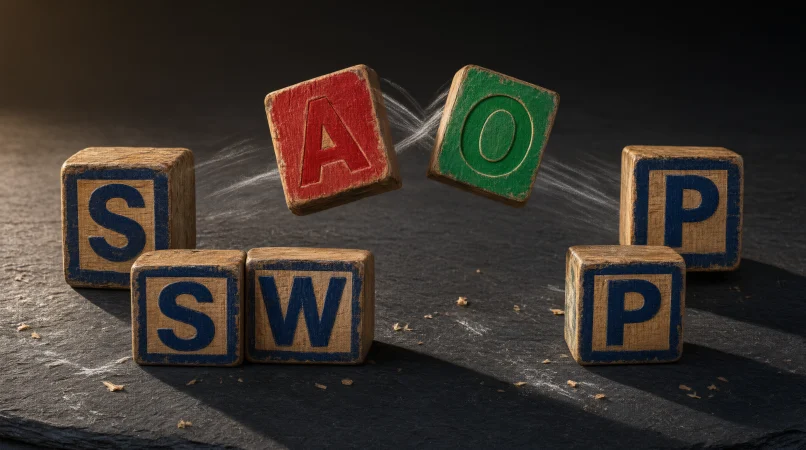
Have you ever wondered whether to write swap or swop? Both spellings appear in English, and both can mean to exchange one for another.
However, one spelling is much more common than the other, and knowing when to use each can help you write naturally and confidently.
if you are writing an email, completing a school assignment, or creating online content, choosing the right spelling makes your message clearer.
Swop is an accepted alternative, especially in some British English contexts. This guide explains their meanings, origins, usage, examples, and common mistakes.
Quick Answer: Swap or Swop?
Swap and swop are both accepted English spellings meaning to exchange one thing for another. However, swap is far more common and is the safest choice in most writing.
- Swap: The standard, widely used spelling in American and British English.
- Swop: A less common alternative, traditionally associated with British English and some other varieties.
- Example: “Would you like to swap seats?”
- Recommendation: Use swap in formal writing, professional communication, and international content unless you have a specific reason to use swop.
What Does Swap Mean?
The word swap means to exchange, trade, or replace one thing with another. It can describe exchanging physical objects, changing responsibilities, sharing items, or replacing one option with another.
For example, two friends might swap books after finishing them, colleagues might swap shifts at work, or a family might swap an old car for a newer model.
Swap can be used as both a verb and a noun.
Swap as a Verb
As a verb, swap describes the action of exchanging things.
Examples:
- I decided to swap my blue shirt for a white one.
- Can we swap seats so I can sit near the window?
- The two students swapped their notebooks.
- We need to swap the old batteries for new ones.
- She agreed to swap her afternoon shift with a colleague.
In these sentences, the word describes an exchange between people or things.
Swap as a Noun
As a noun, swap refers to an exchange itself.
Examples:
- We made a swap at the school book fair.
- The children organized a toy swap.
- The shirt was too small, so I requested a swap.
- Our neighborhood held a clothing swap on Saturday.
The noun is common in everyday conversations, shopping, and community activities.
What Does Swop Mean?
Swop is an alternative spelling of swap. It generally carries the same meaning: to exchange, trade, or replace something.
Although it is a legitimate English word, it is considerably less common in modern usage. Some British English speakers and writers use it, but swap is more widely recognized across English-speaking regions.
Examples:
- Would you like to swop your cards with me?
- The children decided to swop toys.
- We could swop our shifts if the manager agrees.
- She offered to swop her ticket for mine.
These sentences are understandable, but many readers would naturally expect swap instead.
Is Swop Incorrect?
No. Swop is not inherently incorrect or a spelling mistake. It is an established variant of swap.
However, being accepted does not mean both spellings are equally common. In contemporary writing, swap is the more practical choice because it is widely used in the United States, the United Kingdom, and other English-speaking countries.
If you encounter swop in a book, article, or message, you can generally interpret it as meaning swap.
Swap vs Swop: Key Differences
The principal difference between these words is spelling preference rather than meaning.
| Feature | Swap | Swop |
|---|---|---|
| Meaning | Exchange or trade | Exchange or trade |
| Part of speech | Verb and noun | Verb and noun |
| American English | Standard and common | Rare |
| British English | Standard and common | Accepted but less common |
| International writing | Recommended | Less widely preferred |
| Example | Let’s swap books. | Let’s swop books. |
The table shows why swap is usually the better choice. Both spellings communicate the same basic idea, but swap is more familiar to a broader audience.
Swap or Swop in American and British English
Regional spelling preferences are an important consideration when choosing between swap and swop.
American English
In American English, swap is the normal spelling. It appears in everyday conversation, newspapers, business communication, educational materials, and online content.
Examples:
- Can we swap places?
- I want to swap this item for a different size.
- The players swapped jerseys after the game.
Swop is uncommon in American English and may look unusual to many readers.
British English
British English also commonly uses swap. The alternative swop is recognized and has appeared in British usage, but it is generally less frequent.
Examples:
- Shall we swap seats?
- They swapped houses for the weekend.
- The children decided to swap stickers.
You may encounter swop in British writing, informal communication, or particular regional contexts. Nevertheless, British writers can use swap without concern.
Which Spelling Should You Choose?
Use swap when writing for an international audience, preparing professional documents, publishing blog posts, or creating educational content.
You might retain swop when quoting an original source, preserving a writer’s chosen spelling, or following a specific publication’s style guide.
The Origin and History of Swap and Swop
Swap developed in English as a word associated with exchanging or trading. It has been used in informal speech and writing for centuries. Over time, it became the dominant spelling in general English.
Swop developed as a variant spelling with the same meaning. English has many words with alternative spellings, and differences in pronunciation, regional habits, and historical writing practices can contribute to these variations.
Neither spelling introduces a different action. The distinction is primarily conventional: swap became the more established spelling in modern standard usage.
| Word | Historical and modern role | Present-day preference |
|---|---|---|
| Swap | Established English word for exchanging | Widely preferred |
| Swop | Alternative spelling with the same meaning | Less common |
For modern writing, current usage matters more than trying to identify which form an individual writer used historically.
Common Expressions Using Swap
The word swap appears in many everyday expressions. Learning these phrases will help you use it naturally.
Swap Places
This means exchanging positions with another person.
Example: “Could you swap places with me so I can see the screen?”
Swap Ideas
This means sharing thoughts, suggestions, or opinions.
Example: “The team met to swap ideas for the new project.”
Swap Shifts
This means exchanging scheduled work periods.
Example: “I agreed to swap shifts with my coworker.”
Swap Something for Something Else
This describes replacing one item or option with another.
Example: “He swapped his regular coffee for a decaffeinated one.”
Swap Stories
Example: “The travelers sat together and swapped stories about their journeys.”
In all these expressions, swap can be replaced with swop without substantially changing the meaning, although swap sounds more natural to most contemporary readers.
Common Mistakes When Using Swap and Swop
Because both words are accepted, the most common mistake is assuming they have different meanings or that one is always grammatically incorrect.
Here are a few errors to avoid.
| Common mistake | Better approach | Explanation |
|---|---|---|
| Treating swop as a word with a different meaning | Recognize both as alternatives | Their basic meanings are the same |
| Assuming swap is exclusively American | Use swap in both varieties | It is standard in American and British English |
| Using swop in every context without considering the audience | Prefer swap for general writing | It is more widely recognized |
| Writing “I swap yesterday” | Write “I swapped yesterday” | The past tense is needed for a completed past action |
| Writing “I have swap it” | Write “I have swapped it” | The present perfect requires a past participle |
Remember the Verb Forms
The verb swap follows the regular pattern for English verbs:
- Present: swap
- Third-person singular: swaps
- Past tense: swapped
- Present participle: swapping
- Past participle: swapped
Examples:
- I swap books with my friend every month.
- She swaps recipes with her neighbor.
- We swapped seats yesterday.
- They are swapping gifts.
- I have swapped the item already.
The alternative spelling swop can also take regular verb endings, such as swops, swopped, and swopping. However, these forms are less common than their counterparts based on swap.
Swap vs Swop vs Exchange vs Trade
Although swap and swop have the same general meaning, other words can be more suitable in particular situations.
| Word | Main meaning | Example |
|---|---|---|
| Swap | Exchange one thing for another | We swapped books. |
| Swop | Alternative spelling of swap | We swopped books. |
| Exchange | Give one thing and receive another | I exchanged the damaged item. |
| Trade | Exchange goods, services, or assets | They traded cards. |
| Replace | Put something new in place of something else | She replaced the broken battery. |
Exchange often sounds more formal than swap. Trade may suggest a commercial transaction or a mutually agreed exchange. Replace focuses on putting something else in place of the original rather than necessarily exchanging items with another person.
For example, you might swap seats with a friend, exchange a faulty product at a store, trade collectible cards, or replace an old phone battery.
Why Do People Search for Swap or Swop?
People commonly search for this spelling comparison because they want to avoid errors in writing or determine whether a word is acceptable in their variety of English.
Common reasons include:
- Checking whether swop is a genuine English word.
- Learning the difference between British and American spelling.
- Improving spelling and grammar for school or work.
- Choosing the best spelling for a website or blog.
- Understanding whether the two words have different meanings.
The simplest answer is that both forms are valid, but their popularity differs. If you want your writing to be clear to the largest possible audience, swap is the best default.
Frequently Asked Questions
1. Is it swap or swop?
Both spellings are accepted and mean to exchange or trade something. However, swap is much more common and is the preferred choice in most modern English writing.
2. Is swop a real English word?
Yes. Swop is an established alternative spelling of swap. It is less common, but it is not inherently incorrect.
3. Is swap American or British English?
Swap is used in both American and British English. It is the standard and widely preferred spelling in both varieties.
4. Do swap and swop mean the same thing?
Yes. Both generally mean to exchange, trade, or replace one thing with another. The main difference is how frequently each spelling is used.
5. Which spelling should I use in formal writing?
Use swap. It is more widely recognized and is appropriate for professional emails, reports, educational materials, and online articles.
6. What is the past tense of swap?
The past tense is swapped. For example, “We swapped seats before the meeting.” The less common alternative is swopped.
7. Can I use swop in British English?
Yes. Swop is recognized in British English, although swap is more common. Either can be understood, but swap is generally the safer choice.
Final Thought
Spelling choices do not always come down to one word being correct and another being wrong. English sometimes preserves alternative forms that carry the same meaning but differ in popularity.
Although swop is a legitimate word, swap is the spelling most readers will expect. When in doubt, choose the more widely established form, especially if your writing is intended for a broad audience.
This simple habit will make your articles, messages, and professional documents feel more natural and consistent.

Michael James is the administrator and a dedicated author at Biblenast, responsible for managing the platform and ensuring quality content. Alongside his administrative role, he writes insightful biblical articles that inspire faith, reflection, and spiritual growth. His work supports the mission of making God’s Word accessible and meaningful.