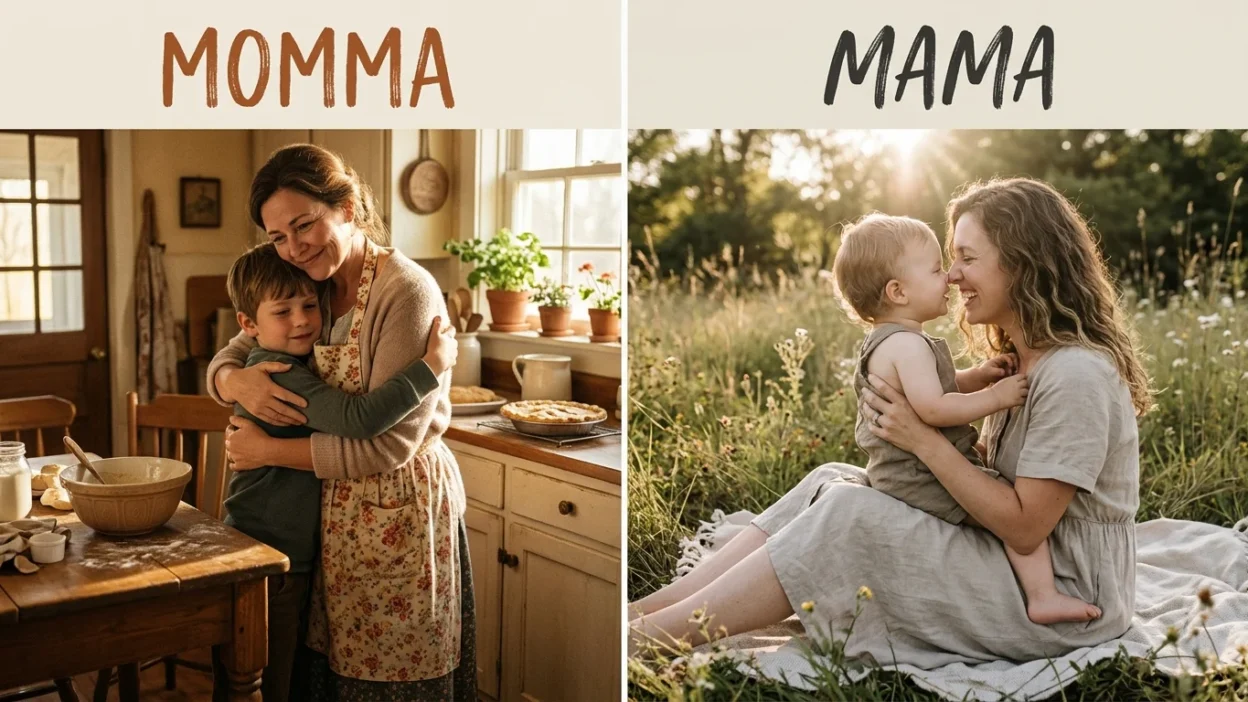
The words momma vs mama are two informal ways to refer to a mother.
Both express affection, familiarity, and closeness, but they differ slightly in spelling, style, and usage.
Mama is a widely recognized term for mother, while momma is often associated with a warm, conversational, or regional style of American English.
Neither spelling is inherently incorrect, and both can appear in family conversations, literature, songs, and personal messages.
Choosing between momma and mama depends on your audience, writing style, and personal preference.
If you are writing a birthday card for your mother, creating a social media caption, or deciding which word to use in a story, either option may work.
However, understanding their common associations can help you select the spelling that sounds most natural.
This guide explains the meaning of each word, compares their usage, and provides examples to help you make the right choice.
Quick Answer: What Is the Difference Between Momma and Mama?
Mama and momma both mean mother. Mama is a widely used, familiar term across many English-speaking communities and other languages. Momma is an informal variant often associated with affectionate, conversational American English. Both are correct, and the best choice depends on personal preference, regional usage, and context.
Why Do People Confuse Momma and Mama?
People often confuse momma and mama because they have nearly identical meanings and similar pronunciations. Both are affectionate terms for a mother, and neither has a universally fixed pronunciation across all English-speaking regions.
Their main difference is spelling and customary usage rather than meaning. Mama is common in many cultures and languages, while momma is particularly familiar in informal American English. People may also encounter both spellings in books, song lyrics, family nicknames, and online posts.
Because there is no strict grammatical rule requiring one spelling over the other, writers sometimes wonder whether one is more correct. In ordinary informal English, both are acceptable.
First Word: What Does Momma Mean?
Momma is an informal noun meaning mother or mom. It is often used to express affection, familiarity, or a close family relationship.
The word is especially recognizable in American English, where it may appear in casual conversation, regional speech, storytelling, and expressions of affection.
Examples:
- “I love you, Momma.”
- “Momma is making dinner tonight.”
- “My momma always encouraged me to follow my dreams.”
- “The little boy ran to his momma.”
Momma can sound warm, personal, and conversational. Some families use it as a preferred name for a mother, while others prefer Mama, Mom, or Mommy.
The word is informal, so it is generally more suitable for family conversations, personal writing, and dialogue than for formal documents.
Second Word: What Does Mama Mean?
Mama is an affectionate noun meaning mother. It is widely used in English and in numerous other languages, although its exact pronunciation and cultural associations vary.
In English, mama can be used by children, adults, and family members when speaking affectionately about or directly to a mother. It also appears in traditional expressions, literature, music, and cultural contexts.
Examples:
- “Mama, can you help me?”
- “My mama taught me to be kind.”
- “She called her mama after the ceremony.”
- “The baby reached for Mama.”
The spelling mama is familiar across many communities, making it a versatile choice for informal writing. However, it is still an informal family term rather than the usual word for a mother in formal or academic prose.
Momma vs Mama: Comparison Table
| Feature | Momma | Mama |
|---|---|---|
| Meaning | Mother | Mother |
| Correct spelling | Yes | Yes |
| General style | Informal and affectionate | Informal and affectionate |
| Common association | American conversational English | Broad use across English-speaking communities |
| Pronunciation | Varies by speaker and region | Varies by speaker and region |
| Typical use | Family talk, dialogue, personal messages | Family talk, songs, stories, personal messages |
| Formal writing | Usually too informal | Usually too informal |
| Best choice | When preferred by the family or character | When preferred by the family or character |
The central difference is convention, not meaning. Neither word is universally more correct, and both can communicate love and respect for a mother.
When Should You Use Momma or Mama?
The best spelling depends on the situation and the tone you want to create.
When to Use Momma
Choose momma when you want an affectionate, conversational tone, especially in an American English setting.
Use it for:
- Personal messages to your mother.
- Informal social media captions.
- Dialogue in stories featuring characters who use this spelling.
- Family nicknames and affectionate expressions.
- Writing that reflects a speaker’s regional vocabulary.
Example: “Happy birthday to my beautiful momma!”
When to Use Mama
Choose mama when you prefer a widely recognized spelling or when it matches your family’s cultural or personal usage.
Use it for:
- Greeting cards and heartfelt messages.
- Family conversations.
- Stories, poems, and songs.
- Personal tributes and memorial posts.
- Writing that reflects a family’s preferred name for a mother.
Example: “Thank you, Mama, for always believing in me.”
Which Is Better for Formal Writing?
Neither momma nor mama is usually the best choice in formal academic or professional writing. In those settings, mother is generally more appropriate.
For example:
- Informal: “My mama inspired me to become a teacher.”
- Formal: “My mother inspired me to become a teacher.”
If you are writing dialogue or quoting someone, retain the spelling that reflects the speaker’s actual wording.
12 Examples of Momma vs Mama in Sentences
These examples show how both terms work naturally in everyday English.
- Momma: “Good morning, Momma! Did you sleep well?”
- Mama: “Good morning, Mama! Did you sleep well?”
- Momma: “My momma makes the best homemade cookies.”
- Mama: “My mama makes the best homemade cookies.”
- Momma: “I called Momma to tell her the good news.”
- Mama: “I called Mama to tell her the good news.”
- Momma: “Happy Mother’s Day to my wonderful momma.”
- Mama: “Happy Mother’s Day to my wonderful mama.”
- Momma: “The child held tightly to her momma’s hand.”
- Mama: “The child held tightly to her mama’s hand.”
- Momma: “I will always remember my momma’s advice.”
- Mama: “I will always remember my mama’s advice.”
Notice that the meaning remains essentially the same in each pair. The choice mainly changes the spelling and the style associated with the word.
Common Mistakes When Using Momma and Mama
Although both words are correct, writers sometimes use them inconsistently or misunderstand their role.
Mistake 1: Thinking One Spelling Is Always Wrong
Incorrect claim: “Momma is incorrect, and only mama is acceptable.”
Correction: Both spellings are recognized informal variants. Their suitability depends on context, regional convention, and personal preference.
Mistake 2: Assuming They Have Different Meanings
Momma and mama generally refer to the same person: a mother. Neither word automatically expresses more love, respect, or closeness than the other.
Mistake 3: Switching Spellings Without a Reason
If you are writing a personal tribute, story, or social media post, choose one spelling and use it consistently unless you are reproducing a person’s preferred wording.
For example, if you begin with “My mama has always supported me,” avoid switching to “My momma is my greatest inspiration” in the same piece without a stylistic reason.
Mistake 4: Using Either Word in Every Formal Situation
In a research paper, official report, or professional biography, mother is often the more suitable choice. However, mama or momma may be appropriate in a direct quotation or a discussion of informal language.
Mistake 5: Confusing Momma With Mommy
Momma and mommy are both affectionate terms for a mother, but they are not identical in style. Mommy is especially associated with children’s speech and family affection, although adults may use it too.
Memory Trick: How Can You Remember Momma vs Mama?
Use this simple memory trick:
- Mama: Think of the widely recognized, straightforward spelling.
- Momma: Think of an informal variant often associated with conversational American English.
- Mother: Think of the more neutral choice for formal writing.
Remember that these are helpful associations, not strict rules. If your family has always used Momma, there is no need to switch to Mama. The spelling that feels natural and reflects the person’s preferred name is often the best choice.
American vs British English: Is Momma or Mama More Common?
The usage of momma and mama varies across English-speaking communities, families, and individual speakers.
In American English, momma is a familiar informal variant, while mama is also widely understood and used. American English more generally favors mom when referring to one’s mother in everyday conversation.
In British English, mum is the more typical everyday term for mother. However, mama and momma can still appear in British writing, family speech, literature, and cultural contexts.
| Variety or context | Common term or usage |
|---|---|
| American English | Mom, mama, momma |
| British English | Mum; mama and momma also occur |
| Formal English | Mother |
| Children’s speech | Mama, mommy, mum, and other family terms |
| Personal or cultural writing | The spelling preferred by the family or community |
These are general tendencies rather than universal rules. A person’s preferred family term may differ from the most common term in their region.
Similar Words: Momma, Mama, Mommy, Mom, and Mother
English has several words for a mother, each with its own style and associations.
| Word | Meaning or style | Example |
|---|---|---|
| Momma | Informal, affectionate | I called my momma. |
| Mama | Informal, affectionate | Mama is waiting for us. |
| Mommy | Affectionate, often associated with children | Mommy, can you read this story? |
| Mom | Common everyday American English | My mom works nearby. |
| Mum | Common everyday British English | My mum is visiting today. |
| Mother | Neutral or formal | My mother lives in London. |
| Mummy | Affectionate term common in British English | Mummy helped me get ready. |
| Ma | Informal or familiar term | Ma, I’m home! |
These words all relate to a mother, but they are not interchangeable in every context. The right choice depends on the speaker, audience, relationship, and intended tone.
Final Verdict: Should You Write Momma or Mama?
Both momma and mama are correct informal words for mother. Choose momma if it matches your preferred conversational style, family nickname, or American English voice. Choose mama if it is the spelling you are accustomed to or the one preferred by your family or intended audience.
Neither spelling is inherently better, and neither has a universal claim to correctness. For formal writing, mother is usually the safer choice. For personal messages, stories, poems, and affectionate captions, either spelling works well.
Ultimately, consistency and personal preference matter more than trying to identify one universally correct form.
FAQs About Momma vs Mama
1. Is momma or mama the correct spelling?
Both are correct informal spellings for mother. The choice depends on personal preference, family tradition, and regional usage.
2. Is mama more common than momma?
Mama is widely recognized across many cultures and languages. Momma is also familiar, particularly in informal American English. Which one is more common depends on the community and context.
3. Is momma an American word?
Momma is strongly associated with informal American English, although its use is not limited to the United States. Both momma and mama appear in different English-speaking communities.
4. Is mama formal or informal?
Mama is generally an informal, affectionate term. In formal writing, mother is usually more appropriate unless mama appears in a quotation, title, or specific cultural context.
5. Do momma and mama mean the same thing?
Yes. Both usually mean mother. Their difference is mainly spelling and usage convention rather than meaning.
6. Which spelling should I use for a Mother’s Day caption?
Either spelling is appropriate. Choose the one that sounds natural to you or matches the name your mother prefers.
Examples:
- “Happy Mother’s Day to my amazing mama!”
- “Happy Mother’s Day to my beautiful momma!”
7. What is the difference between mama, mommy, and momma?
All three can refer affectionately to a mother. Mama and momma are similar informal variants, while mommy is particularly associated with children’s speech and affectionate family language. Actual usage varies between families and regions.
Remember This
- Momma = mother.
- Mama = mother.
- Both spellings are correct in informal contexts.
- Momma is often associated with conversational American English.
- Mama is widely recognized across many communities.
- Mother is generally preferable in formal writing.
- Choose the spelling that suits your audience and personal preference.
Conclusion
The difference between momma and mama is small, but understanding their usage helps you make confident choices in everyday writing. Both words are affectionate ways to refer to a mother, and both are accepted in informal English. Although momma is often associated with American conversational speech, mama is familiar across many cultures and communities. Neither word is automatically more loving or more correct than the other.
When deciding which spelling to use, consider your audience, your family’s preferred terminology, and the tone you want to convey. Use momma or mama in personal messages, captions, stories, and other informal settings. Choose mother for most formal writing. Above all, use the word that feels natural and expresses your intended meaning clearly.

David William is a dedicated writer and spiritual enthusiast with a deep passion for sharing biblical wisdom. As the author behind Biblenast, he focuses on delivering meaningful scripture-based content that inspires faith, reflection, and daily guidance. His mission is to make the teachings of the Bible accessible, uplifting, and relevant to modern life.