
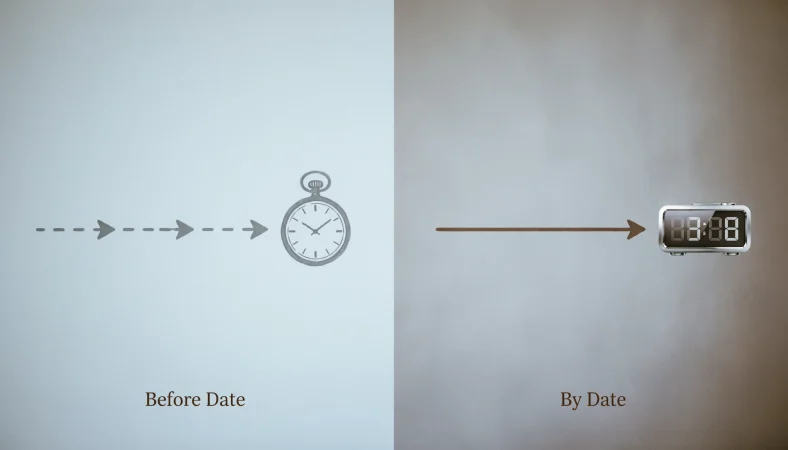
When you see instructions such as “submit the form before the date” or “send your application by the date,” it is natural to wonder if the two expressions mean exactly the same thing.
Although before date vs by date may seem like a small wording issue, the difference can matter when you are dealing with deadlines, appointments, contracts, applications, payments, or official instructions.
The key distinction is simple: before normally means earlier than a specified time or date, while by generally means no later than that date or time. However, real-world usage can sometimes be less precise, especially when people use “before” casually to mean “by.”
Understanding the difference can help you communicate deadlines clearly and avoid misunderstandings.
Quick Answer: Before Date vs By Date
Before a date normally means something must happen earlier than that date, not on the date itself.
By a date normally means something must happen on or before that date. In other words, the stated date is generally included.
For example:
- “Submit the application before June 10” → Submit it earlier than June 10.
- “Submit the application by June 10” → June 10 is generally the latest acceptable day.
If the deadline is important, using by is usually clearer when you intend to include the stated date.
What Does “Before a Date” Mean?
The word before refers to something that occurs earlier than a particular point in time.
When used with a calendar date, “before June 10” normally means prior to June 10.
For example:
Please register before July 1.
The safest interpretation is that registration should be completed on June 30 or earlier. The phrase does not normally include July 1 itself.
However, context can affect how people understand the sentence. In everyday conversation, someone might say “before July 1” when they simply mean “no later than July 1.” That informal usage can create ambiguity.
Examples of “Before a Date”
- Please pay the bill before March 15.
- We need to finish the project before December 1.
- She moved to London before 2020.
- Please arrive before Monday.
- The application must be completed before August 30.
In each case, before emphasizes an earlier point rather than the stated date itself.
What Does “By a Date” Mean?
By is commonly used to express a deadline. When you say something must be completed by a particular date, you generally mean it must be completed at or before that date.
For example:
Please submit your report by June 10.
This normally means June 10 is the final day for submission.
The person may submit the report on June 7, June 9, or June 10, depending on any additional instructions.
Examples of “By a Date”
- Please respond by Friday.
- The payment must arrive by April 30.
- Submit your application by September 15.
- We need the documents by Monday morning.
- The project should be completed by December 31.
The important idea is that by establishes a latest acceptable point.
Before Date vs By Date: The Main Difference
The easiest way to remember the distinction is:
Before = earlier than
By = no later than
Consider this example:
Submit the assignment before May 20.
This normally suggests that May 19 is the latest acceptable date.
Now compare:
Submit the assignment by May 20.
This normally allows submission on May 20 as well.
| Expression | Typical meaning | Is the stated date included? | Example |
|---|---|---|---|
| Before June 10 | Earlier than June 10 | Usually no | Submit before June 10 |
| By June 10 | No later than June 10 | Usually yes | Submit by June 10 |
| On June 10 | Specifically June 10 | Yes | Submit on June 10 |
| After June 10 | Later than June 10 | No | Submit after June 10 |
This distinction becomes particularly important for deadlines and official instructions.
Why “By” Is Usually Better for Deadlines
If you are writing instructions and want the stated date to be the final day, by is generally the clearer choice.
For example:
Please submit your application by October 15.
The reader can reasonably understand October 15 as the deadline.
By contrast:
Please submit your application before October 15.
A careful reader may understand this to mean October 14 is the last acceptable day.
This is why professional writing often uses by for deadlines.
Common contexts include:
- Job applications
- School assignments
- Tax documents
- Invoice payments
- Project milestones
- Registration deadlines
- Legal and administrative forms
- Business correspondence
Is “Before” Ever Used to Mean “By”?
Yes. In everyday English, speakers sometimes use before loosely to mean “no later than.”
For example, someone might say:
Can you send it before Friday?
They may actually mean, “Can you send it by Friday?”
The listener may understand the intended meaning from context.
However, this does not make the expressions technically identical. When precision matters, it is better to distinguish between them.
If Friday itself is acceptable, say:
Can you send it by Friday?
If Friday is not acceptable, say:
Can you send it before Friday?
This small change can eliminate confusion.
Before Date vs By Date in Contracts and Formal Instructions
Date-related wording becomes especially important in formal contexts.
A contract, policy, application, or official notice may establish a specific deadline. In such situations, you should not assume that before and by are interchangeable.
For example:
The tenant must provide notice before January 1.
This may indicate that notice must be given no later than December 31.
Meanwhile:
The tenant must provide notice by January 1.
This normally allows January 1 as the deadline, subject to the document’s specific terms and any applicable rules.
When a deadline has legal or financial consequences, always check the surrounding language rather than relying only on ordinary conversational meaning.
Common Mistakes With Before and By
Mistake 1: Assuming They Always Mean the Same Thing
“Before” and “by” overlap in many everyday situations, but they are not always equivalent.
Better approach: Use before for an earlier-than point and by for a latest acceptable deadline.
Mistake 2: Including the Date After “Before”
A common interpretation problem is:
Finish the work before August 1.
Someone may complete it on August 1 and believe they complied.
If August 1 is allowed, use:
Finish the work by August 1.
Mistake 3: Using “By” When You Mean an Exact Date
“By Friday” does not normally mean “on Friday.” It means Friday or earlier.
If you specifically want the event to occur on Friday, say:
The meeting is on Friday.
Mistake 4: Ignoring the Time
A date may not be enough when a deadline has a precise time.
Compare:
Submit the form by June 10.
with:
Submit the form by June 10 at 5:00 p.m.
The second version gives the reader a much more precise deadline.
Before Date vs By Date in Everyday Examples
Here are some practical comparisons:
Example 1
- “Pay the bill before March 5.” → Pay earlier than March 5.
- “Pay the bill by March 5.” → March 5 can generally be the final day.
Example 2
- “Call me before Monday.” → Call during the period leading up to Monday.
- “Call me by Monday.” → Call no later than Monday.
Example 3
- “Finish the work before noon.” → Finish earlier than noon.
- “Finish the work by noon.” → Noon is the latest expected time.
These examples show that the same principle works with both dates and times.
American vs British English Differences
There is no major difference between American and British English in the basic distinction between before and by.
Both varieties generally use:
- before = earlier than a particular time or date
- by = no later than a particular time or date
The bigger issue is not regional English but context and communication style.
British and American speakers may both use “before” informally when they mean “by,” but formal writing benefits from being explicit.
Date formatting can differ, however. American English commonly writes dates as June 10, 2026, while British English commonly uses 10 June 2026. The underlying meaning of “before” and “by” remains the same.
How to Make Deadline Language Clearer
If you are writing an email, notice, policy, or instruction, clarity should be your priority.
Instead of:
Please send the documents before June 10.
Use:
Please send the documents by June 10.
if June 10 is acceptable.
If June 10 is not acceptable, make that clear:
Please send the documents no later than June 9.
You can also specify a precise time:
Please submit the documents by June 10 at 5:00 p.m.
This approach removes unnecessary uncertainty.
A Simple Memory Trick
Remember these two phrases:
Before = earlier
By = deadline
If you want something to happen earlier than a date, choose before.
If you want something completed no later than a date, choose by.
For example:
Finish before Friday.
Think: Friday is excluded.
Finish by Friday.
Think: Friday is included.
This is a useful rule for emails, schoolwork, workplace communication, and everyday conversations.
FAQs About Before Date vs By Date
Does “before June 10” include June 10?
Normally, no. “Before June 10” means earlier than June 10. If June 10 is included, “by June 10” is usually clearer.
Does “by June 10” include June 10?
Generally, yes. “By June 10” normally means on or before June 10.
Is “before” the same as “by”?
Not exactly. “Before” normally means earlier than the specified point, while “by” normally means no later than that point.
Which is better for a deadline, before or by?
By is generally better when the stated date is the final acceptable date. It communicates the deadline more clearly.
Does “by Friday” mean on Friday?
It can include Friday, but it does not mean specifically Friday. It means Friday or earlier.
What does “before Monday” mean?
Normally, it means earlier than Monday, so Sunday would generally be the latest day if the statement refers to calendar days.
Can “before” mean “by” in casual English?
Yes. People sometimes use “before” loosely to mean “no later than.” However, this can cause confusion when an exact deadline matters.
Should I use “no later than” for maximum clarity?
Yes. No later than is especially useful when precision is important because it explicitly identifies the latest acceptable point.
Final Summary
The difference between before date vs by date mainly comes down to whether the stated date is included.
Before normally means earlier than the specified date, while by generally means no later than the specified date.
Therefore, “before June 10” usually points to a deadline before June 10, whereas “by June 10” normally allows June 10 itself.
For everyday conversation, people may occasionally use these expressions loosely, but precise wording is important for deadlines, business communication, applications, contracts, and official instructions.
When the stated date is the final day someone can act, by is usually the safest choice.
Actionable Takeaway
Before sending an important deadline message, ask yourself one question: Is the stated date allowed?
- No → use “before.”
- Yes → use “by.”
- Need maximum clarity → use “no later than” and, if necessary, specify the exact time.
That simple check can prevent avoidable misunderstandings.

Patricia Mary is a devoted writer and contributor at Biblenast, passionate about sharing the message of faith through meaningful biblical content. She focuses on creating inspiring and thoughtful writings that encourage spiritual growth, reflection, and a deeper connection with God’s Word in everyday life.