
Have you ever wondered whether a material adsorbs something or absorbs it?
The words adsorb vs absorb look almost identical, and both describe a substance taking up another substance.
However, they refer to two different processes. Understanding this small distinction can make your writing more precise, especially in chemistry, environmental science, medicine, engineering, and everyday explanations.
The easiest way to remember the difference is to focus on where the substance goes.
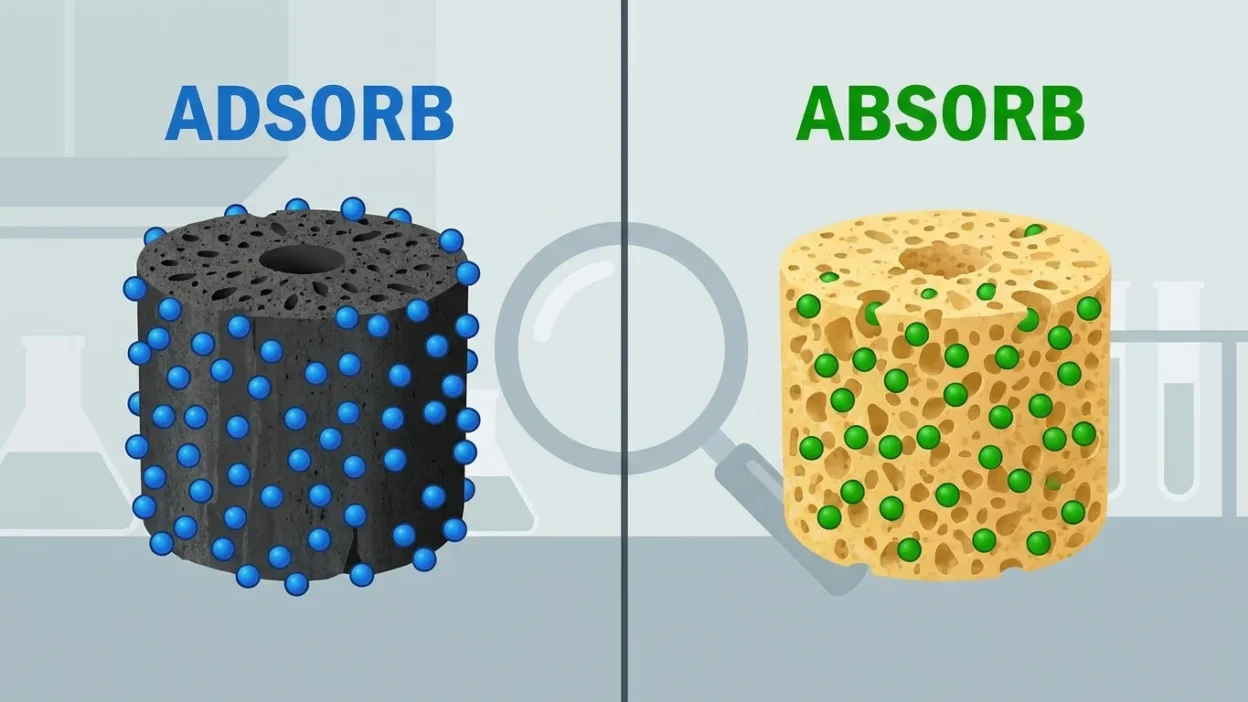
When a material absorbs something, it takes it into its interior. When a material adsorbs something, the substance sticks to its surface.
Once you understand this surface-versus-inside distinction, choosing between adsorb and absorb becomes much easier.
Quick Answer: Adsorb vs Absorb
Absorb means to take something into the inside or bulk of a material.
Adsorb means to attract and hold something on the surface of a material.
- A sponge absorbs water.
- Activated carbon adsorbs certain molecules onto its surface.
- Absorption happens throughout a material.
- Adsorption mainly occurs at a surface or interface.
What Does Absorb Mean?
The verb absorb means to take in or soak up something. The absorbed substance generally moves into the interior of another material rather than remaining only on its surface.
For example, when you spill water on a sponge, the water enters the sponge’s pores. The sponge has absorbed the water.
Absorption can occur with liquids, gases, energy, and even information in a figurative sense.
Examples of Absorb
- A towel absorbs spilled water.
- Plants absorb water through their roots.
- Black surfaces can absorb heat and light.
- The lungs absorb oxygen from the air.
- She quickly absorbed the information from the lecture.
In everyday English, absorb is by far the more common word.
What Does Adsorb Mean?
The verb adsorb describes a process in which atoms, ions, molecules, or other particles become attached to the surface of a material.
Unlike absorption, the substance does not necessarily penetrate into the material. Instead, it accumulates or attaches at the surface.
Adsorption is especially important in chemistry, materials science, water treatment, environmental engineering, and industrial processes.
For example, activated carbon adsorbs many contaminants because molecules can attach to its extensive internal surface area.
Adsorb vs Absorb: The Main Difference
The central difference is simple:
Absorption happens inside a material; adsorption happens on its surface.
Think about a sponge and a piece of activated carbon.
When a sponge takes in water, the water enters its structure. That is absorption.
When molecules attach to the surface of activated carbon, they are adsorbed.
This distinction may seem technical, but it is extremely useful in scientific writing because the two processes can behave differently and have different mechanisms.
Adsorb vs Absorb Comparison Table
| Feature | Absorb | Adsorb |
|---|---|---|
| Basic meaning | Take something into the interior | Hold something on a surface |
| Location | Throughout or within a material | Mainly at the surface |
| Process | Absorption | Adsorption |
| Common example | Sponge taking in water | Activated carbon holding contaminants |
| Common fields | Everyday life, biology, physics, chemistry | Chemistry, environmental science, engineering |
| Memory clue | Into the material | At the surface |
| Related noun | Absorption | Adsorption |
Easy Trick to Remember Adsorb vs Absorb
One of the easiest memory tricks is to associate the D in adsorb with deposit or surface.
You can think:
ADsorb = particles ADhere to a surface.
This is not the scientific definition, but it is a useful memory aid.
For absorb, imagine a sponge soaking up water. The liquid goes inside.
Another simple question can help:
“Does it go in or stick on?”
- If it goes in, use absorb.
- If it sticks on, use adsorb.
Adsorption in Chemistry
Adsorption is particularly important in chemistry because surfaces can interact with molecules in different ways.
A substance that attracts molecules to its surface is called an adsorbent. The material being held on the surface is called an adsorbate.
For example, activated carbon can act as an adsorbent, while certain organic compounds or pollutants may be adsorbates.
Adsorption can involve relatively weak physical forces, known as physisorption, or stronger chemical interactions, known as chemisorption.
This is why the term appears frequently in discussions about catalysts, purification, filtration, gas separation, and environmental cleanup.
Absorption in Science and Everyday Life
Absorption is equally important but describes a different movement.
In biology, the small intestine absorbs nutrients from digested food. The body then transports those nutrients for use or storage.
In plants, roots absorb water and dissolved minerals from the surrounding soil.
In physics, materials may absorb electromagnetic radiation, including light or infrared energy.
In everyday situations, materials such as towels, tissues, cotton, and sponges absorb liquids.
These examples all involve something entering or being taken into the material.
Real-Life Examples of Adsorb vs Absorb
Here are some practical examples to make the distinction clearer.
Example 1: Sponge
Correct: The sponge absorbed the water.
The water entered the sponge’s structure.
Example 2: Activated Carbon
Correct: Activated carbon adsorbed the contaminant.
The contaminant attached to the carbon’s surface.
Example 3: Human Body
Correct: The intestines absorb nutrients.
Nutrients move into biological tissues and circulation.
Example 4: Water Purification
Correct: Activated carbon can adsorb certain pollutants from water.
The pollutants attach to the carbon’s surface.
Example 5: Figurative English
Correct: The student absorbed everything the teacher explained.
Here, absorbed is being used figuratively to mean learning or taking in information.
Common Mistakes With Adsorb and Absorb
Because the words differ by only one letter, confusion is common.
Mistake 1: Using “absorb” for every kind of taking in
Not every process involving the capture of molecules is absorption. In scientific contexts, if molecules are attaching specifically to a surface, adsorption is the more accurate term.
Mistake 2: Assuming adsorption means ordinary sticking
Adsorption is more precise than simply saying something “sticks.” It refers to the accumulation or attachment of a substance at a surface or interface.
Mistake 3: Confusing “adsorbent” and “absorbent”
These nouns are related but different.
An absorbent material takes a substance into itself.
An adsorbent material provides a surface onto which another substance can attach.
For example:
- Paper towel = absorbent
- Activated carbon = adsorbent
Mistake 4: Treating the words as interchangeable in technical writing
In casual conversation, people may not notice the difference. In scientific or technical writing, however, using the wrong term can change the meaning of a sentence.
Adsorbent vs Absorbent
The distinction between the adjectives and nouns follows the same basic rule.
Absorbent describes something capable of absorbing.
Adsorbent describes a material capable of adsorption.
| Word | Meaning | Example |
|---|---|---|
| Absorb | Take into the material | A towel absorbs water. |
| Absorbent | Able to take in a substance | Cotton is highly absorbent. |
| Adsorb | Hold a substance on a surface | Carbon adsorbs pollutants. |
| Adsorbent | Material that provides a surface for adsorption | Activated carbon is an adsorbent. |
Are Adsorption and Absorption the Same Process?
No. They are related but distinct processes.
Both involve one substance being taken up by another, which explains why the terms are easy to confuse. The major difference is where the captured substance ends up.
With absorption, the substance enters the bulk or interior of the absorbing material.
With adsorption, the substance concentrates at the surface of the adsorbent.
In some real systems, both processes can occur simultaneously, which can make scientific analysis more complicated.
American vs British English: Adsorb vs Absorb
There is no major American-versus-British English difference in the meanings or spellings of adsorb and absorb.
Both forms are standard in American and British English:
- adsorb
- adsorption
- absorb
- absorption
The difference is scientific rather than regional.
Whether you are writing for an American or British audience, the same surface-versus-interior distinction applies.
Why Is Adsorb vs Absorb Important?
Knowing the difference matters when accuracy is important.
This is particularly true in:
- Chemistry
- Biology
- Environmental science
- Medicine
- Water purification
- Materials science
- Chemical engineering
- Pharmaceutical research
- Industrial filtration
Using absorb instead of adsorb in a technical explanation can suggest that a substance enters the material when it actually remains concentrated at its surface.
For students, researchers, writers, and professionals, learning this distinction improves both scientific vocabulary and clarity.
How to Choose the Correct Word
When you are unsure, use this three-step method:
1. Identify what is being taken up.
Is it water, heat, light, nutrients, information, or molecules?
2. Ask where it goes.
Does it enter the material, or does it remain attached to the surface?
3. Choose the word.
- Inside → absorb
- Surface → adsorb
For everyday English, absorb will usually be the correct choice. Reserve adsorb for situations involving surface attachment or accumulation.
Frequently Asked Questions About Adsorb vs Absorb
Is it “adsorb” or “absorb”?
Both words are correct, but they describe different processes. Absorb means to take something into the interior of a material, while adsorb means to hold something on its surface.
What is an easy way to remember adsorption?
Remember ADsorb = ADhere. Adsorbed particles attach to a surface. Absorbed substances go into the material.
Does activated carbon absorb or adsorb?
Activated carbon primarily adsorbs many substances onto its large surface area. In specific situations, other processes may also contribute to removal.
Does a sponge adsorb water?
A sponge is commonly described as absorbing water because water enters its pores and structure. In scientific contexts, surface interactions can also occur, but absorb is the natural word for this everyday example.
What is the difference between adsorbent and absorbent?
An adsorbent holds substances on its surface, while an absorbent takes substances into its interior.
Is adsorption only used in chemistry?
No. Adsorption is also important in environmental science, medicine, engineering, materials science, water treatment, and industrial purification.
Is there an American and British English difference?
No significant regional difference exists. American and British English use adsorb and absorb with the same meanings.
Can adsorption and absorption happen together?
Yes. A real material or system can sometimes experience both processes. Scientists distinguish them based on where and how the substance is taken up.
Final Summary
The difference between adsorb vs absorb comes down to one essential idea: surface versus inside. To absorb means to take something into the interior or bulk of a material, as a sponge absorbs water. To adsorb means to attract and hold particles on a surface, as activated carbon adsorbs certain contaminants.
Once you remember “absorb = in” and “adsorb = on the surface,” the distinction becomes much easier. The words are not interchangeable in technical contexts, even though they sound almost the same. Both American and British English use them in the same way, so this is a matter of scientific meaning rather than regional spelling or grammar.
Actionable Takeaway
Before using adsorb or absorb, ask yourself one question: Does the substance go into the material, or does it attach to its surface?
- Goes inside → ABSORB
- Attaches to the surface → ADSORB
Use this simple test whenever you write a science assignment, technical report, educational article, or professional explanation. It will help you choose the precise word with confidence.

Michael James is the administrator and a dedicated author at Biblenast, responsible for managing the platform and ensuring quality content. Alongside his administrative role, he writes insightful biblical articles that inspire faith, reflection, and spiritual growth. His work supports the mission of making God’s Word accessible and meaningful.