Have you ever wondered whether the correct word is adsorb vs absorb?
These two terms are easy to confuse because they look almost identical and are closely related in meaning.
However, they describe two different processes.
Understanding the distinction is especially important in chemistry, biology, medicine, environmental science, and technical writing.
The key is to look at where the substance goes.
When a material is absorbed, it is taken into the interior of another substance.
When a substance is adsorbed, it sticks to the surface of another material. Once you understand this simple difference—absorb goes in; adsorb stays on the surface—the two words become much easier to use correctly.
Quick Answer: Adsorb vs Absorb
Absorb means to take in or soak up a substance throughout the interior of a material.
Adsorb means to attract and hold molecules, atoms, ions, or other particles on the surface of a material.
- Absorb = take in
- Adsorb = hold on the surface
- Absorption = movement into the material
- Adsorption = attachment to the surface
Example: A sponge absorbs water, while activated carbon adsorbs certain chemicals onto its surface.
What Does Absorb Mean?
Absorb is a common verb meaning to take something in. The thing being absorbed can enter and become distributed within another material.
For example, when you spill water on a paper towel, the towel absorbs the water. The liquid does not simply remain on the surface. It moves into the spaces and fibers of the towel.
Absorption can occur with liquids, gases, energy, and even information.
Common meanings of absorb
Absorb can mean:
- To take in a liquid
- To take in a gas
- To take in energy such as heat or light
- To incorporate a substance into another material
- To take in information or knowledge
- To occupy someone’s attention completely
For example:
The sponge absorbed the spilled water.
Or:
Plants absorb water through their roots.
The word also has non-scientific meanings:
She was completely absorbed in her book.
Here, absorbed means deeply interested or focused.
What Does Adsorb Mean?
Adsorb is a more specialized scientific term. It means that atoms, molecules, ions, or other particles become attached to the surface of a material.
The particles do not necessarily enter the material’s interior. Instead, they collect or remain on its surface.
For example, activated carbon adsorbs many substances because it has a large and highly porous surface area.
In scientific contexts, adsorption is important in areas such as:
- Chemistry
- Environmental science
- Water purification
- Gas separation
- Catalysis
- Pharmaceutical research
- Chromatography
- Soil science
A simple example is:
Activated carbon adsorbs impurities from water.
The impurities attach to the carbon’s surface rather than being absorbed throughout the carbon in the ordinary sense.
Adsorption vs Absorption: The Main Difference
The most important distinction is surface versus interior.
| Term | Meaning | Where Does It Happen? | Example |
|---|---|---|---|
| Absorb | Take in or soak up | Throughout the material | A sponge absorbs water. |
| Adsorb | Attract and hold particles | On the surface | Carbon adsorbs pollutants. |
| Absorption | Process of taking something in | Interior/bulk of material | Roots absorb water. |
| Adsorption | Process of surface attachment | Surface of material | Charcoal adsorbs certain chemicals. |
Think of it this way:
Absorption = inside
Adsorption = surface
That is the fundamental difference.
Absorb vs Adsorb: An Easy Memory Trick
A simple memory trick can make this distinction almost impossible to forget.
Absorb has “absorb” like a sponge
Think about a sponge soaking up water.
The water goes inside the sponge.
So:
Absorb → goes in
Adsorb has “ad-” for attachment
Think of adsorption as particles being attracted or attached to a surface.
So:
Adsorb → sticks to the surface
Another useful phrase is:
Absorb it. Adsorb it onto a surface.
This distinction is particularly helpful when studying chemistry or writing scientific material.
Examples of Absorb in a Sentence
Here are practical examples showing how absorb is used.
Everyday examples
- The towel absorbed the spilled coffee.
- Dry soil quickly absorbs rainwater.
- This material absorbs moisture from the air.
- The sponge absorbed almost all the water.
Scientific examples
- Plants absorb nutrients through their roots.
- The skin can absorb certain substances.
- Dark surfaces absorb more radiant energy.
- The material absorbs heat from its surroundings.
Figurative examples
Absorb does not always describe a physical substance.
- Students absorb new information.
- He quickly absorbed the instructions.
- She was completely absorbed in her work.
In these examples, the concept is still one of taking something in.
Examples of Adsorb in a Sentence
Adsorb is most often found in technical or scientific contexts.
- Activated carbon adsorbs organic compounds.
- The clay surface adsorbs certain ions.
- The material can adsorb pollutants from water.
- Molecules adsorb onto the surface of the catalyst.
- Silica gel adsorbs moisture from the surrounding air.
- The filter uses a specialized material to adsorb contaminants.
Notice that adsorb often appears with words such as onto, on the surface, or surface. These clues can help you recognize the intended meaning.
Adsorption vs Absorption in Chemistry
In chemistry, the distinction between adsorption and absorption is especially important.
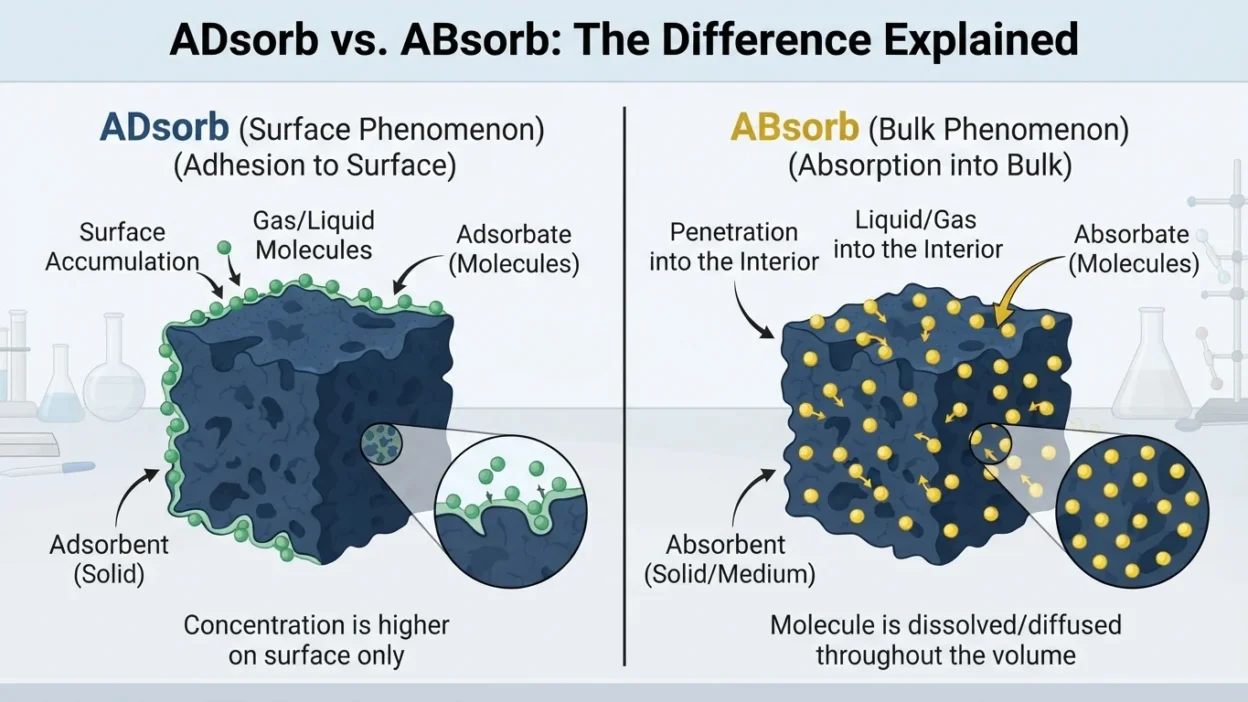
Adsorption is a surface phenomenon. Molecules or other particles accumulate at the surface or interface of a material.
Absorption is a bulk phenomenon. A substance enters and becomes distributed within the volume of another substance.
For example, imagine a solid material exposed to a gas.
If gas molecules collect on the material’s surface, that is adsorption.
If the gas enters the material and spreads through its interior, that is absorption.
This difference is important in chemical engineering, materials science, environmental technology, and laboratory research.
What Is the Difference Between Adsorption and Absorption?
A useful scientific comparison looks like this:
| Feature | Adsorption | Absorption |
|---|---|---|
| Main location | Surface | Interior |
| Process type | Surface phenomenon | Bulk phenomenon |
| Particles | Attach to a surface | Enter the material |
| Common example | Carbon trapping pollutants | Sponge taking in water |
| Related term | Adsorbate/adsorbent | Absorbent |
| Common applications | Filtration, catalysis, purification | Drying, soaking, material uptake |
One important vocabulary distinction is worth remembering:
Adsorbent is the material whose surface attracts and holds the substance.
Adsorbate is the substance that becomes attached to that surface.
For absorption, absorbent describes a material capable of taking in another substance.
Adsorbent vs Absorbent
These words are another common source of confusion.
An absorbent material takes a substance into its interior.
Examples include:
- Paper towels
- Sponges
- Cotton
- Certain fabrics
An adsorbent is a material that holds substances on its surface.
Common adsorbents include:
- Activated carbon
- Silica gel
- Certain clays
- Zeolites
For example:
A paper towel is absorbent because it takes up water.
Activated carbon is an adsorbent because molecules attach to its extensive surface.
Real-World Applications of Absorption
Absorption happens all around us.
Household products
Paper towels, cloths, sponges, and absorbent pads are designed to take in liquids.
Biology
Living organisms rely on absorption in many ways. For example, the digestive system absorbs nutrients, while plant roots absorb water and minerals from the soil.
Energy
Materials can absorb forms of electromagnetic radiation, including light. Materials can also absorb heat.
Medicine
Certain substances and medicines can be absorbed by the body through different biological pathways.
Understanding absorption helps explain how substances move from one location into another material or system.
Real-World Applications of Adsorption
Adsorption has many important practical applications.
Water purification
Activated carbon can adsorb various organic compounds and other contaminants, making it useful in water-treatment systems.
Air purification
Adsorbent materials can capture certain gases, vapors, and odors from air.
Chromatography
Adsorption can help separate substances based on how strongly different molecules interact with a surface.
Catalysis
Surface interactions are fundamental to many catalytic processes, where reactant molecules interact with a catalyst’s surface.
Moisture control
Materials such as silica gel adsorb water molecules from their surroundings and are commonly used to help control humidity in enclosed packaging.
Common Mistakes With Adsorb and Absorb
The biggest mistake is treating adsorb and absorb as interchangeable.
For example:
The sponge adsorbed the water.
This is generally incorrect if you mean the sponge soaked up the water.
The better sentence is:
The sponge absorbed the water.
Now consider:
Activated carbon absorbed the pollutant onto its surface.
If the intended scientific meaning is that the pollutant attached to the surface, adsorbed is more precise:
Activated carbon adsorbed the pollutant onto its surface.
Another mistake is assuming that adsorb is simply a more scientific spelling of absorb. It is not. They describe different physical processes.
How to Choose the Right Word
When deciding between these words, ask:
Does the substance go into the material?
Use absorb.
The fabric absorbed the liquid.
Does the substance attach to the material’s surface?
Use adsorb.
The carbon adsorbed the molecules.
You can also use the following shortcut:
Inside → absorb
Surface → adsorb
This rule will solve most everyday and scientific usage questions.
American vs British English: Adsorb vs Absorb
Unlike spelling pairs such as color/colour or canceled/cancelled, adsorb and absorb do not have a meaningful American-versus-British spelling difference.
Both American English and British English use:
- absorb
- absorption
- adsorb
- adsorption
- absorbent
- adsorbent
The distinction is therefore scientific and semantic, rather than regional.
Whether you are writing for an American, British, Australian, Canadian, or international audience, the basic difference remains the same.
Why Are Adsorb and Absorb Confused?
There are several reasons these words cause confusion.
First, they differ by only one letter. Second, both involve a substance interacting with another material. Third, both can make something seem as though it has “taken up” another substance.
The difference becomes clearer when you visualize the process.
Imagine water entering a sponge. That is absorption.
Now imagine molecules attaching themselves to the outside surface of activated carbon. That is adsorption.
The two processes may occur together in some real-world systems, but the terms identify different mechanisms.
Frequently Asked Questions About Adsorb vs Absorb
What is the simple difference between adsorb and absorb?
Absorb means to take something into the interior of a material. Adsorb means to hold or accumulate something on a material’s surface.
Does a sponge absorb or adsorb water?
A sponge primarily absorbs water because the water enters its pores and internal structure.
Does activated carbon absorb or adsorb?
Activated carbon is commonly described as an adsorbent because many molecules attach to its extensive internal surface area. In technical contexts, adsorption is the preferred term for this surface process.
Is adsorption the same as absorption?
No. Adsorption occurs at a surface, while absorption involves penetration into the bulk or interior of a material.
What is an adsorbent?
An adsorbent is a material whose surface attracts and holds another substance. Activated carbon, silica gel, zeolites, and some clays are examples.
What is an absorbent?
An absorbent is a material that can take another substance, particularly a liquid, into its interior. Sponges, paper towels, and cotton are familiar examples.
How can I remember adsorb vs absorb?
Remember absorb = inside and adsorb = surface. A sponge absorbs water, while activated carbon adsorbs molecules onto its surface.
Are adsorb and absorb different in British and American English?
No significant regional difference exists. Both varieties of English use adsorb and absorb with the same basic meanings.
Final Summary
The difference between adsorb vs absorb is simple once you focus on location. Absorb means to take a substance into the interior or bulk of a material. A sponge absorbs water, plants absorb nutrients, and materials can absorb heat or light. The word also has figurative meanings, such as being absorbed in a book or absorbing new information.
Adsorb, by contrast, refers specifically to a surface process. Molecules, ions, or other particles become attached to the surface of another material. Activated carbon adsorbs contaminants, while silica gel adsorbs moisture. The best memory rule is short and practical: absorb means “go in,” while adsorb means “stick to the surface.”
Actionable Takeaway
Whenever you are unsure which word to use, ask yourself one question:
“Does it go inside, or does it stay on the surface?”
- Goes inside → ABSORB
- Sticks to the surface → ADSORB
- Material that takes something inside → ABSORBENT
- Material that holds something on its surface → ADSORBENT
For everyday writing, think of a sponge absorbing water. For scientific writing, think of activated carbon adsorbing pollutants. Once you connect each word to that visual image, you will be much less likely to confuse them.

John Robert is a passionate author and faith-driven writer who contributes insightful and inspiring biblical content to Biblenast. With a strong commitment to sharing God’s Word, he focuses on creating meaningful messages that encourage spiritual growth, reflection, and daily guidance. His work aims to connect readers with the timeless teachings of the Bible.