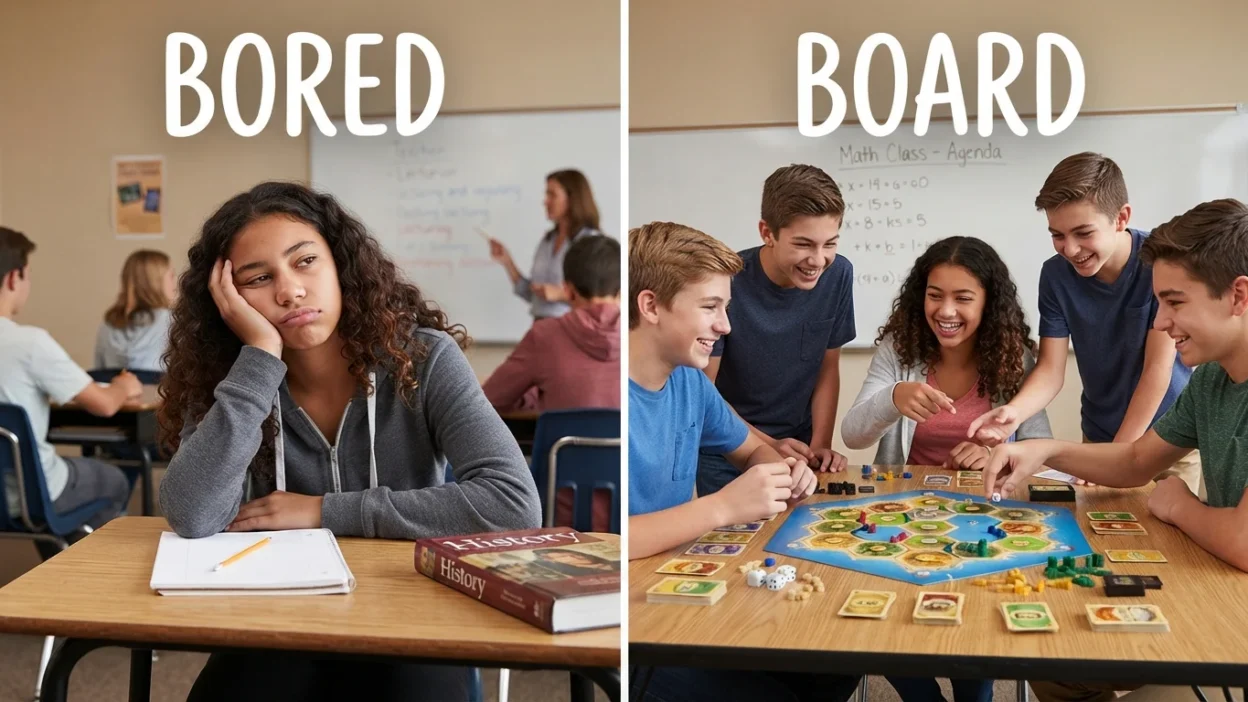
Have you ever written bored vs board and wondered which word is correct? You are not alone.
These two words sound almost exactly the same in many varieties of English, but their meanings, spellings, and grammatical uses are completely different.
This makes them a common source of confusion for English learners and even native speakers when writing quickly.
The good news is that the difference between bored and board is simple once you connect each word with its meaning.
“Bored” describes a feeling of having little interest or excitement, while “board” can refer to a flat piece of material, a group of people managing an organization, or the act of getting onto a vehicle.
This guide explains the difference clearly with examples, common mistakes, pronunciation tips, and American versus British English usage.
Quick Answer: Bored vs Board
Bored is an adjective describing a person’s feeling when they are uninterested, unoccupied, or lacking stimulation.
Board is usually a noun or verb. It can mean a flat piece of wood or another material, a governing group, or the act of getting onto a bus, train, ship, or airplane.
The easiest way to remember them is:
- Bored = feeling uninterested
- Board = wood, group, or getting onto transportation
Although they can sound alike, they are not interchangeable.
What Does “Bored” Mean?
The word bored describes a feeling of having little interest, excitement, or mental stimulation.
If you have nothing engaging to do, you might feel bored.
For example:
“I was bored during the long meeting.”
Here, “bored” describes the speaker’s emotional state.
Other examples include:
- “The children were bored during the rainy afternoon.”
- “I get bored when I have nothing to do.”
- “She looked bored at the party.”
- “He was bored with the repetitive task.”
The word is usually connected with a lack of interest or stimulation.
What Does “Board” Mean?
Board has several different meanings, making it much more versatile than “bored.”
Board as a Noun: A Flat Piece of Material
A board can be a flat piece of wood or another material.
For example:
“He placed the books on a wooden board.”
Common compounds include:
- Wooden board
- Cutting board
- Blackboard
- Whiteboard
- Surfboard
- Noticeboard
- Skateboard
Board as a Noun: A Group of People
A board can also mean a group of people responsible for managing or supervising an organization.
For example:
“The board approved the new policy.”
You may hear:
- Board of directors
- School board
- Board meeting
- Advisory board
- Board member
Board as a Verb: Getting Onto Transportation
The verb board means to get onto a vehicle, especially a plane, train, bus, or ship.
For example:
“Passengers should board the plane at Gate 4.”
Other examples:
- “We boarded the train at noon.”
- “They boarded the bus downtown.”
- “The passengers are boarding the ship.”
Bored vs Board: Comparison Table
| Feature | Bored | Board |
|---|---|---|
| Main word type | Adjective | Noun or verb |
| Basic meaning | Feeling uninterested | Flat material, governing group, or getting onto transportation |
| Example | “I am bored.” | “I boarded the train.” |
| Related word | Boredom | Boarding |
| Pronunciation | Usually sounds like “board” | Usually sounds like “bored” |
| Emotional meaning | Yes | No |
| Transportation meaning | No | Yes |
| Organization meaning | No | Yes |
The most important difference is meaning and spelling, not pronunciation.
Why Do Bored and Board Sound the Same?
Bored and board are generally homophones in standard modern English. Homophones are words that sound alike but have different spellings and meanings.
For many speakers, both are pronounced approximately like “bord.”
That means you cannot always determine which word someone means simply by hearing it.
You have to use context.
For example:
“I was bored.”
The context clearly indicates a feeling.
But:
“I boarded the train.”
Here, the word is the verb “boarded,” meaning got onto the train.
This is why homophones can cause problems in writing even when speaking them is easy.
How to Use “Bored” Correctly
Use bored when describing someone’s emotional or mental state.
Correct Examples
- “I am bored at home.”
- “She was bored during the lecture.”
- “They became bored after waiting for an hour.”
- “He gets bored easily.”
- “We were bored because the movie was too slow.”
You can also use common structures such as:
Bored with + noun
“She is bored with her routine.”
Bored by + activity or situation
“He was bored by the long presentation.”
Bored of + noun/activity
“I’m bored of doing the same thing every day.”
The exact preferred construction can vary by English variety and context.
How to Use “Board” Correctly
Because “board” has several meanings, always consider the context.
Board as a Physical Object
“The carpenter cut the board into two pieces.”
Board as an Organization
“The board discussed the company’s financial results.”
Board as Transportation
“We need to board the flight before the gate closes.”
Board as Accommodation or Meals
The word can also appear in expressions involving accommodation and food.
For example:
“The hotel provides room and board.”
Here, “board” refers historically to meals provided as part of lodging.
Common Mistakes With Bored vs Board
Mistake 1: Writing “Board” When You Mean a Feeling
Incorrect:
“I am board today.”
Correct:
“I am bored today.”
If you are describing a lack of interest, use bored.
Mistake 2: Writing “Bored” for Transportation
Incorrect:
“We bored the airplane.”
Correct:
“We boarded the airplane.”
The verb board means to get onto the vehicle.
Mistake 3: Confusing “Bored” With “Boring”
This is another common English mistake.
Bored describes how a person feels.
Boring describes something that causes that feeling.
Compare:
“The movie was boring.”
“I was bored during the movie.”
A movie can be boring, while a person feels bored.
Mistake 4: Choosing by Sound Alone
Because “bored” and “board” sound alike, listening is not enough to choose the spelling.
Instead, ask:
What does the sentence mean?
If it describes a feeling, choose bored.
If it describes wood, an organization, or getting onto transportation, choose board.
Bored vs Boring: An Important Difference
Many learners confuse bored, boring, and board.
Here is the easiest distinction:
- Bored = how someone feels.
- Boring = something that causes a lack of interest.
- Board = a different word with several meanings.
For example:
“The lecture was boring, so I became bored.”
That sentence uses both adjectives correctly.
Another example:
“I was bored while sitting on the board.”
Here, “bored” describes the person’s feeling, while “board” refers to a physical object.
American vs British English Differences
There is no major spelling difference between American and British English for bored and board.
Both varieties spell the words exactly the same way:
- bored
- board
The pronunciation can vary slightly depending on regional accent.
Some speakers may pronounce the vowel sounds differently, but the words remain homophones in many major English varieties.
There can also be differences in expressions involving these words.
For example, British English commonly uses bored of in informal speech:
“I’m bored of this.”
American English traditionally favors constructions such as:
“I’m bored with this.”
or
“I’m bored by this.”
However, actual usage varies, and “bored of” is increasingly encountered across different varieties of English.
Bored vs Board in Everyday Sentences
Seeing the words in realistic contexts can make the distinction easier.
Examples With “Bored”
- “I was bored because the internet was down.”
- “The students looked bored.”
- “She gets bored when she has to wait.”
- “He was bored with the repetitive routine.”
Examples With “Board”
- “Please write your answer on the board.”
- “The board will meet tomorrow.”
- “We boarded the train at 7:30.”
- “She bought a new cutting board.”
- “Passengers are now boarding.”
Notice how the meaning immediately changes based on the spelling.
How to Remember Bored vs Board
Try this simple memory trick:
Bored has an “ed” because it describes how you “feel.”
You can also associate:
Bored → boredom → feeling
Board → boarding → getting onto a vehicle
Another useful shortcut is to create a mental image.
When you see bored, imagine someone sitting around with nothing interesting to do.
When you see board, imagine a wooden plank, a classroom board, or an airplane boarding gate.
Visual associations can make homophones easier to remember.
Why Homophones Cause So Many Spelling Errors
English contains many homophones, including:
- Their / there / they’re
- To / too / two
- Your / you’re
- Hear / here
- Right / write
- Brake / break
- Bored / board
Because the spoken sound does not reveal the spelling, writers must rely on meaning and context.
The best approach is not to memorize isolated spellings. Instead, learn the words in complete sentences.
For example:
“I am bored.”
“Please board the train.”
These sentence patterns are easier to recall than dictionary definitions alone.
Frequently Asked Questions
What is the difference between bored and board?
Bored describes a feeling of being uninterested or unstimulated. Board can mean a flat piece of material, a governing group, or the act of getting onto transportation.
Are bored and board pronounced the same?
In many English accents, yes. They are commonly pronounced as homophones, although exact pronunciation can vary by regional accent.
Is “I am board” correct?
No, not if you mean that you feel uninterested. The correct sentence is “I am bored.”
Is it “board the plane” or “bored the plane”?
The correct expression is “board the plane.” The verb “board” means to get onto an airplane or another form of transportation.
What is the difference between bored and boring?
Bored describes a person’s feeling, while boring describes something that causes a lack of interest. For example, “The class was boring, and I was bored.”
Are bored and board different in British and American English?
They are spelled the same in both major varieties of English. Pronunciation can differ by accent, but the words are commonly homophones.
Can board be a verb?
Yes. “Board” can mean to get onto a plane, train, bus, or ship. For example, “We boarded the train at 8 a.m.”
How can I remember the difference between bored and board?
Remember bored = a feeling and board = wood, a group, or getting onto transportation. Connecting each spelling to a specific meaning makes the distinction easier.
Final Summary
The difference between bored vs board is simple once you focus on meaning. Bored is an adjective that describes a feeling of having little interest or excitement. Board, on the other hand, can be a noun referring to a flat piece of material or a group of people, or a verb meaning to get onto a vehicle. Although the two words often sound the same, their spellings and meanings are completely different.
When writing, do not rely on pronunciation alone. Look at what the sentence is trying to communicate. If you are talking about an emotional state, choose bored. If you are talking about a physical board, an organization, or getting onto transportation, choose board. This simple context-based approach will help you avoid one of English’s most common homophone mistakes.
Actionable Takeaway
Remember this three-part rule: Bored = feeling, Board = object/group, Board = getting on. If you mean “I have no interest,” write bored. If you mean “wood,” “committee,” or “get onto a plane,” write board. Practicing these words in short sentences is the fastest way to make the correct spelling automatic.

David William is a dedicated writer and spiritual enthusiast with a deep passion for sharing biblical wisdom. As the author behind Biblenast, he focuses on delivering meaningful scripture-based content that inspires faith, reflection, and daily guidance. His mission is to make the teachings of the Bible accessible, uplifting, and relevant to modern life.