
If you have come across the words promulgate vs propagate, you may have wondered whether they mean the same thing.
Both verbs can involve spreading information, ideas, beliefs, or something from one person to another, which makes them easy to confuse.
However, they emphasize different actions and are used in different contexts.
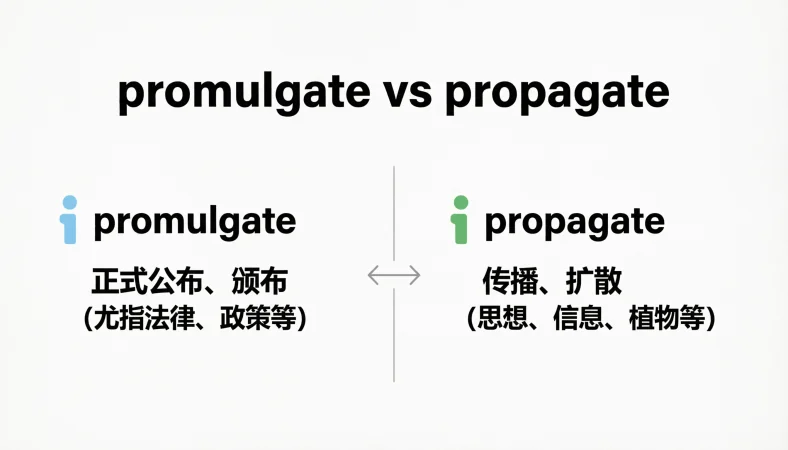
The key difference is simple: promulgate usually means to officially announce, publish, or make something widely known, especially a law, rule, doctrine, or policy.
Propagate generally means to spread, promote, reproduce, or cause something to become more widespread.
Understanding this distinction can make your writing more precise, particularly in academic, legal, religious, scientific, and professional contexts.
Quick Answer: Promulgate vs Propagate
Promulgate means to officially or publicly announce, publish, or make something known. It is commonly used for laws, regulations, policies, doctrines, and official statements.
Propagate means to spread something widely, such as an idea, belief, message, plant, or biological organism.
The easiest distinction is:
- Promulgate = officially announce or publish
- Propagate = spread or reproduce
- A government may promulgate a law.
- A person may propagate an idea.
- A plant can propagate through seeds or cuttings.
What Does “Promulgate” Mean?
Promulgate is a verb meaning to make something officially or publicly known, especially by formally announcing or publishing it.
The word is particularly common in legal, governmental, academic, and religious writing.
For example:
“The government promulgated new safety regulations.”
This means the government formally announced or issued the regulations so that people would know about them.
Other examples include:
- “The agency promulgated new environmental rules.”
- “The church promulgated a revised doctrine.”
- “The administration promulgated a new policy.”
- “The court’s decision was promulgated to the public.”
The word often carries a sense of authority, formality, and official communication.
What Does “Propagate” Mean?
Propagate means to spread something from one place, person, or group to another.
It can be used for ideas, information, beliefs, opinions, rumors, plants, and even waves or signals.
For example:
“Social media can rapidly propagate information.”
Here, propagate means that the information spreads from one person or group to another.
The word also has scientific and biological meanings.
For example:
“Gardeners propagate plants from cuttings.”
In this context, propagation means producing new plants from existing ones.
Promulgate vs Propagate: Comparison Table
| Feature | Promulgate | Propagate |
|---|---|---|
| Basic meaning | Officially announce or publish | Spread or reproduce |
| Main emphasis | Making something publicly known | Increasing distribution or reach |
| Common contexts | Law, government, policy, doctrine | Ideas, information, plants, beliefs |
| Formality | Usually formal | Neutral to formal |
| Can involve ideas? | Yes | Yes |
| Can involve laws? | Very common | Possible but usually different meaning |
| Biological use | Rare | Very common |
| Plant reproduction | No | Yes |
| Example | “The agency promulgated the regulation.” | “The rumor propagated quickly.” |
A useful memory trick is:
Promulgate = make public
Propagate = spread
Promulgate: Common Examples
Because “promulgate” is more formal than everyday words such as “announce” or “publish,” it often appears in specific contexts.
Legal Example
“The government promulgated the new tax regulations.”
The government formally issued the regulations.
Policy Example
“The organization promulgated a new code of conduct.”
The organization officially established and communicated the policy.
Religious Example
“The leaders promulgated the teachings throughout the community.”
Here, the word emphasizes formally making teachings known.
Academic Example
“The institution promulgated revised academic standards.”
The standards were formally announced or issued.
In each example, the central idea is official communication or formal publication.
Propagate: Common Examples
“Propagate” has a wider range of uses.
Ideas
“The author propagated the idea through several articles.”
The idea was spread to a larger audience.
Beliefs
“The group was accused of propagating false beliefs.”
The group was spreading those beliefs among others.
Information
“Online platforms can propagate information within minutes.”
The information spreads rapidly.
Plants
“Gardeners propagate roses using cuttings.”
Here, propagation means producing new plants.
Signals and Waves
In physics and telecommunications, waves and signals can propagate through a medium or environment.
For example:
“Radio waves propagate through space.”
This is a technical use of the word.
The Main Difference in Context
The difference becomes clearer when you focus on what the speaker wants to emphasize.
If the focus is on officially announcing or issuing something, use promulgate.
If the focus is on spreading something from one person or place to another, use propagate.
Compare these sentences:
“The government promulgated the new law.”
The emphasis is on the official announcement or issuance.
“The media propagated the message.”
The emphasis is on the message spreading to a wider audience.
The same general subject can sometimes involve both actions.
For example, an authority could promulgate a new policy, while newspapers and social media propagate information about that policy.
Promulgate vs Propagate in Legal English
Legal writing is one of the clearest places to see the distinction.
Promulgate is frequently associated with the formal issuance of laws, regulations, rules, and official directives.
For example:
“The department promulgated regulations governing workplace safety.”
This means the department formally issued the regulations.
Propagate, however, would normally focus on the spread of information, opinions, or beliefs surrounding the law.
For example:
“The campaign helped propagate misinformation about the regulation.”
The law itself is promulgated; information about it may be propagated.
Promulgate vs Propagate in Religious Writing
Both words can appear in religious contexts, but their emphasis differs.
A religious institution might promulgate an official doctrine, statement, or teaching.
For example:
“The council promulgated a formal statement of doctrine.”
A person or group might propagate a religious belief by teaching it to others.
For example:
“Missionaries propagated their message throughout the region.”
The distinction is between formally making something known and spreading something among people.
Promulgate vs Propagate in Science
The word propagate is especially important in science.
It can describe the movement or transmission of:
- Sound waves
- Light
- Radio waves
- Signals
- Heat in certain contexts
- Biological organisms
- Genetic material
For example:
“Sound waves propagate through the air.”
It can also describe biological reproduction:
“Plants can be propagated from seeds.”
By comparison, promulgate is generally not a scientific term for physical transmission or reproduction.
Common Mistakes With Promulgate and Propagate
Mistake 1: Treating Them as Perfect Synonyms
Although both can relate to making something known, they are not interchangeable in every sentence.
Incorrect or awkward:
“The government propagated the new regulation.”
If the intended meaning is that the government formally issued the regulation, promulgated is more precise.
Better:
“The government promulgated the new regulation.”
Mistake 2: Using Promulgate for Plant Reproduction
You would not normally say:
“Gardeners promulgate plants.”
The appropriate word is:
“Gardeners propagate plants.”
Mistake 3: Thinking Propagate Always Has a Negative Meaning
“Propagate” is sometimes used negatively, especially with phrases such as “propagate misinformation.” But the word itself is neutral.
For example:
“The company propagated useful information about recycling.”
There is nothing inherently negative about propagation.
Mistake 4: Assuming Promulgate Always Means “Spread”
Promulgate can involve spreading information, but its distinctive feature is formal or official public communication.
Synonyms for Promulgate
Depending on the context, synonyms for promulgate include:
- Announce
- Proclaim
- Publish
- Issue
- Declare
- Publicize
- Formalize
- Make known
- Introduce officially
Not every synonym works in every sentence. For example, “issue” is particularly natural with regulations, while “proclaim” can sound more ceremonial.
Synonyms for Propagate
Depending on the context, synonyms for propagate include:
- Spread
- Distribute
- Circulate
- Promote
- Transmit
- Disseminate
- Reproduce
- Multiply
- Broadcast
Again, context matters. A gardener might propagate a plant, while a journalist might disseminate information.
American vs British English Differences
There is no major difference in spelling between American and British English for promulgate and propagate.
Both varieties use:
- Promulgate
- Propagate
The main difference is not regional spelling but frequency and context.
“Promulgate” is relatively formal in both American and British English. In everyday conversation, speakers are often more likely to say “announce,” “publish,” or “issue.”
“Propagate” is more versatile and can be used naturally in scientific, technical, academic, biological, and general contexts in both varieties.
For international readers, choosing a simpler synonym can sometimes improve readability when a highly formal word is unnecessary.
How to Remember the Difference
Try this simple formula:
Promulgate → publicize officially
Propagate → spread widely
Imagine a government publishing a new regulation. It promulgates the regulation.
Then imagine people discussing that regulation online. Information about it may propagate through social networks.
Another memory trick is to associate:
- Promulgate → proclamation
- Propagate → propagation
A proclamation is an official public announcement, while propagation is the process of spreading or reproducing something.
Which Word Should You Use?
Choose promulgate when:
- A government formally announces a regulation.
- An institution officially publishes a rule.
- An authority declares a doctrine or policy.
- You are discussing formal issuance.
- The context is legal or administrative.
Choose propagate when:
- An idea spreads.
- Information circulates.
- A belief is promoted.
- A plant is reproduced.
- A signal or wave travels.
- Something becomes more widespread.
If you’re writing for a general audience, remember that promulgate is more formal, while “propagate” has several technical and everyday applications.
Frequently Asked Questions
What is the difference between promulgate and propagate?
Promulgate means to officially announce, publish, or make something publicly known. Propagate means to spread, distribute, transmit, or reproduce something.
Is promulgate a synonym for propagate?
They can overlap when discussing the spread of information, but they are not exact synonyms. Promulgate emphasizes formal or official communication, while propagate emphasizes spreading or reproduction.
Can you promulgate an idea?
Yes. An organization, authority, or individual can promulgate an idea, especially when formally promoting or making it known. However, “propagate an idea” emphasizes its spread.
Can you propagate a law?
It is possible to describe information or beliefs about a law as being propagated, but promulgate a law or regulation is usually more precise when referring to its formal issuance.
What does promulgate mean in law?
In legal contexts, promulgate generally means to formally announce, publish, or issue a law, regulation, rule, or official directive so that it becomes publicly known.
What does propagate mean in biology?
In biology and gardening, propagate means to produce new plants or organisms from existing ones. Plants can be propagated through seeds, cuttings, division, grafting, and other methods.
Is propagate a negative word?
No. Propagate is neutral. It can describe spreading helpful information, transmitting signals, reproducing plants, or spreading harmful misinformation depending on the context.
Are promulgate and propagate spelled differently in British English?
No. Both words have the same standard spelling in American and British English. Differences mainly concern style and context rather than spelling.
Final Summary
The difference between promulgate vs propagate comes down to emphasis. Promulgate means to officially announce, publish, proclaim, or issue something, particularly a law, regulation, policy, doctrine, or formal statement.
It is a relatively formal word and appears frequently in legal, governmental, institutional, and religious contexts.
Propagate focuses on spreading, transmitting, promoting, or reproducing something.
It can describe ideas, beliefs, information, plants, biological material, waves, and signals.
When you are unsure which word to choose, ask whether the sentence emphasizes officially making something known or causing something to spread.
Actionable Takeaway
Use this quick rule: Promulgate = officially make known; propagate = spread or reproduce.
If a government issues a regulation, it promulgates it. If an idea travels from person to person, it propagates.
Keeping that distinction in mind will make your legal, academic, scientific, and everyday writing more accurate and natural.

Michael James is the administrator and a dedicated author at Biblenast, responsible for managing the platform and ensuring quality content. Alongside his administrative role, he writes insightful biblical articles that inspire faith, reflection, and spiritual growth. His work supports the mission of making God’s Word accessible and meaningful.