
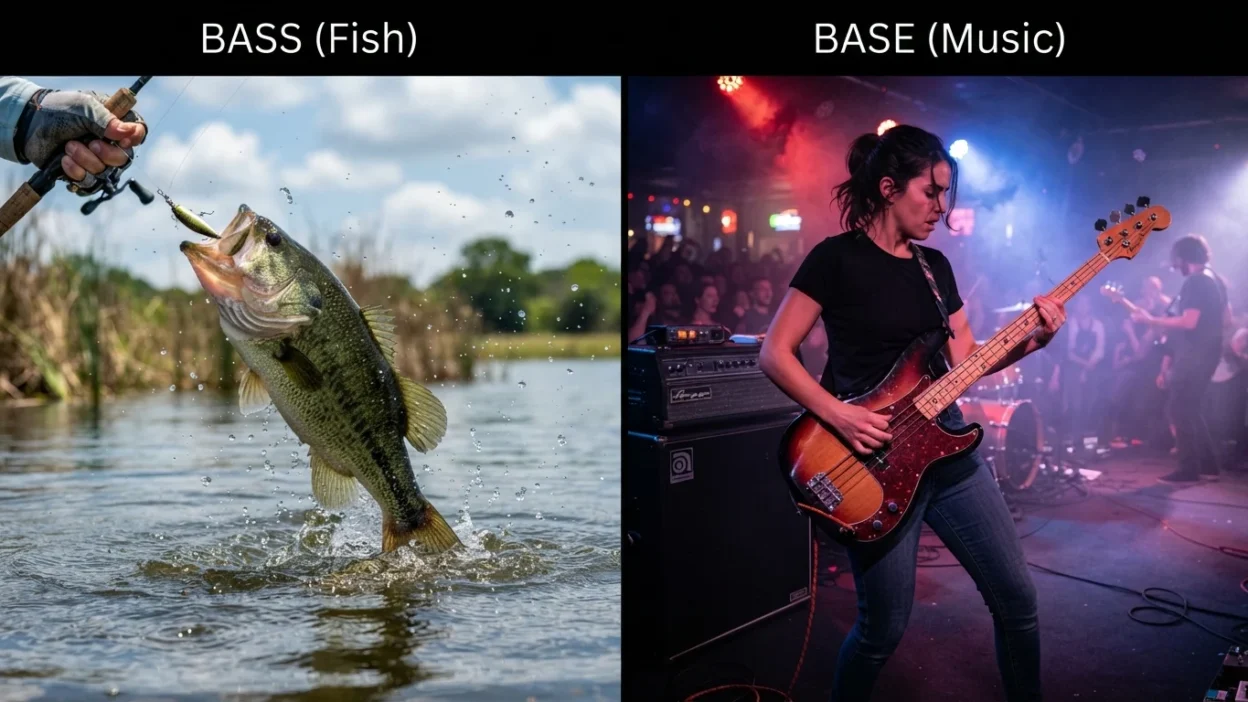
Bass or base can be confusing because the two words are spelled differently but can sound exactly the same in some contexts.
If you have ever written “bass” when you meant “base,” or wondered why the same looking pronunciation seems to have completely different meanings, you are not alone.
These words belong to different vocabulary families and are used in very different situations.
Base commonly refers to a bottom, foundation, starting point, or place from which something operates.
Bass, however, has several meanings. It can refer to a low musical sound, a bass instrument, or certain types of fish.
The tricky part is pronunciation: bass has two standard pronunciations depending on its meaning, while base has only one common pronunciation. Understanding the distinction will help you use both words confidently.
Quick Answer: Bass or Base?
Base usually means the bottom, foundation, starting point, or main supporting part of something.
Bass can refer to a low musical pitch, a musical instrument that produces low sounds, or a type of freshwater or marine fish.
Examples:
- The statue stands on a stone base.
- The song has a powerful bass line.
- We established a military base nearby.
- He caught a large bass while fishing.
Easy rule: Think base = foundation or starting point and bass = low sound or fish.
What Does Base Mean?
Base is a versatile English word that can function as a noun, verb, or adjective.
As a noun, base often means the bottom or supporting part of something.
- The lamp has a wide base.
- The statue rests on a marble base.
- The mountain has a broad base.
It can also mean a foundation or starting point.
- Trust is the base of a healthy relationship.
- The company uses customer feedback as the base for its decisions.
- The army established a new military base.
In mathematics, a base can mean the number system used for counting or the bottom side of certain geometric shapes.
- Binary uses base 2.
- The triangle has a long base.
Base as a verb
As a verb, base means to use something as the foundation or main reason for a decision.
- The report is based on recent research.
- We based our decision on the available evidence.
- The movie is based on a true story.
This use is extremely common in everyday and academic English.
What Does Bass Mean?
Bass has several unrelated meanings, which is one reason this word can be confusing.
Bass in music
In music, bass refers to low-pitched sounds or the lowest musical range.
- The song has a deep bass.
- Turn down the bass on the speakers.
- I love the bass in this recording.
The word can also refer to a bass instrument, particularly the bass guitar or double bass.
- She plays bass in a rock band.
- He bought a new bass guitar.
- The bass player joined the band last year.
In these musical contexts, bass is pronounced “base.”
Bass as a fish
Bass is also the name of several types of fish.
- We went fishing for bass.
- He caught a large bass in the lake.
- The restaurant serves locally caught bass.
This meaning is pronounced “bass” (rhyming roughly with mass).
That difference in pronunciation is important:
- Bass = low musical sound → pronounced like base
- Bass = fish → pronounced like mass
Bass vs Base: Key Difference
| Word | Meaning | Pronunciation | Example |
|---|---|---|---|
| Base | Foundation, bottom, starting point | “base” | The building has a strong base. |
| Bass | Low musical sound | “base” | The bass is very deep. |
| Bass | Type of fish | “bass” | He caught a bass. |
The words bass and base can therefore sound identical when bass refers to music. Context tells the reader or listener which meaning is intended.
Why Are Bass and Base Pronounced Differently?
The spelling of bass comes from historical linguistic development, and English spelling does not always provide a reliable guide to pronunciation.
When bass refers to music, it is pronounced like base.
For example:
“The bass in this song is excellent.”
When bass refers to a fish, it has a different pronunciation:
“We caught a bass in the river.”
This is a classic example of an English word whose pronunciation changes according to meaning.
By comparison, base is pronounced consistently like the musical form of bass.
Bass or Base in Everyday Sentences
Context usually makes the intended meaning obvious.
Base
- The building has a concrete base.
- We returned to the military base.
- The argument has no factual base.
- The researchers based their conclusions on evidence.
- Start from the base of the mountain.
Bass
- The speakers produce excellent bass.
- He plays bass in a jazz group.
- The bass guitar is difficult to master.
- We went fishing for bass.
- The lake contains several species of bass.
Common Expressions With Base
The word base appears in many common phrases.
Home base
A home base is a central or familiar place.
- The office became our home base during the project.
Base camp
A base camp is a main camp used as a starting or support location, especially during expeditions.
- The climbers returned to base camp.
Based on
This means founded on or developed from something.
- The film is based on a novel.
- The decision was based on reliable evidence.
Base level
This refers to a starting or minimum level.
- We need to establish a base level before measuring improvement.
Common Expressions With Bass
In music, you may hear:
- bass line
- bass guitar
- bass player
- bass clef
- bass frequency
- bass sound
- deep bass
- bass response
For example:
“The speakers have excellent bass response.”
In fishing contexts, common phrases include:
- bass fishing
- largemouth bass
- smallmouth bass
- sea bass
- freshwater bass
The exact fish meant by bass depends on the species and context.
Common Mistakes With Bass and Base
Mistake 1: Writing “bass” when you mean foundation
Incorrect:
The base of the statue is made of stone.
This sentence is actually correct because the foundation is a base.
Using bass would be incorrect.
Mistake 2: Writing “base” for musical sound
Incorrect:
Turn up the base.
Correct:
Turn up the bass.
When talking about low-frequency sound, use bass.
Mistake 3: Assuming bass always sounds the same
It does not.
- Musical bass → “base”
- Fish bass → “bass”
This is an important pronunciation distinction.
Mistake 4: Confusing “base” with “basis”
These words are related but are not always interchangeable.
- The decision was based on evidence.
- Evidence was the basis for the decision.
Base can mean a foundation, while basis commonly means the underlying reason, principle, or foundation for something.
American vs British English: Bass or Base
There is no major American-British spelling difference between bass and base. Both varieties of English use the same spellings and broadly the same meanings.
The pronunciation distinction for bass is also essentially the same:
- Musical bass is pronounced like base.
- Fish bass has the different pronunciation associated with the fish.
There can be differences in which fish species are commonly discussed in different regions, but that does not change the basic spelling rule.
Bass or Base: How to Remember the Difference
A simple memory trick can make this much easier:
BASE = bottom or foundation.
Think:
“A building has a base.”
BASS = music or fish.
Think:
“The song has deep bass.”
Or:
“The fisherman caught a bass.”
Remember that musical bass sounds like base, which is why spelling mistakes are particularly common.
Frequently Asked Questions
Is bass pronounced the same as base?
Sometimes. When bass refers to low musical sounds or the bass instrument, it is pronounced like base. When it refers to a type of fish, it has a different pronunciation.
What is the difference between bass and base?
Base usually refers to a foundation, bottom, starting point, or support. Bass usually refers to a low musical sound, a bass instrument, or a type of fish.
Is it “bass guitar” or “base guitar”?
The correct spelling is bass guitar. The word bass refers to the instrument’s low musical range and is pronounced like base in this context.
Is it “base of a song” or “bass of a song”?
When referring to the low-frequency musical part of a song, the correct word is bass.
Is bass a fish?
Yes. Bass is a common name for several species of fish. The pronunciation of bass meaning fish differs from its musical pronunciation.
Is base a noun or verb?
It can be both. As a noun, base can mean a foundation or starting point. As a verb, base can mean to establish something on a particular foundation, as in “The conclusion is based on evidence.”
Why does bass have two pronunciations?
English has many words whose pronunciation varies according to meaning. Bass developed distinct pronunciations for its musical and fish-related meanings.
Which is correct: base or bass for speakers?
For audio equipment, the correct word is bass when you mean low-frequency sound. For example, “These headphones have powerful bass.”
Final Summary
The difference between bass or base is mainly a matter of meaning. Base refers to a foundation, bottom, starting point, or something on which another thing is built. It can also function as a verb, as in “The study is based on reliable evidence.” Bass, meanwhile, can refer to low musical sounds, a musical instrument, or a type of fish. The musical meaning is pronounced like base, while the fish meaning has a different pronunciation.
If you are talking about a foundation, support, starting point, or underlying structure, choose base. If you are discussing music or certain kinds of fish, choose bass. Remembering these two simple categories will eliminate most spelling and usage mistakes, even when the pronunciation makes the words seem identical.
The easiest rule is: base supports something; bass makes music or swims.

Patricia Mary is a devoted writer and contributor at Biblenast, passionate about sharing the message of faith through meaningful biblical content. She focuses on creating inspiring and thoughtful writings that encourage spiritual growth, reflection, and a deeper connection with God’s Word in everyday life.