
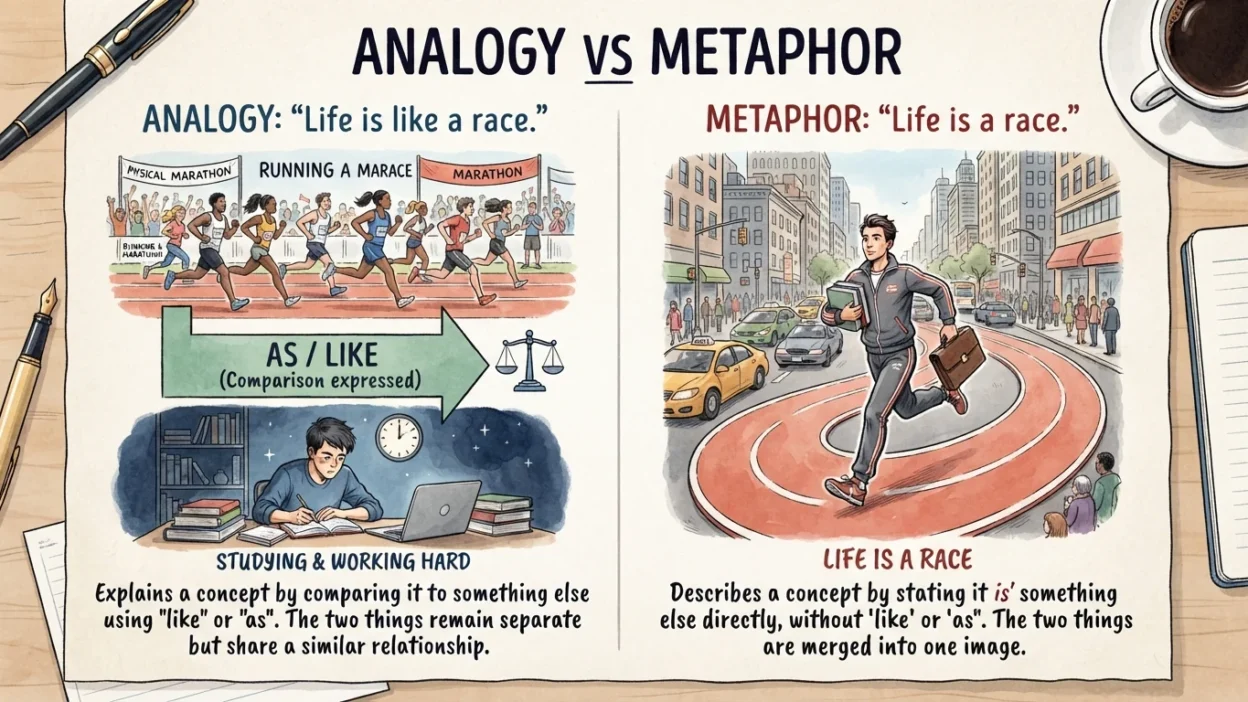
Have you ever compared one thing to another to make a difficult idea easier to understand?
If so, you have probably used an analogy or a metaphor without realizing it.
These two terms are closely related, but they do not mean exactly the same thing.
Understanding the difference can make your writing, speaking, teaching, and everyday communication much clearer.
The main difference between an analogy vs metaphor is purpose and depth.
A metaphor usually makes a direct comparison to describe something vividly,
while an analogy explains how two different things are similar in a particular way.
Both are powerful tools for explaining ideas, creating images in the reader’s mind, and making communication more memorable.
Quick Answer: Analogy vs Metaphor
An analogy is a comparison between two different things used mainly to explain or clarify an idea.
A metaphor is a figure of speech that describes one thing as another to create a vivid comparison or image.
For example:
- Metaphor: “The classroom was a zoo.”
- Analogy: “Managing a classroom is like conducting an orchestra because the teacher must coordinate many different people toward one goal.”
In simple terms, metaphors create vivid comparisons, while analogies usually explain relationships or ideas.
What Is an Analogy?
An analogy is a comparison between two things that are different but share certain similarities. The comparison helps someone understand an unfamiliar, complicated, or abstract concept by connecting it to something familiar.
Analogies are especially useful in teaching, explanations, arguments, and problem-solving.
For example:
“Learning a language is like building a house. You need a strong foundation of basic vocabulary and grammar before you can build more advanced skills.”
Learning a language and building a house are obviously different activities. However, the analogy highlights a similar relationship: both require a solid foundation before more complex elements can be added.
Examples of Analogies
Here are several everyday examples:
- “A good teacher is like a gardener because both help others grow.”
- “The human brain is like a computer in the way it processes and stores information.”
- “Running a business is like steering a ship because you have to adjust your direction when conditions change.”
- “Studying for an exam is like training for a marathon because consistent preparation matters more than last-minute effort.”
Notice that these comparisons usually have an explanatory purpose.
What Is a Metaphor?
A metaphor is a figure of speech in which one thing is described as another thing, even though the two are not literally the same.
Metaphors create mental pictures and help communicate emotions, qualities, or experiences in a memorable way.
For example:
“Her voice was music to my ears.”
Her voice is not literally music. The metaphor suggests that her voice was extremely pleasant to hear.
Another example is:
“Time is a thief.”
Time cannot literally steal things. This metaphor expresses the idea that time seems to take moments, opportunities, and parts of our lives away from us.
Examples of Metaphors
- “The city is a jungle.”
- “He has a heart of stone.”
- “Her smile was sunshine.”
- “The news gave me a wave of anxiety.”
- “Life is a journey.”
- “His words were weapons.”
Metaphors are common in literature, speeches, advertising, journalism, conversations, and creative writing.
Analogy vs Metaphor: The Main Difference
The easiest way to distinguish an analogy from a metaphor is to consider what the comparison is trying to accomplish.
A metaphor generally makes a comparison to create an image, emotion, or impression.
An analogy generally develops a comparison to explain how something works or why two situations are similar.
| Feature | Analogy | Metaphor |
|---|---|---|
| Main purpose | Explain or clarify | Create an image or impression |
| Structure | Often more developed | Usually shorter |
| Comparison | Explains a relationship | Directly compares one thing with another |
| Common use | Teaching, reasoning, explanations | Literature, conversation, creative writing |
| Example | “Learning is like climbing a mountain because progress takes effort.” | “Learning is a mountain.” |
| Level of detail | Can contain several similarities | Often focuses on one main comparison |
Analogy vs Metaphor Examples Side by Side
Seeing the two forms together makes the distinction easier.
Example 1: Life
Metaphor:
“Life is a journey.”
This creates a simple image. Life is being compared to a journey.
Analogy:
“Life is like a journey because you encounter unexpected turns, make choices about where to go, and learn from the places you have already visited.”
The analogy expands the comparison and explains the similarities.
Example 2: The Internet
Metaphor:
“The Internet is an ocean.”
This creates a vivid image of something enormous and difficult to explore completely.
Analogy:
“The Internet is like an ocean because it contains enormous amounts of information, and finding reliable material can be like navigating through deep water.”
The analogy explains why the comparison makes sense.
Example 3: A Difficult Exam
Metaphor:
“The exam was a monster.”
This emphasizes how frightening or difficult the exam felt.
Analogy:
“Preparing for the exam was like training for a long-distance race because success depended on regular preparation rather than one burst of effort.”
Here, the comparison explains the process rather than simply creating an image.
Is Every Metaphor an Analogy?
Not necessarily.
This is one of the most common points of confusion.
A metaphor can contain an analogy-like comparison, but not every metaphor develops a detailed relationship between two things.
For example:
“She is a star.”
This metaphor compares the woman to a star, perhaps suggesting that she is talented, admired, or impressive.
It does not explain several similarities between her and a star. Therefore, it works primarily as a metaphor.
An analogy, by contrast, normally makes the relationship more explicit.
“She is like a star because her talent attracts attention wherever she performs.”
The second example gives the reader a reason for the comparison.
Is Every Analogy a Metaphor?
No.
An analogy can use metaphorical language, but an analogy is broader than a simple metaphor.
For example:
“The heart works like a pump.”
This is an analogy because it compares the function of the heart to something familiar to help explain how it works.
It does not necessarily mean the heart literally is a mechanical pump.
Analogies are frequently used in science, education, technology, medicine, and everyday explanations.
Why Do Writers Use Metaphors?
Metaphors make language more vivid and emotionally powerful.
Instead of saying:
“He was very angry.”
a writer might say:
“He was a volcano ready to erupt.”
The metaphor immediately creates an image of intense, uncontrollable anger.
Metaphors can help writers:
- Make abstract ideas easier to imagine
- Express emotions
- Create memorable descriptions
- Add personality to writing
- Make stories more engaging
- Communicate complex feelings indirectly
Good metaphors are especially useful when literal language feels flat or ordinary.
Why Do Writers Use Analogies?
Analogies are particularly valuable when the reader needs to understand something rather than simply visualize it.
Teachers, speakers, and writers use analogies to break complicated concepts into familiar ideas.
For example, someone explaining computer memory to a beginner might say:
“Computer memory is like a workspace where information is kept temporarily while you are using it.”
The comparison gives the learner a familiar mental model.
Analogies can also strengthen an argument by showing how one situation resembles another.
Common Mistakes With Analogy and Metaphor
1. Treating the terms as exact synonyms
Although both involve comparison, they are not interchangeable in every context.
A metaphor is generally a figure of speech, while an analogy is usually a more developed comparison used for explanation or reasoning.
2. Assuming an analogy must use “like” or “as”
Many analogies use “like” or “as,” but this is not a requirement.
The important feature is the explanatory relationship between the two things being compared.
3. Making an analogy too complicated
A long analogy can become confusing if it contains too many unnecessary similarities.
Choose one clear relationship and develop it naturally.
4. Using a metaphor that is too vague
A metaphor should give readers something meaningful to connect with.
Instead of writing:
“The meeting was a thing.”
a stronger metaphor might be:
“The meeting was a battlefield.”
The second version communicates tension and conflict immediately.
5. Taking metaphors literally
Expressions such as “break the ice” or “he has a heart of stone” are not normally intended literally.
Understanding figurative language requires considering the context.
Analogy vs Metaphor in Academic Writing
Both can be useful in academic writing, but they should be used carefully.
Analogies are often helpful when explaining complicated theories or concepts to general readers. They can make technical information more accessible.
Metaphors can also improve academic communication, especially when describing abstract concepts. However, overly creative metaphors may make formal writing less precise.
For academic or professional writing, always make sure the comparison supports the actual point rather than distracting from it.
Analogy vs Metaphor in Everyday English
You encounter both forms constantly in ordinary conversation.
Someone might say:
“My boss is a machine.”
This is a metaphor suggesting that the boss works extremely hard or efficiently.
Someone might explain:
“Running a small business is like juggling because you have to keep several responsibilities in the air at once.”
That is an analogy because the comparison helps explain the experience.
You do not need to consciously label these expressions while speaking. Understanding the distinction simply helps you choose the right technique when writing or explaining something.
American vs British English: Is There a Difference?
There is no major difference between American and British English in the definitions or basic use of analogy and metaphor.
Both varieties of English use these forms of figurative language in broadly the same way.
Some vocabulary, spelling, or cultural references surrounding a comparison may differ between American and British audiences, but the distinction between an analogy and a metaphor remains essentially the same.
For example, an American or British writer can use:
“Learning is a journey.”
as a metaphor and:
“Learning a new skill is like learning to ride a bicycle because practice gradually builds confidence.”
as an analogy.
How to Choose Between an Analogy and a Metaphor
Ask yourself what you want the comparison to do.
Choose a metaphor when you want to:
- Create a strong mental picture
- Express emotion
- Make language memorable
- Add creativity to your writing
- Describe something vividly
Choose an analogy when you want to:
- Explain a complicated idea
- Teach a new concept
- Show how two situations are related
- Make an argument easier to understand
- Connect unfamiliar information to something familiar
A useful rule is:
If the comparison mainly paints a picture, think metaphor. If it mainly explains a relationship, think analogy.
Frequently Asked Questions
What is the main difference between analogy and metaphor?
A metaphor makes a direct figurative comparison, often to create an image or emotional effect. An analogy usually explains a relationship between two different things by showing how they are similar.
Is “life is a journey” a metaphor or analogy?
“Life is a journey” is primarily a metaphor. If you explain that life resembles a journey because it involves choices, unexpected turns, destinations, and lessons along the way, the comparison becomes an analogy.
Can an analogy contain a metaphor?
Yes. An analogy can use metaphorical language as part of a larger explanation. The two concepts can overlap, but their purposes are not identical.
What is an easy example of a metaphor?
“She has a heart of stone” is a simple metaphor. It does not mean her heart is literally made of stone; it suggests that she is emotionally cold or unwilling to show compassion.
What is an easy example of an analogy?
“Learning vocabulary is like planting seeds because repeated practice helps knowledge grow over time.” This compares two different processes to explain how learning develops.
Which is better for teaching: analogy or metaphor?
An analogy is often more useful for teaching because it can explain relationships in detail. However, a well-chosen metaphor can make a lesson memorable and give students a strong mental image.
Are analogy and simile the same thing?
No. A simile explicitly compares two things using words such as “like” or “as.” An analogy can be more extended and explanatory, while a metaphor makes a figurative comparison directly.
Final Summary
The difference between analogy vs metaphor becomes much easier to understand when you focus on purpose. A metaphor usually creates a vivid comparison, helping readers picture an idea or feel an emotion. An analogy goes further by explaining a similarity or relationship between two different things. For example, “He is a rock” is a metaphor, while explaining that someone is like a rock because they remain dependable during difficult situations is an analogy.
Both are valuable forms of figurative language. Metaphors can make writing expressive and memorable, while analogies can make complex ideas easier to understand. When choosing between them, ask yourself whether you want to create an image or explain a connection. That simple question will usually point you in the right direction.
Actionable Takeaway
Before using a comparison in your writing, decide what you want your reader to understand. If you need a quick, vivid image, use a metaphor. If you need to explain why two things are similar or how an unfamiliar idea works, use an analogy. Practice turning one metaphor into a longer analogy, and you will quickly become more confident with both forms of language.

John Robert is a passionate author and faith-driven writer who contributes insightful and inspiring biblical content to Biblenast. With a strong commitment to sharing God’s Word, he focuses on creating meaningful messages that encourage spiritual growth, reflection, and daily guidance. His work aims to connect readers with the timeless teachings of the Bible.