Bobble vs bauble is a surprisingly common spelling and vocabulary confusion.
The two words look and sound somewhat similar, but they describe completely different things.
One can refer to a small round decoration, movement, or ornament on clothing, while the other usually means a small decorative object, especially something used for Christmas decorations.
Knowing the difference between bobble vs bauble can help you avoid embarrassing spelling mistakes in emails, articles, shopping descriptions, and everyday writing.
Although both words are perfectly valid English, choosing the right one depends entirely on what you are trying to describe.
Quick Answer: Bobble vs Bauble
Bobble usually means a small ball or rounded decoration, or a repeated up-and-down movement. It can also describe a small pom-pom-like object attached to clothing.
Bauble means a small decorative object, especially a colorful ornament hung on a Christmas tree. In British English, bauble is particularly common for Christmas ornaments.
Easy memory tip:
- Bobble = ball-like object or bouncing movement
- Bauble = decorative ornament
What Does Bobble Mean?
The word bobble has several meanings, depending on context.
As a noun, a bobble can be a small rounded object, often made from wool, fabric, or another soft material. For example, a knitted hat may have a bobble on top.
A bobble can also describe a small raised area or lump. In clothing, you may hear someone talk about “bobbling” when small balls of fiber form on a sweater after repeated washing and wearing.
As a verb, to bobble means to move with small, repeated bouncing or jerking motions. It can also mean to mishandle something, particularly in sports.
Examples of “bobble”
- She wore a woolly hat with a red bobble.
- The ball began to bobble across the wet field.
- My new sweater has started to bobble after several washes.
- He bobbled the football and lost possession.
- The baby’s toy had colorful bobbles attached to it.
The exact meaning is therefore determined by context.
What Does Bauble Mean?
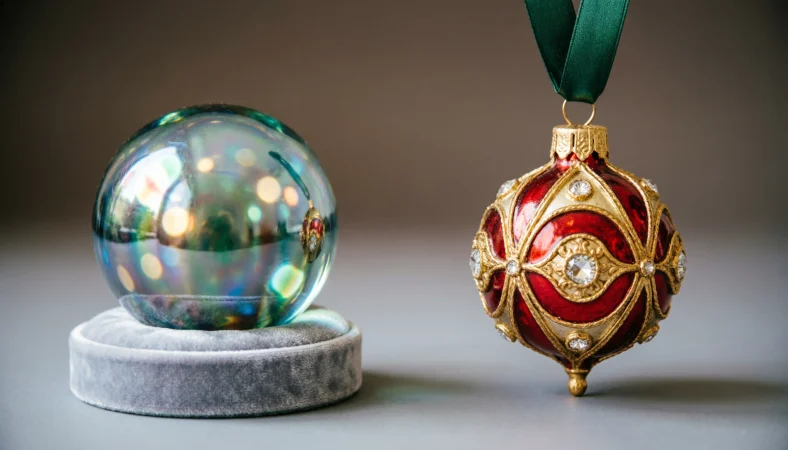
A bauble is a small, decorative object. The word is especially associated with Christmas tree ornaments.
A Christmas bauble may be made of glass, plastic, wood, metal, or another material. It is commonly round, colorful, and designed to hang from a Christmas tree.
For example:
- We bought gold and silver baubles for the Christmas tree.
- The children carefully hung each bauble on the branches.
- A red bauble fell from the tree and broke.
- The shop sells handmade Christmas baubles.
The word can also be used more broadly for a small, attractive but sometimes inexpensive decorative object.
In some contexts, bauble can carry a slightly dismissive meaning. Someone might describe jewelry or decorative possessions as “baubles” when suggesting that they are attractive but not particularly valuable or important.
Bobble vs Bauble: Side-by-Side Comparison
| Feature | Bobble | Bauble |
|---|---|---|
| Basic meaning | Small rounded object or bouncing movement | Small decorative object |
| Common association | Hats, fabric, sports, movement | Christmas trees and ornaments |
| Part of speech | Noun and verb | Mainly noun |
| Example | A bobble on a hat | A bauble on a Christmas tree |
| Common phrase | Bobble hat | Christmas bauble |
| Meaning in sports | Mishandle a ball | Not normally used |
| Decorative use | Small pom-pom-like decoration | Ornament or trinket |
The most important distinction is simple: a bobble is often associated with shape or movement, while a bauble is associated with decoration.
Why Are Bobble and Bauble Confused?
There are several reasons these words cause confusion.
First, they have very similar spellings. Both begin with b and contain the letters b, b, and l. When typing quickly, it is easy to substitute one for the other.
Second, both words can describe small decorative objects. A bobble can be attached to a hat or piece of clothing, while a bauble can hang from a Christmas tree.
Third, pronunciation can sometimes contribute to uncertainty, particularly for people learning English as a second language.
The solution is to focus on meaning rather than appearance.
Bobble Examples in Everyday English
Understanding real-life examples makes the distinction easier.
Clothing
A bobble hat is a knitted hat with a soft ball or pom-pom attached to the top.
He put on his bobble hat before going outside.
In British English, bobble hat is a familiar expression.
Hair accessories
A bobble can also refer to a small elastic hair tie, particularly in British usage.
She tied her hair back with a black bobble.
American English speakers may be more likely to say hair tie, elastic, or hair band, depending on the type.
Sports
In sports, bobble can mean to fail to control a ball cleanly.
The goalkeeper bobbled the ball before recovering it.
Here, bobble is clearly about movement or handling, not decoration.
Bauble Examples in Everyday English
The most familiar use of bauble involves Christmas.
We decorated the tree with colorful baubles.
You might also see the word in retail descriptions:
These handmade glass baubles make beautiful Christmas decorations.
Bauble can also be used figuratively:
The necklace was dismissed as nothing more than a glittering bauble.
In this sentence, the word emphasizes the decorative or ornamental nature of the item.
Common Mistakes With Bobble and Bauble
Mistake 1: Calling a Christmas ornament a “bobble”
If you mean a Christmas tree ornament, bauble is normally the better word, particularly in British English.
Incorrect in the intended sense:
We bought twenty Christmas bobbles.
Better:
We bought twenty Christmas baubles.
Mistake 2: Calling a pom-pom a “bauble”
A soft ball attached to the top of a winter hat is generally a bobble or pom-pom, not a bauble.
She wore a blue hat with a large bobble.
Mistake 3: Assuming they are interchangeable
They are not interchangeable simply because both can refer to small objects.
Compare:
The hat has a bobble.
The Christmas tree has a bauble.
Changing the words changes the meaning or makes the sentence sound unnatural.
American vs British English Differences
The distinction becomes especially useful when comparing British and American vocabulary.
Bauble is strongly associated with British English when referring to Christmas tree ornaments. In American English, Christmas ornament is often more common.
For example:
British English:
We bought some new Christmas baubles.
American English:
We bought some new Christmas ornaments.
That does not mean Americans never use bauble. The word exists in American English too, but ornament is generally more natural in everyday American speech for Christmas decorations.
The word bobble also has several British uses. For example, British speakers commonly say bobble hat and may use bobble for a hair elastic. American speakers often use alternatives such as pom-pom, beanie with a pom-pom, or hair tie.
Bobble Hat vs Christmas Bauble
This is one of the easiest ways to remember the difference.
A bobble hat is something you wear.
A Christmas bauble is something you hang on a Christmas tree.
Think:
Hat → bobble
Tree → bauble
This simple association can prevent most spelling errors.
Is Bauble Always Related to Christmas?
No. Although Christmas is the most common modern association, bauble has a broader meaning.
A bauble can be any small decorative item or trinket. Historically and figuratively, the word has sometimes been used for objects considered attractive but of limited practical or financial value.
For example:
The antique shop was filled with colorful baubles and ornaments.
However, if you are writing about Christmas decorations, bauble is an especially natural choice in British English.
Is Bobble Always a Decorative Object?
No. This is another important distinction.
A bobble can refer to:
- A small ball or pom-pom
- A raised piece of material
- A hair elastic in British English
- A bouncing or uneven movement
- A mistake while handling a ball in sports
For example, to bobble a ball has nothing to do with decoration.
This variety of meanings makes bobble much more flexible than bauble.
A Simple Memory Trick
If you regularly confuse these words, use this trick:
Bobble has “BO” like “bounce.”
A bobble can bounce, move, or describe a round object.
Bauble has “BA” like “beautiful accessory.”
A bauble is generally decorative.
This is not an official linguistic rule, but it is a useful memory aid when writing quickly.
When Should You Use Bobble or Bauble?
Use bobble when you mean:
- A pom-pom
- A rounded lump
- A small fabric ball
- A hair elastic in some varieties of British English
- A bouncing or jerky movement
- Mishandling a ball in sports
Use bauble when you mean:
- A Christmas tree ornament
- A small decorative object
- A trinket
- An ornamental possession
When in doubt, ask yourself whether the object is primarily being described because of its shape or movement or because it is a decoration.
FAQs About Bobble vs Bauble
Is a Christmas ornament called a bobble or bauble?
In British English, a Christmas tree ornament is commonly called a bauble. In American English, Christmas ornament is more common.
Is a pom-pom a bobble?
Yes. A small rounded pom-pom, especially one attached to a hat, can be called a bobble, particularly in British English.
Are bobble and bauble pronounced the same?
They can sound quite similar, but they are different words with different meanings. Pronunciation can also vary slightly by accent.
What is a bobble hat?
A bobble hat is a knitted or winter hat with a soft rounded decoration, or bobble, attached to the top.
What is a Christmas bauble?
A Christmas bauble is a decorative ornament hung on a Christmas tree, often made from glass, plastic, or another decorative material.
Is “bauble” more British than American?
It is strongly associated with British English in the context of Christmas decorations. American speakers more commonly use ornament.
Can bauble mean jewelry?
Yes. Bauble can refer to a small decorative object or piece of jewelry, particularly when the speaker wants to emphasize its ornamental rather than practical value.
Summary: Bobble vs Bauble
The difference between bobble vs bauble becomes easy once you focus on meaning.
A bobble can be a small rounded object, a pom-pom, a bouncing movement, or even a mistake when handling a ball. A bauble, meanwhile, is primarily a decorative object, especially a Christmas tree ornament.
In British English, you are particularly likely to encounter bobble hat, hair bobble, and Christmas bauble.
American English often uses pom-pom, hair tie, and Christmas ornament instead. The words may look alike, but they are not interchangeable.
Actionable Takeaway
Before choosing the word, ask: “Am I describing a bobbing/round object or a decorative ornament?”
- Round, soft, bouncing, or attached to a hat → bobble
- Christmas decoration or decorative trinket → bauble
Remembering that one distinction will help you spell and use both words confidently.

Michael James is the administrator and a dedicated author at Biblenast, responsible for managing the platform and ensuring quality content. Alongside his administrative role, he writes insightful biblical articles that inspire faith, reflection, and spiritual growth. His work supports the mission of making God’s Word accessible and meaningful.