
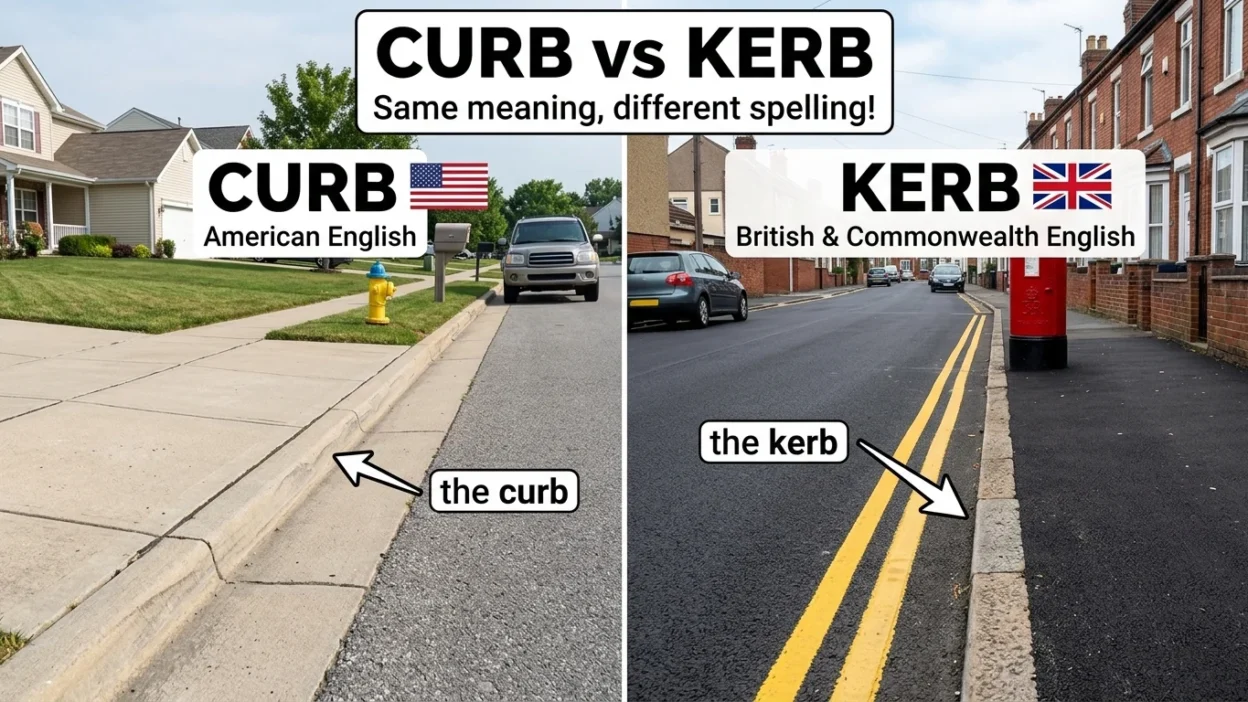
Have you ever wondered whether to write curb vs kerb when describing the edge of a sidewalk or pavement?
Both spellings are correct, and they refer to the same thing in this context.
However, choosing the right spelling depends mainly on whether you are following American or British English.
The difference is simple, but it can be confusing for students, English learners, writers, and anyone who communicates with an international audience.
One spelling is standard in the United States, while the other is commonly used in the United Kingdom and several other English-speaking regions.
Interestingly, curb also has a separate meaning as a verb: to control, limit, or restrain something.
Understanding these distinctions will help you choose the correct word for essays, emails, professional documents, and everyday conversations.
Quick Answer: Curb vs Kerb
Curb is the standard American English spelling, while kerb is the standard British English spelling for the raised edge between a road and a sidewalk or pavement.
- Curb: American English — “The car stopped beside the curb.”
- Kerb: British English — “The car stopped beside the kerb.”
- Verb meaning: Curb means to control or limit something, as in “We must curb unnecessary spending.”
- Easy rule: Use curb for American audiences and kerb for British audiences when referring to the edge of a road.
What Does Curb Mean?
The word curb has two common meanings in English. It can refer to a physical structure beside a road or describe the act of controlling or limiting something.
1. Curb as a Noun
As a noun, curb refers to a raised edge, usually made of concrete or stone, that separates a road from a sidewalk, pavement, or another area.
In American English, this spelling is widely used in everyday conversation, road construction, transportation, and property descriptions.
Examples of curb in a sentence:
- She sat on the curb while waiting for her friend.
- The driver pulled over and parked near the curb.
- Please do not leave your bicycle on the curb.
- The city repaired the damaged curb outside the school.
- The delivery truck stopped at the curb to unload its packages.
In these examples, curb describes a physical feature of a street.
2. Curb as a Verb
As a verb, curb means to control, restrain, reduce, or limit something. It is often used when discussing behavior, spending, emotions, habits, or problems.
Examples of curb as a verb:
- The government introduced new measures to curb inflation.
- She tried to curb her anger during the discussion.
- Parents can help children curb excessive screen time.
- The company wants to curb unnecessary expenses.
- Regular exercise may help curb feelings of stress for some people.
Notice that the verb is spelled curb, not kerb. Even in British English, the verb generally retains the spelling curb.
What Does Kerb Mean?
Kerb is the British English spelling of the noun curb when it refers to the raised edge separating a road from a pavement or sidewalk.
The meaning is exactly the same. The difference lies in regional spelling conventions rather than definition, pronunciation, or function.
In the United Kingdom, kerb is the conventional spelling used in road design, highway maintenance, construction documents, and everyday writing.
Examples of kerb in a sentence:
- The pedestrian waited at the kerb before crossing the road.
- The council replaced the broken kerb outside the library.
- Please park your car close to the kerb.
- Rainwater flowed along the kerb after the storm.
- A cyclist carefully avoided the high kerb near the junction.
In British English, you will commonly see kerb on signs, in local council documents, and in discussions about street maintenance.
Curb vs Kerb: Key Differences at a Glance
The easiest way to understand these words is to compare their spelling, usage, and regional preferences.
| Feature | Curb | Kerb |
|---|---|---|
| Main usage | American English | British English |
| Part of speech for road edge | Noun | Noun |
| Meaning | Raised road edge | Raised road edge |
| Pronunciation | /kɜːrb/ | /kɜːb/ |
| Verb meaning control or limit | Yes | No, not in standard usage |
| Common context | US road and sidewalk terminology | UK road and pavement terminology |
| Example | Sit on the curb. | Sit on the kerb. |
The pronunciation may vary slightly by accent, but the two nouns generally sound alike or very similar within the same regional variety of English.
Why Are Curb and Kerb Spelled Differently?
English spelling varies across countries because of historical developments, regional preferences, and changes in how words have been standardized.
The spelling curb is standard in American English for the raised edge of a road. British English traditionally uses kerb to distinguish this physical structure from the verb curb, which means to restrain or control.
Both spellings have become established in their respective varieties of English. Neither is inherently more correct than the other.
This is similar to other regional spelling differences, such as:
- Color (American English) vs colour (British English)
- Center (American English) vs centre (British English)
- Tire (American English) vs tyre (British English)
- Gray (American English) vs grey (British English)
These differences are part of normal English usage. The best choice depends on your audience and the style of English you are following.
American English vs British English
Regional spelling is the most important factor when deciding between curb and kerb.
Curb in American English
American writers use curb for both the physical edge of a street and the verb meaning to limit or control.
For example:
- The car was parked beside the curb.
- The city plans to lower the curb near the crossing.
- We need to curb rising costs.
In the United States, writing kerb to describe a road edge may look unfamiliar or inconsistent with American spelling conventions.
Kerb in British English
British writers generally use kerb for the physical edge of a road. However, they still use curb as a verb meaning to control or restrain.
For example:
- The car stopped beside the kerb.
- The workers repaired the kerb outside the station.
- The new policy aims to curb pollution.
This distinction is especially useful for writers producing content for international readers.
What About Other English-Speaking Countries?
Usage may vary across English-speaking countries. British-style spelling conventions are common in places such as Australia and New Zealand, where kerb is generally used for the roadside structure.
However, individual organizations, technical publications, and international style guides may have their own preferences. When writing for a particular country or institution, follow its established spelling standards.
Curb vs Kerb: Practical Examples in Everyday English
Seeing the words in context makes the difference easier to remember.
| Context | American English | British English |
|---|---|---|
| Parking | Park next to the curb. | Park next to the kerb. |
| Road repairs | The curb needs fixing. | The kerb needs fixing. |
| Pedestrian safety | Stay away from the curb. | Stay away from the kerb. |
| Construction | The contractor installed a new curb. | The contractor installed a new kerb. |
| Controlling costs | We need to curb spending. | We need to curb spending. |
The last example is particularly important. The verb curb does not change to kerb in British English.
Common Mistakes When Using Curb and Kerb
Although these words are easy to understand, a few common errors can affect spelling consistency and clarity.
1. Using Kerb in American English
If you are writing for an American audience, use curb when referring to the raised edge of a road.
Incorrect for standard American usage: “The driver parked beside the kerb.”
Preferred: “The driver parked beside the curb.”
The first spelling is not impossible to understand, but it does not follow conventional American spelling.
2. Using Curb and Kerb Interchangeably in One Article
Mixing both spellings without a reason can make an article look inconsistent.
For example, writing “The car stopped at the curb” in one paragraph and “The workers repaired the kerb” in another may confuse readers if both sentences follow the same regional style.
Tip: Choose American or British English before you start writing, and apply that choice consistently.
3. Writing Kerb as a Verb
In standard modern English, curb is the usual spelling for the verb meaning to restrain or limit.
Incorrect: “The company wants to kerb its spending.”
Preferred: “The company wants to curb its spending.”
This distinction remains important even when the rest of the article follows British English.
4. Assuming the Words Have Different Meanings
When referring to the edge of a road, curb and kerb describe the same feature. The difference is regional spelling, not meaning.
Do not waste time trying to identify a physical difference between them. Focus instead on your intended audience.
5. Forgetting Your Audience
A spelling choice that looks natural to one audience may look unusual to another.
For example, an American blog should generally use curb, while a British local council website should generally use kerb for road edges.
Consistency makes writing easier to read and helps establish a professional style.
Related Words and Expressions
Understanding related vocabulary can help you use these terms more naturally.
- Sidewalk: The American English term for a path alongside a road for pedestrians.
- Pavement: The usual British English term for a pedestrian path alongside a road.
- Roadside: The area along the side of a road.
- Curbside: The area next to a curb, especially where vehicles stop or park.
- Curb appeal: The visual attractiveness of a property when viewed from the street.
- Curb one’s enthusiasm: An expression meaning to restrain or moderate excitement.
- Curb spending: To reduce or control expenditure.
- Kerb stone: A stone or concrete unit forming the edge of a road or pavement.
These expressions show how curb and kerb fit into everyday English, construction terminology, transportation, and figurative language.
How to Remember Curb vs Kerb
A simple memory trick can help you choose the correct spelling without looking it up.
Remember: America uses C for curb. Britain uses K for kerb.
Think of the letter C in curb as a reminder of the United States. When writing about the physical edge of a road for a British audience, remember the K in kerb.
You can also remember the verb rule:
If you mean to control or limit something, use curb.
For example:
- Curb pollution.
- Curb your spending.
- Curb your anger.
- Curb excessive screen time.
This rule works in both American and British English.
Frequently Asked Questions (FAQs)
1. Is curb or kerb correct?
Both are correct. Curb is the standard American English spelling for the edge of a road, while kerb is the standard British English spelling.
2. Is kerb British or American?
Kerb is primarily British English. It is commonly used in the United Kingdom and in other regions that follow British spelling conventions.
3. Do curb and kerb mean the same thing?
Yes. When referring to a raised edge beside a road or pavement, both words have the same meaning. The difference is regional spelling.
4. Is curb used in British English?
Yes. British English uses curb as a verb meaning to control, limit, or restrain something. For example, “The government hopes to curb inflation.”
5. Is kerb used in American English?
Kerb may appear in American writing when quoting British material or discussing British terminology, but curb is the standard American spelling for the roadside structure.
6. How do you spell curb in the UK?
It depends on the meaning. Use kerb for the raised edge of a road and curb for the verb meaning to control or limit something.
7. Is curb appeal or kerb appeal correct?
Both expressions are correct in their respective varieties of English. Curb appeal is standard in American English, while kerb appeal is common in British English. Both refer to the attractiveness of a property when viewed from the street.
8. What is the plural of curb and kerb?
The plural forms are curbs and kerbs, respectively. For example, an American writer might describe damaged curbs, while a British writer might refer to damaged kerbs.
Final Summary: Curb vs Kerb
The difference between curb and kerb is mainly a matter of regional spelling. American English uses curb for the raised edge between a road and a sidewalk, while British English generally uses kerb for the same feature. Both words refer to the same physical structure, and neither spelling is universally better than the other. The right choice depends on the audience you are writing for.
There is one important rule to remember: the verb is spelled curb in both American and British English when it means to control, limit, or restrain something. If you are writing for American readers, use curb consistently. If you are writing for British readers, use kerb for the road edge but retain curb in expressions such as “curb spending.” By following this simple distinction, you can avoid common spelling mistakes and write with greater confidence.
Actionable takeaway: Before publishing an article, check whether your target audience follows American or British English, then use the appropriate spelling consistently throughout the text.

David William is a dedicated writer and spiritual enthusiast with a deep passion for sharing biblical wisdom. As the author behind Biblenast, he focuses on delivering meaningful scripture-based content that inspires faith, reflection, and daily guidance. His mission is to make the teachings of the Bible accessible, uplifting, and relevant to modern life.