
Choosing the correct preposition can be surprisingly difficult, especially when talking about education, courses, schools, and training programs.
Should you say enroll in a course, enroll at a university, or enroll on a course? All three expressions appear in English, but they are not always interchangeable.
The right choice depends on what you are enrolling in and which variety of English you are using.
The good news is that you do not need to memorize complicated grammar rules to use these phrases correctly.
Once you understand the difference between in, at, and on, you can write more naturally and confidently.
If you are a student filling out an application, an English learner improving your grammar, or a professional writing an email,
this guide explains the meanings, practical examples, regional differences, and common mistakes to help you choose the right expression.
Quick Answer: Enroll In or Enroll At or Enroll On
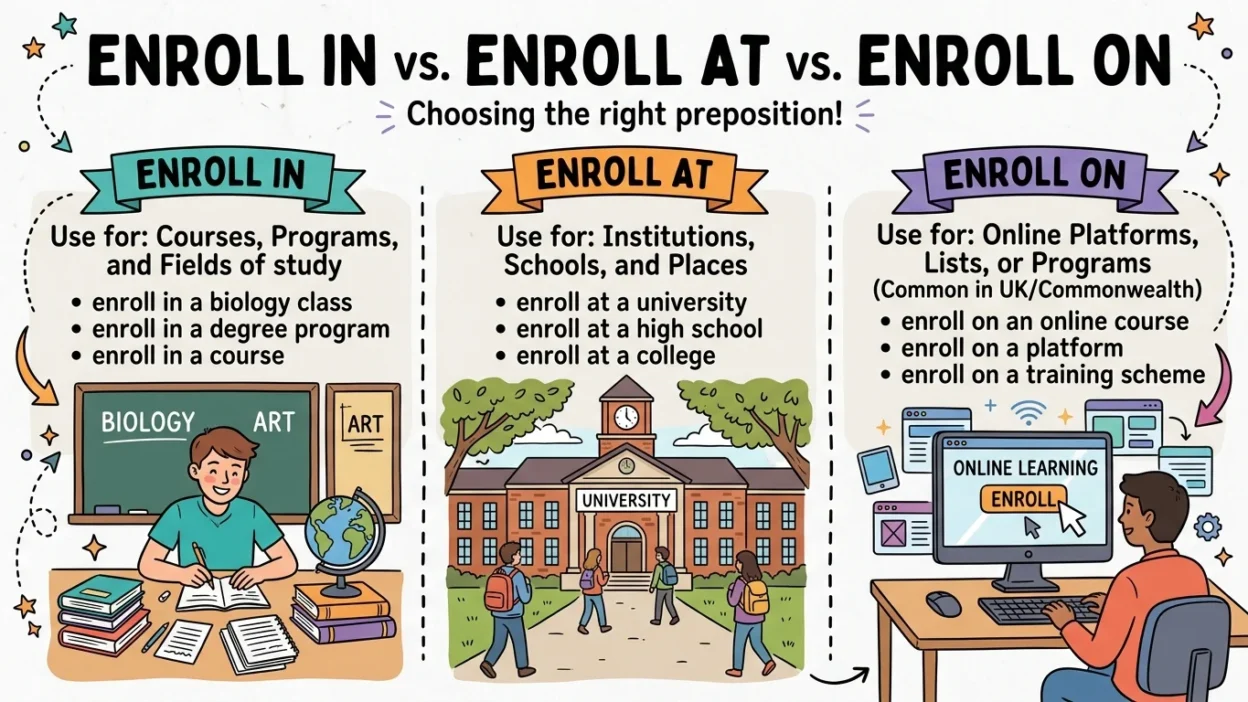
Enroll in is generally used for a course, program, class, or educational activity. Enroll at is commonly used when referring to the institution where someone registers. Enroll on is especially common in British English when talking about a course or program.
- Enroll in a course: She enrolled in an English course.
- Enroll at a university: He enrolled at Oxford University.
- Enroll on a course: She enrolled on a photography course.
In American English, enroll in a course is usually the preferred expression. In British English, both enroll on a course and enroll in a course are used, although enrol is the traditional British spelling.
What Does Enroll Mean?
The verb enroll means to officially register or sign up for a course, educational institution, program, activity, or service. It usually involves completing a registration process so that you can participate in something.
For example:
- I want to enroll in a computer science course.
- She enrolled at a local college.
- They enrolled on a professional development program.
The word can also be used outside education. People enroll in health insurance plans, training programs, membership schemes, and other organized services.
The spelling varies by region. American English generally uses enroll, while British English traditionally uses enrol. The corresponding forms are enrolling and enrolled in American English, and enrolling and enrolled are also standard in British English.
The main challenge is choosing the right preposition after the verb.
When to Use Enroll In
Use enroll in when you want to emphasize the course, program, class, subject, or activity that someone is joining.
This is the most widely recommended choice in American English and is also correct in British English.
Examples of Enroll In
- I plan to enroll in an online marketing course.
- She enrolled in a nursing program last year.
- My brother wants to enroll in a driving class.
- They enrolled in a professional training program.
- Several students enrolled in the advanced mathematics course.
- He decided to enroll in a master’s degree program.
In each sentence, the preposition in introduces the educational activity or program.
Enroll In for Online Courses
The phrase enroll in is particularly natural when discussing online learning, digital classes, and distance education.
Examples include:
- You can enroll in the course through the university website.
- I enrolled in an online English class to improve my writing.
- Thousands of learners enrolled in the free coding program.
The same rule applies whether the course takes place online, in a classroom, or through a combination of both.
Enroll In Beyond Education
You can also use enroll in for programs and services that are not traditional academic courses.
Examples:
- She enrolled in a health insurance plan.
- We enrolled in the company’s retirement program.
- He enrolled in a fitness membership program.
Remember: If the focus is on the course, class, or program itself, enroll in is usually a safe and natural choice.
When to Use Enroll At
Use enroll at when you want to identify the school, college, university, or other institution where someone registers or becomes a student.
The preposition at emphasizes the place or organization rather than the particular course.
Examples of Enroll At
- She enrolled at a private university.
- He enrolled at Harvard University last autumn.
- My cousin enrolled at a local community college.
- They enrolled at the technical institute near their home.
- I hope to enroll at a university next year.
These examples focus on the educational institution rather than a specific class.
Enroll At vs Enroll In a University
Both phrases can be correct when talking about university enrollment, but their emphasis differs.
- Enroll at a university: Focuses on the institution.
- Enroll in a university program: Focuses on the program of study.
Compare these sentences:
- Maria enrolled at the university in September.
- Maria enrolled in a business administration program in September.
The first tells us where Maria registered. The second identifies what she registered to study.
In everyday English, enroll in a university is also widely used, particularly in American English. Therefore, the distinction is a helpful guideline rather than an absolute rule.
When to Use Enroll On
Use enroll on when referring to a course or training program, especially in British English.
This expression is common in British educational contexts, including vocational training, professional qualifications, and university courses. American speakers generally prefer enroll in for the same meaning.
Examples of Enroll On
- She enrolled on a photography course.
- He enrolled on a teacher training program.
- I would like to enroll on an evening English course.
- Several employees enrolled on a leadership development course.
- They enrolled on a course in digital design.
These sentences are natural in British English. An American writer would generally use enrolled in instead.
Is Enroll On Incorrect?
No. Enroll on is an established expression, particularly in British English. However, it may sound less natural to American readers.
For example:
- British English: She enrolled on a history course.
- American English: She enrolled in a history course.
If you are writing for an international audience, enroll in a course is often the clearest option because it is broadly understood and widely used.
Enroll In vs Enroll At vs Enroll On: Comparison Table
The following table summarizes the main differences.
| Phrase | Main purpose | Typical usage | Example |
|---|---|---|---|
| Enroll in | Identifies a course or program | American and British English | I enrolled in a science course. |
| Enroll at | Identifies an institution | American and British English | She enrolled at the college. |
| Enroll on | Identifies a course or program | Particularly British English | He enrolled on a training course. |
The choice depends on the context, the intended meaning, and the audience. In some situations, more than one preposition may be acceptable, but the emphasis can change.
American English vs British English
Regional differences affect both the spelling of enroll and the prepositions commonly used with it.
American English
American English generally uses the spelling enroll and favors enroll in when discussing courses and programs.
Examples:
- I enrolled in a college course.
- She enrolled at the university.
- He enrolled in an online training program.
The phrase enroll on a course is less common in standard American usage.
British English
British English traditionally spells the verb enrol, with one l. It commonly uses enrol on a course, although enrol in a course is also correct.
Examples:
- I enrolled on a business course.
- She enrolled at the university.
- He enrolled in a professional qualification program.
The spelling difference does not change the basic meaning of the verb.
| American English | British English |
|---|---|
| Enroll | Enrol |
| Enrolling | Enrolling |
| Enrolled | Enrolled |
| Enroll in a course | Enrol on or in a course |
| Enroll at a university | Enrol at a university |
If you are writing for a specific country, follow the spelling and usage conventions expected by your readers.
Common Mistakes With Enroll In, At, and On
Understanding the rules is easier when you know which mistakes to avoid.
1. Using Enroll At for Every Situation
Although enroll at is correct for institutions, it is not always the best choice for a course.
Less natural in many contexts: I enrolled at a Spanish course.
Better: I enrolled in a Spanish course.
Use in when referring to the course itself.
2. Assuming Enroll On Is Always Wrong
Some learners believe enroll on is grammatically incorrect because they have learned American English.
However, enrol on a course is common in British English. The phrase is appropriate when it matches the variety of English being used.
3. Confusing the Course With the Institution
Consider the difference:
- I enrolled at the college.
- I enrolled in a chemistry course.
The college is the institution, while chemistry is the subject of the course.
Remembering this distinction makes the correct preposition easier to identify.
4. Mixing American and British Conventions
Using enroll in one sentence and enrol in another can make a document look inconsistent.
Choose one spelling style and apply it throughout your writing. The same principle applies to other regional spelling differences.
5. Forgetting That Enroll Usually Requires a Preposition in These Examples
In sentences that identify the course or institution, a preposition is normally needed.
Incorrect: She enrolled a computer course.
Correct: She enrolled in a computer course.
However, enroll someone can be grammatical when the verb takes a direct object.
For example: The school enrolled 200 new students this year.
This is a different sentence structure, so the preposition is not required.
How to Choose the Correct Phrase
If you are unsure which expression to use, follow these simple steps.
- Identify what follows the verb. Is it a course, an institution, or a program?
- Choose the preposition. Use in for a course or program, at for an institution, and on when following common British course-related usage.
- Consider your audience. American readers generally expect enroll in a course, while British readers may naturally use enrol on a course.
- Check consistency. Keep your spelling and regional conventions consistent throughout your document.
Here is a quick practice exercise:
- She wants to enroll ___ a nursing course.
- He enrolled ___ a university in London.
- They enrolled ___ a professional training course in the UK.
Suggested answers: in, at, and on are natural choices for these examples, respectively. The third answer reflects common British usage; in would also be acceptable.
Frequently Asked Questions
1. Is it enroll in or enroll at a university?
Both can be correct. Enroll at a university emphasizes the institution, while enroll in a university program emphasizes the course or program of study.
2. Is it enroll in or enroll on a course?
Both expressions are used. Enroll in a course is standard in American English and widely understood internationally. Enroll on a course is particularly common in British English.
3. Is enroll on grammatically correct?
Yes. It is an established expression in British English, especially when referring to courses and training programs. American English generally favors enroll in.
4. Should I use enroll at or enroll in college?
Both can be correct, depending on the intended meaning and regional usage. Enroll at college emphasizes the institution, while enroll in a college course identifies a particular class. American English also commonly uses enroll in college.
5. Is it enroll in or enroll at school?
Use enroll at school when emphasizing the school as the institution. Use enroll in a school program when referring to a specific program. In American English, enroll in school is also common.
6. What is the British spelling of enroll?
The traditional British spelling is enrol, with one l. For example, British writers may say, “I enrolled on a course,” while American writers typically write, “I enrolled in a course.”
7. Is it enroll in a program or enroll on a program?
Both may occur, but enroll in a program is widely used in American and British English. Enroll on a program is also found in British usage, particularly in educational and training contexts. Follow the conventions of your intended audience.
8. Can I say enroll for a course?
Yes, enroll for a course is used in some varieties and contexts, particularly in British English. However, enroll in a course is a widely accepted choice, while enroll on a course is also common in British English.
Final Summary
The difference between enroll in, enroll at, and enroll on depends mainly on what you are talking about and which variety of English you are using. Use enroll in when focusing on a course, class, or program. Use enroll at when emphasizing the institution where someone registers. Use enroll on when referring to a course in contexts where British English conventions favor that expression. Remember that American English generally uses enroll, while British English traditionally uses enrol.
The most useful rule is to think about your intended meaning before choosing a preposition. If you are writing an email about joining an online class, enroll in a course is a clear and natural option. If you are describing where someone became a student, enroll at a university may fit better. For British readers, enrol on a course is also a natural choice. By understanding these small differences and staying consistent, you can improve your grammar and communicate more confidently.
Actionable takeaway: Use enroll in a course, enroll at an institution, and enroll on a course when following British English conventions. When in doubt, consider your audience and keep your usage consistent.

John Robert is a passionate author and faith-driven writer who contributes insightful and inspiring biblical content to Biblenast. With a strong commitment to sharing God’s Word, he focuses on creating meaningful messages that encourage spiritual growth, reflection, and daily guidance. His work aims to connect readers with the timeless teachings of the Bible.