
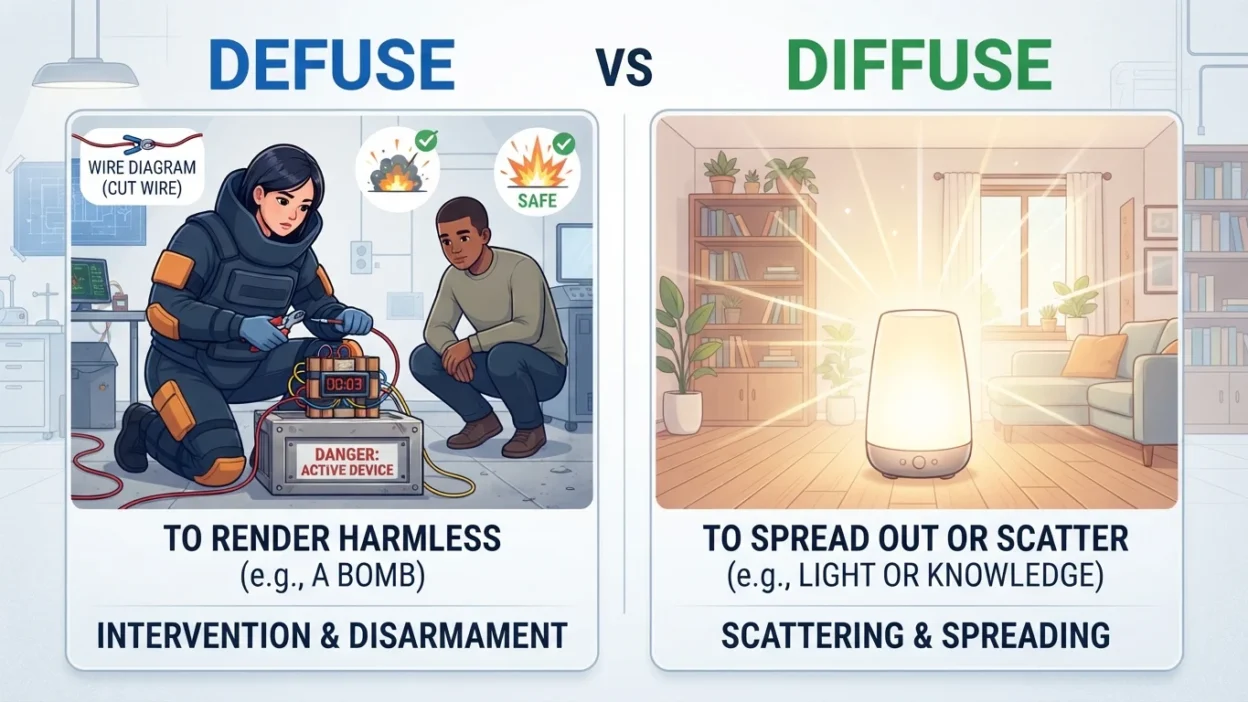
Defuse vs diffuse is one of those English word pairs that can easily trip you up.
The words look almost identical, sound similar, and can both describe something becoming less intense.
Yet they have distinct meanings, and using the wrong one can make an otherwise clear sentence inaccurate or confusing.
The simplest way to remember the difference is to focus on the action involved.
Defuse means to make something less dangerous, tense, or explosive, while diffuse means to spread something out or make it less concentrated.
If you are writing an email, an essay, a report, or a technical document, knowing when to use each word will make your English more precise and natural.
Quick Answer: Defuse vs Diffuse
Defuse means to reduce danger, tension, anger, or hostility. It can also literally mean to remove or disable the fuse of an explosive device.
Diffuse means to spread something over a wider area or make it less concentrated. It can describe light, heat, gases, smells, information, influence, and even attention.
Remember:
- Defuse = calm or neutralize
- Diffuse = spread or disperse
- Defuse a conflict
- Diffuse light
What Does Defuse Mean?
Defuse is a verb that means to make a dangerous, difficult, or tense situation less threatening.
Its original literal sense relates to explosives. To defuse a bomb means to remove or disable its fuse so that the device cannot explode as intended.
The word is now used much more frequently in a figurative sense. Someone can defuse an argument, defuse tension, or defuse a crisis by taking action that prevents a situation from becoming more serious.
For example:
The manager tried to defuse the argument before it became heated.
Here, defuse means to reduce the tension and prevent the disagreement from escalating.
Common uses of defuse
You can use defuse when talking about:
- Arguments
- Conflicts
- Tension
- Anger
- Hostility
- Crises
- Dangerous situations
- Explosive devices
- Awkward or uncomfortable situations
Related words include calm, de-escalate, neutralize, ease, and pacify, depending on the context.
What Does Diffuse Mean?
Diffuse means to spread something out over a larger area or distribute it so that it becomes less concentrated.
It can describe a physical process. For example, light can diffuse through a curtain, heat can diffuse through a material, and a scent can diffuse through a room.
For example:
The curtains diffused the harsh sunlight.
The curtains caused the light to spread more evenly and become softer.
Diffuse can also describe abstract things. Information, ideas, influence, responsibility, and attention can all become diffuse or spread across different places or people.
For example:
The new idea gradually diffused throughout the organization.
Here, the idea spread among many people.
Defuse vs Diffuse: The Main Difference
The central difference is simple:
Defuse = reduce danger or tension.
Diffuse = spread something out.
| Word | Meaning | Common Contexts | Example |
|---|---|---|---|
| Defuse | Make less dangerous or tense | Conflict, anger, crises, bombs | She tried to defuse the conflict. |
| Diffuse | Spread or disperse | Light, heat, gases, information | The clouds diffused the sunlight. |
| Defused | Made less dangerous or tense | Arguments, crises, explosives | The mediator defused the situation. |
| Diffused | Spread throughout an area | Light, heat, scents, ideas | The fragrance diffused through the room. |
If you are talking about calming something, use defuse.
If you are talking about spreading something, use diffuse.
Defuse vs Diffuse: Easy Memory Trick
A simple memory trick can save you from confusing these words again.
Think of “fuse” in defuse
The word defuse contains fuse.
A fuse is associated with an explosive device, so defuse can remind you of removing danger.
You can also associate it with a heated situation:
Defuse = take the heat out of a situation.
Think of “disperse” for diffuse
Diffuse is closely related in meaning to disperse, scatter, and spread.
So remember:
Defuse = calm it.
Diffuse = spread it.
For example:
- Defuse an argument.
- Diffuse sunlight.
That contrast is enough to distinguish the words in most situations.
Examples of Defuse in a Sentence
Here are some natural examples of defuse.
Arguments and disagreements
- The teacher stepped in to defuse the argument.
- She apologized to defuse the tension.
- The mediator helped defuse the dispute.
- He tried to defuse the situation with a calm explanation.
Anger and hostility
- Her friendly response helped defuse his anger.
- The manager used humor to defuse the customer’s frustration.
- A sincere apology can sometimes defuse hostility.
Crises and dangerous situations
- The negotiator was brought in to defuse the crisis.
- Police attempted to defuse the increasingly tense situation.
- The bomb squad successfully defused the device.
In each case, the central idea is reducing danger or tension.
Examples of Diffuse in a Sentence
Now look at examples of diffuse.
Light
- The lampshade diffused the bright light.
- Clouds diffused the sunlight.
- Frosted glass helps diffuse light evenly.
Heat and substances
- Heat gradually diffused through the metal.
- The smell diffused throughout the house.
- The gas quickly diffused into the surrounding air.
Information and ideas
- The internet allows information to diffuse rapidly.
- The idea diffused across several communities.
- New practices gradually diffused throughout the industry.
Attention and responsibility
- His attention became diffused by constant interruptions.
- Responsibility was diffused among several departments.
The common thread is always some form of spreading, scattering, or becoming less concentrated.
Defuse or Diffuse a Situation?
This is one of the most common usage questions.
The correct choice is generally defuse:
The manager stepped in to defuse the situation.
Why? Because the manager is trying to make the situation calmer or less dangerous.
You might see diffuse used incorrectly in this expression because people associate both words with reducing intensity. But diffuse does not normally mean “calm a tense situation.”
Use defuse for:
- Defuse a situation
- Defuse an argument
- Defuse a conflict
- Defuse tension
- Defuse anger
- Defuse a crisis
Defuse or Diffuse Tension?
The standard expression is:
Defuse tension
For example:
His joke helped defuse the tension in the room.
The meaning is that the joke reduced the uncomfortable or hostile atmosphere.
Although tension can become less concentrated metaphorically, defuse is the established choice when referring to interpersonal tension or conflict.
Defuse or Diffuse a Bomb?
The correct word is:
Defuse a bomb
This is the literal meaning of defuse.
For example:
The bomb disposal team managed to defuse the device safely.
Using diffuse here would be incorrect.
A helpful way to remember this is that defuse contains the word fuse, which connects directly to an explosive device.
Defuse vs Diffuse in Science
The distinction becomes slightly more technical in scientific writing.
Diffuse is commonly used to describe the movement or spreading of particles, substances, energy, or other phenomena.
For example:
Molecules diffuse from areas of higher concentration toward areas of lower concentration.
This is related to diffusion, a fundamental scientific concept.
By contrast, defuse is generally not a scientific process term. It is primarily associated with neutralizing danger or reducing tension, especially in ordinary communication.
Therefore:
- Diffusion → spreading or movement through a medium
- Defusion/defuse → reducing or neutralizing a problem or danger
Diffusion vs Defusion
These nouns can also cause confusion.
Diffusion is the process of spreading or dispersing.
Diffusion allows molecules to move through a medium.
Defusion is much less common. It can refer to the act of defusing something, particularly in specialized contexts, although everyday English generally uses the verb defuse rather than the noun.
If you are writing about the scientific spreading of particles, use diffusion.
Common Mistakes With Defuse and Diffuse
One frequent mistake is:
The mediator tried to diffuse the argument.
If the intended meaning is to calm the argument, the correct version is:
The mediator tried to defuse the argument.
Another common mistake is:
The curtains defused the sunlight.
The correct word is:
The curtains diffused the sunlight.
The curtains are spreading the light rather than calming or neutralizing it.
A quick correction test
Ask yourself what the subject is doing.
If it is:
- Calming → defuse
- De-escalating → defuse
- Neutralizing → defuse
- Reducing hostility → defuse
- Spreading → diffuse
- Dispersing → diffuse
- Scattering → diffuse
- Making less concentrated → diffuse
This test works particularly well when proofreading.
Defused vs Diffused
The same distinction applies to the past-tense forms.
Defused means made less dangerous or less tense.
The mediator defused the conflict.
Diffused means spread out or dispersed.
The sunlight was diffused by the clouds.
Compare:
| Form | Meaning | Example |
|---|---|---|
| Defused | Calmed or neutralized | She defused the disagreement. |
| Diffused | Spread or dispersed | The light diffused through the window. |
The extra d at the end does not change the fundamental distinction between the two words.
When to Use Defuse
Choose defuse when your sentence involves reducing the potential for conflict or danger.
Common collocations include:
- Defuse tension
- Defuse a conflict
- Defuse an argument
- Defuse a crisis
- Defuse anger
- Defuse hostility
- Defuse a confrontation
- Defuse a bomb
- Defuse a dangerous situation
For example:
A calm conversation helped defuse the conflict.
When to Use Diffuse
Choose diffuse when something spreads across an area or becomes less concentrated.
Common collocations include:
- Diffuse light
- Diffuse heat
- Diffuse a gas
- Diffuse a scent
- Diffuse information
- Diffuse an idea
- Diffuse responsibility
- Diffuse attention
For example:
The frosted window diffused the light, creating a softer atmosphere.
American vs British English: Defuse vs Diffuse
There is no significant American-versus-British spelling difference between defuse and diffuse.
Both American English and British English use the same spellings and meanings:
- Defuse
- Diffuse
- Defused
- Diffused
- Defusing
- Diffusing
Therefore, this is not a regional spelling issue. The important thing is choosing the word that accurately communicates your intended meaning.
This differs from pairs such as canceled/cancelled, where American and British spelling conventions can differ.
Related Words and Synonyms
Knowing related vocabulary can make the distinction easier.
Defuse synonyms
Depending on context, synonyms include:
- Calm
- De-escalate
- Neutralize
- Ease
- Pacify
- Settle
- Reduce tension
- Disarm
Diffuse synonyms
Depending on context, related words include:
- Spread
- Disperse
- Scatter
- Distribute
- Radiate
- Circulate
- Dilute
- Distribute widely
If calm fits your sentence, defuse is likely the word you need.
If spread fits your sentence, diffuse is likely correct.
Frequently Asked Questions About Defuse vs Diffuse
Is it defuse or diffuse a situation?
The correct expression is generally defuse a situation when you mean to calm or make a tense or dangerous situation less serious.
Is it defuse or diffuse tension?
Use defuse tension. For example: The manager’s apology helped defuse the tension.
Is it defuse or diffuse an argument?
Use defuse an argument when you mean to calm or prevent the argument from escalating.
Is it defuse or diffuse a bomb?
The correct phrase is defuse a bomb. It means to disable the explosive device.
What is the difference between defuse and diffuse?
Defuse means to reduce danger or tension, while diffuse means to spread something out or make it less concentrated.
Can diffuse mean calm?
Generally, no. Diffuse means to spread, disperse, or make less concentrated. Defuse is the normal word for calming a conflict or tense situation.
Is “diffuse” related to diffusion?
Yes. Diffuse and diffusion are closely related. Diffusion involves the spreading or movement of particles or substances through a medium.
Are defuse and diffuse different in British and American English?
No significant difference exists. Both British and American English use defuse and diffuse with the same basic meanings.
Final Summary
The difference between defuse vs diffuse is easier than it first appears. Defuse means to reduce danger, tension, anger, hostility, or the potential for conflict. Its literal meaning is to disable an explosive device, which gives you a useful clue for remembering the spelling. In everyday communication, you can defuse an argument, defuse tension, or defuse a crisis.
Diffuse, on the other hand, means to spread something out, disperse it, or make it less concentrated. You can diffuse light, diffuse heat, or describe information and ideas diffusing through a group. The simplest rule is worth remembering: defuse means calm or neutralize, while diffuse means spread or disperse. Once you connect each word with its core action, the difference becomes much easier to apply naturally.
Actionable Takeaway
Before choosing between these two words, ask yourself:
Am I calming or neutralizing something?
→ Use defuse.
Am I spreading or dispersing something?
→ Use diffuse.
Try these quick examples:
- The mediator defused the conflict.
- The curtains diffused the sunlight.
- The negotiator defused the crisis.
- The fragrance diffused throughout the room.
Remember the shortcut: Defuse = defuse a fuse, conflict, or crisis. Diffuse = disperse or spread. This simple distinction will help you use both words accurately in everyday, academic, and professional writing.

Michael James is the administrator and a dedicated author at Biblenast, responsible for managing the platform and ensuring quality content. Alongside his administrative role, he writes insightful biblical articles that inspire faith, reflection, and spiritual growth. His work supports the mission of making God’s Word accessible and meaningful.