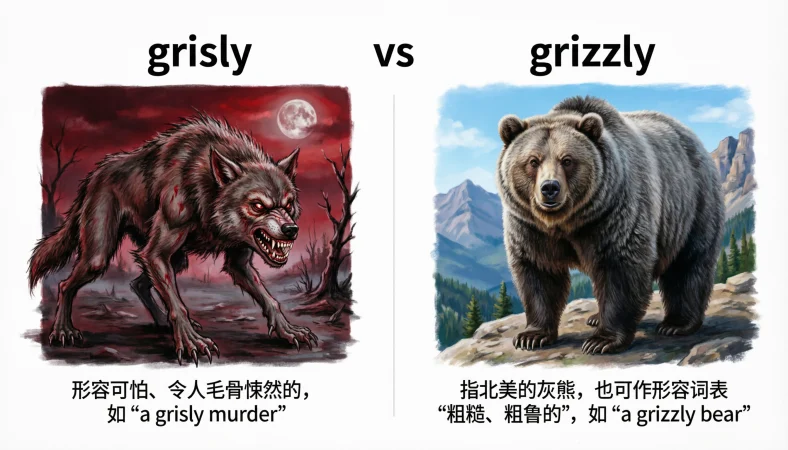
If you have ever wondered about grisly vs grizzly, you are not alone. These two words look and sound remarkably similar, but they have completely different meanings.
One is generally used to describe something horrifying, unpleasant, or involving death, while the other is most commonly associated with a large North American bear.
Because their pronunciation can be similar in some varieties of English, confusing them is an easy mistake to make.
Understanding grisly vs grizzly is especially useful when writing about news, nature, literature, or everyday experiences. Choosing the wrong spelling can change the meaning of an entire sentence.
In this guide, we will explain the difference between grisly and grizzly, explore their origins, provide clear examples, and show you a simple way to remember which spelling belongs where.
Quick Answer: Grisly vs Grizzly
Grisly means horrifying, gruesome, or involving something unpleasant, especially death or violence.
Grizzly usually refers to the North American grizzly bear, but it can also mean grayish or gray-haired.
Remember: grisly = gruesome; grizzly = bear.
What Does Grisly Mean?
Grisly is an adjective used to describe something that is horrifying, gruesome, or unpleasant to look at or think about. It is particularly common when discussing death, injuries, violence, or disturbing scenes.
For example:
- The detectives discovered a grisly scene.
- The movie contains several grisly details.
- The newspaper reported the grisly discovery.
- The novel describes a grisly murder.
The word does not necessarily mean that something is literally bloody. It can describe anything that creates a strong sense of horror or disgust.
Meaning of Grisly at a Glance
| Word | Part of Speech | Main Meaning | Example |
|---|---|---|---|
| Grisly | Adjective | Horrifying or gruesome | The police investigated a grisly crime. |
| Grisly | Adjective | Disturbing or unpleasant | The documentary contained grisly details. |
| Grisly | Adjective | Associated with death or violence | They found a grisly scene. |
When you see grisly, think of something disturbing or gruesome rather than an animal.
What Does Grizzly Mean?
Grizzly has several meanings, but its best-known use is as a noun referring to the grizzly bear, a large brown bear native to parts of North America.
For example:
- We saw a grizzly near the trail.
- The park is home to many grizzly bears.
- Rangers warned hikers about a nearby grizzly.
As an adjective, grizzly can also describe something that is gray or streaked with gray, particularly hair or a beard.
For example:
- He had a grizzly beard.
- The old sailor had grizzly gray hair.
Therefore, grizzly is not normally the word you want when describing something horrifying.
Meaning of Grizzly at a Glance
| Word | Part of Speech | Meaning | Example |
|---|---|---|---|
| Grizzly | Noun | A grizzly bear | A grizzly crossed the road. |
| Grizzly | Adjective | Gray or grayish | He had a grizzly beard. |
| Grizzly | Adjective/Noun | Related to the grizzly bear | Grizzly habitat must be protected. |
Grisly vs Grizzly: The Main Difference
The easiest way to understand grisly vs grizzly is to focus on their meanings rather than their similar spelling.
Grisly describes something frightening, gruesome, or horrifying.
Grizzly most commonly refers to a type of bear or something associated with that bear. It can also describe something grayish.
Here is the basic comparison:
| Feature | Grisly | Grizzly |
|---|---|---|
| Main meaning | Horrifying or gruesome | A North American bear |
| Common use | Death, violence, disturbing events | Wildlife and nature |
| Can describe a scene? | Yes | Usually no |
| Can refer to an animal? | No | Yes |
| Can describe gray hair? | No | Yes |
| Memory clue | Grisly = gruesome | Grizzly = grizzly bear |
The spelling difference is only one letter, but the meanings are dramatically different.
Origin and History of Grisly
Grisly has a long history in English and is related to words associated with fear and terror. It developed from Middle English forms connected with the idea of causing fear or horror.
Over time, its meaning became strongly associated with things that are horrifying, particularly disturbing scenes involving death or violence.
Today, the word appears frequently in journalism, crime writing, horror fiction, historical writing, and descriptions of violent events.
The historical development explains why grisly is connected with fear rather than bears.
Origin and History of Grizzly
The history of grizzly is quite different. The word is associated with the appearance of the grizzly bear’s fur, which can have gray or silver-tipped hairs.
The name is connected with an older use of words referring to gray or grayish coloring. The animal’s coat can appear brown, gray, or silver depending on lighting, season, and the individual bear.
This gives us an important memory connection:
Grizzly → grayish-looking bear → grizzly bear.
Origin Comparison
| Word | Historical Association | Modern Meaning |
|---|---|---|
| Grisly | Fear, terror, horror | Horrifying or gruesome |
| Grizzly | Gray or grayish appearance | Grizzly bear; grayish in appearance |
Is There a Biblical or Religious Connection?
There is no special biblical distinction between grisly and grizzly. Neither word is a central biblical term, and the modern distinction between them is primarily an English vocabulary issue.
You may encounter grisly in discussions of biblical stories when writers describe violent or disturbing events. However, that does not make grisly a specifically biblical word.
If you are studying a Bible translation, the exact wording can vary between translations. It is therefore important to distinguish the meaning of the English vocabulary word from the meaning of the underlying biblical passage.
Spiritual or Symbolic Meaning of Grisly and Grizzly
Although these words do not have established spiritual meanings, writers sometimes use them symbolically.
Grisly can symbolically represent suffering, mortality, violence, fear, or the consequences of destructive actions. In literature or religious commentary, a grisly image may be used to emphasize the seriousness of sin, human suffering, judgment, or death.
Grizzly, on the other hand, can symbolize strength, wilderness, power, courage, or untamed nature when the grizzly bear is used metaphorically.
These are contextual interpretations rather than fixed biblical definitions.
| Word | Possible Symbolic Association | Important Note |
|---|---|---|
| Grisly | Death, suffering, fear, mortality | Literary/contextual symbolism |
| Grizzly | Strength, wilderness, power | Often based on bear symbolism |
Grisly vs Grizzly in Modern English
Both words remain common in modern English, but they appear in very different contexts.
Grisly frequently occurs in:
- Crime reports
- Horror stories
- News articles
- Historical accounts
- True-crime discussions
- Descriptions of accidents
- Fiction involving violence
Grizzly frequently occurs in:
- Wildlife documentaries
- National park information
- Nature writing
- Outdoor safety guides
- Animal science
- Discussions about bears
Context usually makes the intended word obvious.
For instance, “a grizzly bear attacked the campsite” clearly requires grizzly, while “investigators discovered a grisly scene” requires grisly.
Why Do People Confuse Grisly and Grizzly?
The confusion comes mainly from their nearly identical spelling and pronunciation.
Both words begin with gris/griz, and their endings differ by only one letter. When people hear rather than see the word, the distinction can be even harder to recognize.
Another reason is that people may have learned one word primarily through speech. If they have rarely seen it written, they may choose the spelling that looks familiar.
The solution is to connect each word with a memorable idea:
Grisly = gruesome.
Grizzly = grizzly bear.
This simple association can prevent most spelling mistakes.
Common Mistakes With Grisly and Grizzly
One common mistake is writing grizzly when describing a disturbing event.
Incorrect:
The investigators found a grizzly scene.
Correct:
The investigators found a grisly scene.
Another mistake is using grisly when talking about the animal.
Incorrect:
We saw a grisly bear in the national park.
Correct:
We saw a grizzly bear in the national park.
A useful proofreading trick is to replace the word mentally with its meaning. If you mean “horrifying,” choose grisly. If you mean “bear,” choose grizzly.
Grisly vs Grizzly: Example Sentences
Seeing both words in context makes the difference easier to remember.
Examples With Grisly
- The detective described the crime as a grisly murder.
- The reporter avoided including the most grisly details.
- The documentary showed a grisly scene from the battlefield.
- The hikers came across a grisly discovery.
- The horror novel contains several grisly descriptions.
Examples With Grizzly
- A grizzly bear was spotted near the forest.
- The ranger explained how to respond to a grizzly encounter.
- The national park provides habitat for grizzly bears.
- We watched a grizzly fishing in the river.
- The wildlife photographer captured an image of a grizzly.
American vs British English Usage
The distinction between grisly and grizzly is generally maintained in both American and British English.
However, grizzly is particularly familiar in American English because the grizzly bear is a well-known North American animal. British English speakers may encounter the word mainly when reading about North American wildlife.
Grisly is used in both varieties of English to describe something horrifying or gruesome.
There is therefore no major American-versus-British spelling difference to memorize for these two words. The key is understanding their separate meanings.
A Simple Trick to Remember Grisly vs Grizzly
Use this memory trick:
Grisly = gruesome.
Both words contain the idea of something unpleasant when you connect grisly with gruesome.
Then remember:
Grizzly = grizzly bear.
You can also picture a grizzly bear whenever you see the letter z in grizzly.
The mental pairing is:
Once this association becomes familiar, the spelling difference becomes much easier to remember.
Final Summary: Grisly vs Grizzly
The difference between grisly vs grizzly is simple once you connect each word with its primary meaning.
Grisly is an adjective meaning horrifying, gruesome, or disturbing, especially when describing death, violence, or unpleasant events.
Grizzly most commonly refers to the North American grizzly bear and can also describe something grayish in appearance.
The words are easy to confuse because their spellings and pronunciations are similar, but they cannot normally be used interchangeably.
Remember grisly = gruesome and grizzly = bear, and you will be able to choose the correct word confidently in everyday writing.
Final Thought
Although grisly vs grizzly looks like a minor spelling issue, choosing the right word matters because the meanings are completely different. Grisly belongs in descriptions of horrifying, gruesome, or disturbing situations, while grizzly usually refers to a powerful North American bear.
The two words may sound similar, but their contexts make them easy to separate once you learn the distinction.
When proofreading, ask yourself what you are trying to describe: something gruesome or a bear? That quick question can prevent a surprisingly common vocabulary mistake.
With the simple memory rule “grisly = gruesome, grizzly = bear,” you can confidently use both words in your writing.
FAQs About Grisly vs Grizzly
1. What is the difference between grisly and grizzly?
Grisly means horrifying or gruesome, while grizzly usually refers to a North American bear.
2. Is it grisly bear or grizzly bear?
The correct expression is grizzly bear. A grizzly is a type of North American brown bear.
3. Does grisly mean scary?
It can. Grisly generally means horrifying, gruesome, or disturbing rather than simply frightening.
4. Can grizzly mean gray?
Yes. Grizzly can describe something gray or streaked with gray, particularly hair or a beard.
5. Is “grisly murder” correct?
Yes. Grisly murder is a standard expression because grisly can describe something involving horrifying or gruesome circumstances.
6. How can I remember the difference between grisly and grizzly?
Remember “grisly = gruesome” and “grizzly = bear.” This association makes the spelling difference easier to recall.
7. Are grisly and grizzly pronounced the same?
They can sound very similar, and pronunciation varies by speaker and dialect. Their meanings and spellings, however, are distinct.

John Robert is a passionate author and faith-driven writer who contributes insightful and inspiring biblical content to Biblenast. With a strong commitment to sharing God’s Word, he focuses on creating meaningful messages that encourage spiritual growth, reflection, and daily guidance. His work aims to connect readers with the timeless teachings of the Bible.