
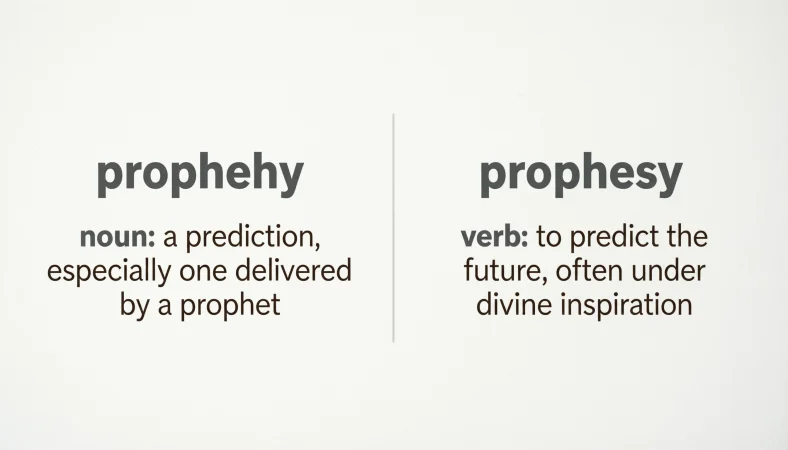
If you have ever wondered about prophecy vs prophesy, you are not alone. These two words look almost identical, sound similar, and are closely connected in meaning.
However, they have different grammatical roles, and using one in place of the other can make an otherwise polished sentence incorrect.
The easiest way to remember the difference is this: prophecy is a noun, while prophesy is a verb. A prophecy is a prediction, revelation, or message believed to come from divine inspiration, while to prophesy means to speak or declare such a message.
Once you understand this simple distinction, choosing the right word becomes much easier.
Quick Answer: Prophecy vs Prophesy
Prophecy is a noun that refers to a prediction, revelation, or divinely inspired message.
Prophesy is a verb meaning to speak, declare, or predict something, especially under divine inspiration.
- Prophecy: “The prophecy was fulfilled.”
- Prophesy: “The prophet continued to prophesy.”
A simple memory trick is: prophecy = thing/message; prophesy = action.
What Does Prophecy Mean?
Prophecy is a noun. It describes a prediction about the future or a message that is believed to be inspired by God or another divine source.
The word is especially common in religious contexts, including discussions about the Bible, prophets, Scripture, and divine revelation. However, prophecy can also be used more generally for a prediction that later appears to come true.
For example:
- “The ancient prophecy described a coming king.”
- “Many people believe the prophecy was fulfilled.”
- “The book contains several prophecies about the future.”
In religious writing, a prophecy does not always mean simply “predicting the future.” It can also refer to delivering a message from God to a particular audience.
What Does Prophesy Mean?
Prophesy is a verb. It describes the act of delivering a prophecy or speaking under prophetic inspiration.
For example:
- “The prophet was called to prophesy.”
- “He prophesied that a great change would come.”
- “The prophet continued to prophesy to the people.”
Because prophesy is a verb, it normally describes what someone does.
This gives you a useful grammatical distinction:
A person can prophesy, but a person delivers or gives a prophecy.
Prophecy vs Prophesy: The Main Difference
The most important difference between these words is their part of speech.
| Word | Part of Speech | Meaning | Example |
|---|---|---|---|
| Prophecy | Noun | A prediction or inspired message | “The prophecy was recorded.” |
| Prophesy | Verb | To speak or declare prophetically | “She was called to prophesy.” |
| Prophesied | Verb, past tense | Spoke or predicted prophetically | “He prophesied about the coming event.” |
| Prophetic | Adjective | Relating to prophecy | “The passage has prophetic significance.” |
This grammatical difference explains why you cannot freely substitute one word for the other.
How to Use Prophecy in a Sentence
Use prophecy when you are talking about the message, prediction, revelation, or statement itself.
Examples include:
- “The prophecy gave hope to the people.”
- “The ancient prophecy has been studied for centuries.”
- “They discussed the meaning of the prophecy.”
- “The prophecy concerned the future of the nation.”
- “The biblical prophecy pointed toward a coming event.”
You can usually test the sentence by replacing prophecy with “prediction” or “message.” If that works, prophecy is probably the correct choice.
How to Use Prophesy in a Sentence
Use prophesy when you need a verb describing the action of speaking or declaring prophetically.
Examples:
- “The prophet was commanded to prophesy.”
- “Some believers prophesy during worship.”
- “He continued to prophesy despite opposition.”
- “The prophet would prophesy about future events.”
Notice that each example describes an action.
A useful test is to replace prophesy with “predict,” “declare,” or “speak prophetically.” If the sentence still makes sense, prophesy may be the correct word.
Prophecy vs Prophesy Examples
Seeing the words side by side makes the difference clearer.
Prophecy
- “The prophecy was written down.”
- “The people waited for the fulfillment of the prophecy.”
- “This passage contains an important prophecy.”
- “The prophecy became the subject of intense discussion.”
Prophesy
- “The prophet was instructed to prophesy.”
- “He began to prophesy about what was to come.”
- “They believed she could prophesy.”
- “The prophet continued to prophesy before the people.”
Both in One Sentence
You can also use both words together:
“The prophet continued to prophesy, delivering a prophecy of hope.”
Here, prophesy describes the action, while prophecy describes the message.
Why Are Prophecy and Prophesy So Easy to Confuse?
The confusion is understandable because the two words come from the same linguistic family and are closely related in meaning.
Their spelling is also nearly identical:
- prophecy
- prophesy
The final letters provide an important clue. Prophecy ends in -cy, while prophesy ends in -sy.
Their pronunciation also differs slightly in standard English usage. The noun prophecy is generally pronounced with a final sound like “see,” while the verb prophesy ends with a sound like “sigh.”
That difference can help you identify the word when speaking as well as writing.
Common Mistakes With Prophecy and Prophesy
One common mistake is writing:
“The prophet gave a prophesy.”
This is incorrect in standard English because prophesy is a verb.
The correct sentence is:
“The prophet gave a prophecy.”
Another common error is:
“The prophet prophecy about the future.”
Because the sentence needs a verb, prophesy is required:
“The prophet prophesied about the future.”
Quick correction guide
- A prophecy ✅
- The prophecy ✅
- To prophesy ✅
- He prophesied ✅
- He gave a prophesy ❌
- He prophecy about it ❌
Biblical Meaning of Prophecy
In the Bible, prophecy has a broader meaning than simply predicting future events.
Biblical prophecy can involve communicating a message that is understood as coming from God. Prophets may address present circumstances, warn people about wrongdoing, call them to repentance, offer encouragement, or speak about events yet to come.
This is why biblical prophecy should not automatically be treated as nothing more than fortune-telling.
When studying a biblical prophecy, consider:
- Who delivered the message?
- Who was the original audience?
- What was happening historically?
- Was the message about the present, future, or both?
- How is the passage interpreted within its broader biblical context?
These questions encourage careful interpretation rather than taking individual statements out of context.
Is Prophecy Always About the Future?
No. This is an important misconception.
A prophecy may contain information about future events, but prophecy can also involve a divinely inspired message concerning current circumstances.
For example, a prophetic message might challenge people to change their behavior or encourage them during a difficult period.
Therefore, the meaning of prophecy depends on its context.
American vs British English Differences
There is no major difference between American and British English in the basic distinction between prophecy and prophesy.
Both varieties use:
- prophecy as a noun
- prophesy as a verb
The spelling and grammatical distinction remain essentially the same.
Other forms, such as prophesied and prophetic, are also used in both American and British English.
So whether you are writing an American English article or British English content, the same basic rule applies.
Related Words You Should Know
Understanding related terms can make the distinction easier.
| Word | Type | Meaning |
|---|---|---|
| Prophecy | Noun | A prophetic message or prediction |
| Prophesy | Verb | To speak or declare prophetically |
| Prophesied | Verb | Past tense of prophesy |
| Prophet | Noun | A person who delivers a prophetic message |
| Prophetic | Adjective | Related to prophecy |
| Prophetically | Adverb | In a prophetic manner |
These words are related, but they cannot always replace one another grammatically.
A Simple Memory Trick
If you frequently forget which spelling is correct, remember:
Prophecy = the message.
Prophesy = the action.
You can think of the sentence:
“The prophet will prophesy a prophecy.”
Although this sentence may sound somewhat repetitive, it provides an easy way to remember the grammatical difference.
Another shortcut is:
- -cy → noun
- -sy → verb
This is not a universal English spelling rule, but it works well for remembering these two words.
Why Getting the Difference Right Matters
Choosing between prophecy and prophesy is more than a spelling exercise. Correct word choice makes your writing clearer and more credible.
This matters particularly in:
- Bible studies
- sermons
- religious articles
- academic writing
- Christian blogs
- theological discussions
- educational content
- SEO articles
A reader may understand what you mean even when the wrong word is used, but grammatical accuracy strengthens trust and professionalism.
FAQs About Prophecy vs Prophesy
Is prophecy a noun or a verb?
Prophecy is a noun. It refers to a prophetic message, prediction, or revelation.
Is prophesy a noun or a verb?
Prophesy is a verb. It means to speak or declare prophetically.
What is the difference between prophecy and prophesy?
The simplest distinction is grammatical: prophecy is the message or prediction, while prophesy is the act of delivering that message.
Is “a prophesy” correct?
No. In standard English, the correct noun is a prophecy.
Is “prophesied” the past tense of prophesy?
Yes. Prophesied is the past tense and past participle form of prophesy.
How do you remember prophecy vs prophesy?
Remember: prophecy = thing; prophesy = action. You receive, discuss, or fulfill a prophecy, but a person can prophesy.
Are prophecy and prophesy pronounced differently?
Yes. In standard English, the noun and verb have different final sounds, which can help distinguish them when spoken.
Does prophecy always mean predicting the future?
No. In religious contexts, prophecy can also refer to an inspired message addressing present circumstances, correction, encouragement, or God’s purposes.
Final Summary
The difference between prophecy vs prophesy becomes simple once you focus on grammar. Prophecy is a noun that refers to a prophetic message, prediction, or revelation.
Prophesy is a verb that means to speak, declare, or deliver a prophetic message. Related forms such as prophesied, prophet, and prophetic fit different grammatical roles.
When writing, ask yourself whether you are talking about the message or the action. If you mean the message, use prophecy. If you mean the action of speaking prophetically, use prophesy.
This small distinction can make your writing more precise, especially in biblical, religious, academic, and educational contexts.
Actionable Takeaway
Before using either word, try this quick test:
- Can you replace the word with prediction or message? Use prophecy.
- Can you replace it with speak prophetically or declare? Use prophesy.
- If you are describing what a prophet did in the past, use prophesied.
Remember: prophecy is the message; prophesy is the action.
Meta Description: Prophecy vs prophesy explained simply: learn the difference, meanings, examples, pronunciation, common mistakes, and correct usage.
Emersion vs Immersion: Meaning, Differences, Examples, and Correct Usage
If you have searched for emersion vs immersion, you may have noticed that the two words look almost identical.
That one extra “m” can make a surprisingly important difference. Although both words are legitimate English terms, they describe very different ideas and are used in different contexts.
Immersion is the much more common word. It generally means being deeply involved in something or being placed into a liquid or surrounding environment.
Emersion, by contrast, is a specialized term that usually refers to something emerging from concealment, especially the reappearance of a celestial body after it has been obscured. Understanding this distinction will help you avoid choosing the wrong word in everyday writing.
Quick Answer: Emersion vs Immersion
Immersion means being submerged, surrounded, or deeply involved in something.
Emersion means emerging from concealment or becoming visible again, especially in astronomy.
- Immersion: “Language immersion helped her learn Spanish.”
- Emersion: “The telescope recorded the emersion of the star.”
For everyday writing, immersion is usually the word you want.
What Does Immersion Mean?
Immersion is a noun derived from the verb immerse. It describes the act of putting something into a liquid or surrounding environment, or becoming deeply involved in an experience, activity, subject, or culture.
For example:
- “The immersion of the object in water was complete.”
- “He enjoys total immersion in historical research.”
- “The students participated in an English immersion program.”
- “Virtual reality can create an immersive experience.”
The word has both a literal and a figurative meaning.
Literal immersion
Literal immersion involves being physically placed into something, especially liquid.
“The immersion of the cloth in water removed the stain.”
Figurative immersion
Figurative immersion means becoming deeply involved in something.
“Her immersion in the language helped her become fluent.”
This figurative meaning is extremely common in modern English.
What Does Emersion Mean?
Emersion is a noun related to emerge. It refers to the act or process of coming out of something or becoming visible after being hidden or obscured.
The word is relatively uncommon in ordinary conversation.
It has a specialized use in astronomy. For example, when a celestial object becomes visible again after being hidden by another object, its reappearance can be described as an emersion.
For example:
“The astronomers observed the emersion of the star.”
In this context, the star had been hidden from view and then became visible again.
Because emersion is uncommon, many people encounter it only in specialized scientific or technical writing.
Emersion vs Immersion: The Main Difference
The clearest way to understand emersion vs immersion is to think about direction.
Immersion = going into or being deeply surrounded by something.
Emersion = coming out or becoming visible again.
| Word | Meaning | Common Context | Example |
|---|---|---|---|
| Immersion | Being placed into or deeply involved in something | Water, education, language, culture, technology | “She joined an immersion program.” |
| Emersion | Emerging from concealment | Astronomy and technical contexts | “The emersion of the star was observed.” |
The words are therefore not interchangeable.
Immersion Examples in Everyday English
You are likely to encounter immersion frequently.
Education
“The school offers an immersion program for students learning French.”
Here, students are surrounded by the language and culture to encourage learning.
Technology
“The game provides an immersive experience.”
This describes an experience that makes the user feel deeply involved.
Culture
“Travel allowed him to experience cultural immersion.”
The person became deeply involved with another culture.
Physical activity
“The treatment involved immersion in warm water.”
Here, immersion has its literal physical meaning.
Emersion Examples
Because emersion is specialized, its examples are more technical.
- “The astronomer calculated the time of emersion.”
- “The star’s emersion was visible through the telescope.”
- “Observers recorded the emersion after the occultation.”
- “The timing of the lunar object’s emersion was carefully documented.”
In these examples, something that was previously hidden becomes visible again.
Emersion in Astronomy
Astronomy is one of the most important contexts for understanding emersion.
An astronomical object can sometimes pass behind another object from an observer’s perspective. The period during which it is hidden is associated with an occultation. When the hidden object reappears, that event can be called an emersion.
The opposite event, when an object disappears from view, is called an immersion in this specialized astronomical sense.
This creates an interesting contrast:
- Immersion: disappearance behind an obscuring object.
- Emersion: reappearance after being obscured.
That specialized astronomical usage is different from the everyday meaning of immersion.
Why Do People Confuse Emersion and Immersion?
The confusion mainly comes from their spelling and related meanings.
Both words contain:
-mersion
They also describe processes involving movement or changes in visibility or position.
However, their prefixes provide a useful clue:
- im- can suggest movement into or involvement within something.
- e- can suggest movement outward or emergence.
This distinction can help you remember the words.
Immersion Has Many Modern Uses
Unlike emersion, immersion is part of everyday English and appears in many fields.
Language learning
Language immersion means learning a language by being surrounded by it.
Education
An immersion program often places students in a language or cultural environment for extended learning.
Gaming
Immersion describes how strongly a game makes players feel involved in its world.
Virtual reality
Immersion is often used to describe the feeling of being surrounded by a digital environment.
Culture
Cultural immersion involves spending meaningful time experiencing another culture.
Religion
The word can also appear in religious discussions, particularly when describing baptism by immersion.
Because of these uses, immersion is far more familiar to most English speakers.
Common Mistakes With Emersion and Immersion
A common mistake is using emersion when you mean deep involvement.
For example:
“Her emersion in French helped her become fluent.”
In ordinary English, this should be:
“Her immersion in French helped her become fluent.”
Another mistake is using immersion when discussing the reappearance of an astronomical object.
If an astronomical body becomes visible again after being obscured, emersion may be the appropriate technical term.
Quick correction
- “Language immersion” ✅
- “Cultural immersion” ✅
- “Immersion in water” ✅
- “Astronomical emersion” ✅
- “Her emersion in the culture” ❌
- “The emersion program teaches Spanish” ❌
Immersion vs Submersion
Immersion and submersion are related but not always identical.
Submersion generally emphasizes being placed completely beneath a surface, especially water.
Immersion can mean physical placement in a liquid, but it also has the much broader figurative meaning of becoming deeply involved in something.
For example:
“The equipment was submerged in water.”
But:
“She became immersed in the language.”
The second sentence uses the figurative sense.
Emersion vs Emergence
Emersion and emergence are related in appearance but should not be treated as exact synonyms.
Emergence is a much broader word meaning the process of coming into view, becoming known, developing, or appearing.
Emersion is more specialized and is particularly associated with emerging from concealment, including astronomical contexts.
For everyday writing, emergence will often be the more natural choice.
American vs British English Differences
There is no significant American-versus-British spelling difference between emersion and immersion.
Both American and British English use:
- immersion
- emersion
The main difference is not regional but frequency and context.
Immersion is common in both varieties of English, while emersion is relatively rare and tends to appear in scientific or technical contexts.
Therefore, if you see emersion, check the context carefully before assuming it is a spelling mistake.
Related Words and Forms
Understanding the word family can make these terms easier to remember.
| Word | Meaning |
|---|---|
| Immerse | To place into or deeply involve |
| Immersion | The act of immersing or deep involvement |
| Immersive | Creating a strong sense of involvement |
| Immerse oneself | Become deeply involved |
| Emerge | Come out or become visible |
| Emersion | The act of emerging from concealment |
| Emerging | Coming into view or developing |
For example:
“The immersive course provided complete language immersion.”
By contrast:
“The astronomer observed the object’s emersion.”
How to Remember Emersion vs Immersion
A simple memory trick is to focus on direction.
Immersion → in
Think:
Immersion = into something.
Emersion → emerge
Think:
Emersion = emerge from something.
This is particularly useful because emersion is uncommon enough that you may not encounter it regularly.
Another way to remember the distinction is:
Immersion goes in; emersion comes out.
This is a useful shortcut, especially when reading technical material.
When Should You Use Immersion?
Choose immersion when you mean:
- being placed into liquid
- becoming deeply involved
- language learning
- cultural experience
- educational programs
- virtual reality
- gaming experiences
- baptism by immersion
- being surrounded by an environment
In everyday communication, immersion will be the correct choice in the overwhelming majority of situations where these two words might be confused.
When Should You Use Emersion?
Choose emersion when you specifically mean:
- emerging from concealment
- becoming visible after being hidden
- a technical astronomical event
- the reappearance of a celestial object
If you are writing ordinary content and want to describe something simply “coming out,” emergence or reappearance may sound more natural than emersion, depending on the context.
FAQs About Emersion vs Immersion
What is the difference between emersion and immersion?
Immersion means going into, being surrounded by, or becoming deeply involved in something. Emersion means emerging from concealment or becoming visible again.
Is emersion a real word?
Yes. Emersion is a legitimate English word, although it is uncommon. It is particularly used in technical and astronomical contexts.
Is immersion the correct word for language learning?
Yes. Language immersion is the standard expression for learning a language by being surrounded by and regularly exposed to it.
What does emersion mean in astronomy?
In astronomy, emersion can describe the reappearance of an object after it has been hidden or obscured by another celestial body.
Is emersion the opposite of immersion?
In certain specialized contexts, particularly astronomy, the two terms can describe opposite stages: immersion can refer to disappearance from view, while emersion refers to reappearance. Their broader meanings are not simply opposites in every context.
Is “emersion program” correct?
Usually not if you mean a program involving deep exposure or participation. The standard phrase is immersion program.
What is cultural immersion?
Cultural immersion means becoming deeply involved in another culture through meaningful exposure to its language, traditions, people, customs, and everyday life.
How can I remember emersion vs immersion?
Remember immersion = into and emersion = emerge. Immersion involves going in or becoming deeply involved, while emersion involves coming out of concealment.
Final Summary
The distinction between emersion vs immersion is easier once you focus on their meanings rather than their similar spelling.
Immersion is the common word and refers to being placed into something, surrounded by something, or deeply involved in an experience.
It appears frequently in education, language learning, culture, technology, religion, and everyday conversation.
Emersion is much less common and has a more specialized meaning. It describes the act of emerging from concealment or becoming visible again, particularly in astronomical contexts.
If you are talking about language learning, cultural experiences, education, or deep involvement, immersion is almost certainly the word you need.
Actionable Takeaway
Before choosing between the two, ask:
- Do I mean going into or becoming deeply involved? Use immersion.
- Do I mean coming out from concealment? Consider emersion.
- Am I discussing astronomy or another technical context? Emersion may be the precise term.
- Am I talking about language, culture, education, or technology? Immersion is almost certainly correct.
Remember: immersion means going in; emersion means emerging out.

Michael James is the administrator and a dedicated author at Biblenast, responsible for managing the platform and ensuring quality content. Alongside his administrative role, he writes insightful biblical articles that inspire faith, reflection, and spiritual growth. His work supports the mission of making God’s Word accessible and meaningful.