If you have ever wondered about annunciate vs enunciate, you are not alone. These two verbs look and sound remarkably similar, and both are connected with the idea of communicating something aloud.
However, they have different meanings and are used in different situations. Choosing the right word can make your writing more precise and help you avoid an easily overlooked vocabulary mistake.
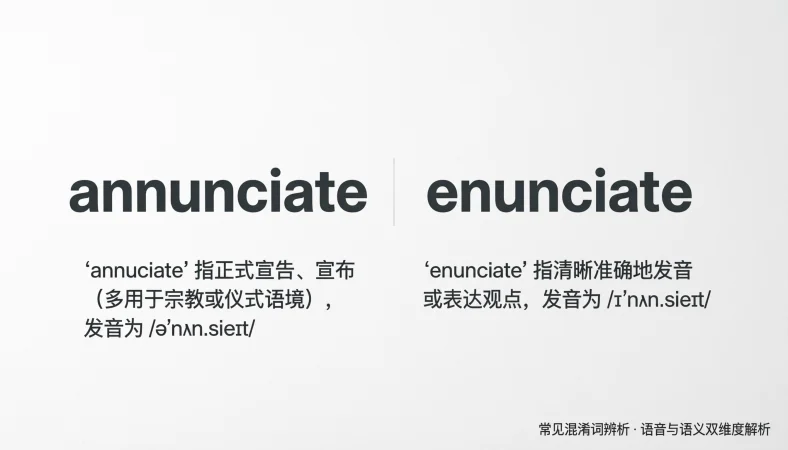
The main difference between annunciate vs enunciate is that annunciate means to announce or proclaim something, while enunciate means to pronounce words clearly or express an idea clearly.
In everyday English, enunciate is much more common, especially when discussing speech and pronunciation.
Understanding the distinction becomes especially useful when describing public speaking, announcements, pronunciation, or the clear presentation of ideas.
Quick Answer: Annunciate vs Enunciate
Annunciate means to announce, proclaim, or make something known.
Enunciate means to pronounce words clearly or express an idea in a clear, definite way.
Use annunciate when the focus is on making an announcement. Use enunciate when the focus is on clear pronunciation or clearly stating an idea.
What Does Annunciate Mean?
Annunciate is a verb meaning to announce, proclaim, or communicate something publicly or formally. It comes from the same Latin family associated with announcing or making something known.
For example:
- The spokesperson will annunciate the results at noon.
- The priest annunciated the news to the congregation.
- The official statement annunciated the government’s decision.
Although annunciate is a legitimate English word, it is relatively uncommon in modern everyday English. Speakers and writers will usually choose announce instead.
This is one reason people sometimes confuse annunciate with enunciate. The words look almost identical, but their meanings are different.
Annunciate Meaning at a Glance
| Word | Part of Speech | Basic Meaning | Commonness |
|---|---|---|---|
| Annunciate | Verb | To announce or proclaim | Uncommon |
| Announce | Verb | To make something known | Very common |
| Enunciate | Verb | To pronounce or express clearly | Common |
What Does Enunciate Mean?
Enunciate has two closely related meanings.
First, it can mean to pronounce words clearly and distinctly. This is the meaning most people encounter in everyday conversation.
For example:
- Please enunciate your words during the presentation.
- The actor enunciated every sentence carefully.
- She speaks quickly, so she needs to enunciate more clearly.
Second, enunciate can mean to express an idea, principle, or statement clearly and precisely.
For example:
- The professor enunciated a new theory.
- The document enunciates the organization’s core principles.
- The leader clearly enunciated his position.
Therefore, enunciate is not limited to pronunciation. It can also describe the clear formulation or expression of an idea.
Annunciate vs Enunciate: The Main Difference
The simplest way to remember annunciate vs enunciate is to focus on the action involved.
Annunciate = announce something.
Enunciate = say something clearly or express it clearly.
Consider these examples:
The company will annunciate the winner.
Here, the intended meaning is that the company will announce the winner.
The presenter should enunciate the winner’s name.
Here, the presenter should pronounce the name clearly.
The first sentence focuses on making information known. The second focuses on the clarity of speech.
| Feature | Annunciate | Enunciate |
|---|---|---|
| Core meaning | Announce or proclaim | Pronounce or express clearly |
| Focus | Making information known | Clarity of speech or ideas |
| Typical context | Formal announcements | Speaking, pronunciation, writing |
| Everyday use | Rare | Common |
| Example | Annunciate a declaration | Enunciate every word |
Origin and History of Annunciate
The history of annunciate is connected to the Latin verb annuntiare, meaning to announce or report. The word entered English through forms influenced by Latin and French.
The underlying idea is communication: information is brought forward and made known to other people.
This connection is also visible in related words such as announce and annunciation.
Because annunciate has a formal and somewhat old-fashioned sound, modern English generally prefers announce. You may still encounter annunciate in formal, literary, historical, or specialized contexts.
Origin and History of Enunciate
Enunciate also has Latin roots. It ultimately comes from Latin enuntiare, associated with declaring, stating, or expressing something.
Over time, English developed the word with meanings connected to both clear expression and clear pronunciation.
This explains why enunciate can be used in two ways:
- To pronounce words distinctly.
- To formulate or state an idea clearly.
Its modern pronunciation-related meaning is especially common in contexts involving public speaking, acting, teaching, broadcasting, and communication skills.
| Word | Historical Root | Basic Historical Idea | Modern Meaning |
|---|---|---|---|
| Annunciate | Latin annuntiare | Announce or report | Announce or proclaim |
| Enunciate | Latin enuntiare | Declare or state | Pronounce or express clearly |
When Should You Use Annunciate?
Use annunciate when you specifically mean to announce or proclaim something.
However, in most modern writing, announce will sound more natural.
For example:
Formal or uncommon:
- The committee annunciated its final decision.
More natural:
- The committee announced its final decision.
The second version is generally preferable because announce is familiar and direct.
If you are writing a formal, historical, literary, or specialized text, annunciate may be appropriate. In ordinary conversation, however, it can sound unnecessarily formal.
When Should You Use Enunciate?
Use enunciate when talking about clear pronunciation or the clear expression of an idea.
Examples include:
- The teacher asked the student to enunciate.
- Radio presenters need to enunciate clearly.
- Actors practice enunciating difficult lines.
- The report enunciates several important principles.
A useful clue is that enunciate is strongly associated with clarity.
If someone tells you, “Please enunciate,” they usually mean, “Please pronounce your words more clearly.”
Common Mistakes With Annunciate and Enunciate
One of the most common mistakes is using annunciate when the writer actually means enunciate.
For example:
Incorrect for pronunciation:
- Please annunciate your words.
Correct:
- Please enunciate your words.
Another mistake is using enunciate when the intended meaning is simply “announce.”
For example:
Awkward:
- The company will enunciate the winner tomorrow.
Better:
- The company will announce the winner tomorrow.
There is also a common misconception that the two words are interchangeable because they sound similar. They are not. Their shared historical connection does not make them synonyms.
Annunciate vs Enunciate Examples
Seeing the words in context makes the difference easier to remember.
Examples of Annunciate
- The official annunciated the new policy.
- The proclamation annunciated an important change.
- The speaker formally annunciated the decision.
In these examples, the focus is on announcing or proclaiming information.
Examples of Enunciate
- Please enunciate each word clearly.
- The actor enunciated the difficult dialogue.
- She enunciated her argument with precision.
- The teacher encouraged the students to enunciate.
Here, the focus is on clarity of pronunciation or expression.
Annunciate vs Enunciate in Speaking and Writing
The distinction becomes particularly useful in communication-related contexts.
If you are discussing how someone speaks, enunciate is usually the appropriate word.
For example:
The newsreader enunciates every word clearly.
If you are discussing the act of making an announcement, announce is usually the natural choice.
For example:
The newsreader announced the election results.
Using annunciate instead of announce is grammatically possible in certain contexts, but it may sound formal or unusual.
| Intended Meaning | Best Choice | Example |
|---|---|---|
| Make something known | Announce | They announced the results. |
| Pronounce clearly | Enunciate | She enunciated every word. |
| Express an idea clearly | Enunciate | He enunciated his argument. |
| Make a formal proclamation | Annunciate / announce | The official announced the decision. |
A Simple Memory Trick
A quick memory trick can help you distinguish the two words.
Think:
ANNUNCIATE → ANNOUNCE
Both begin with ANNUN-, making it easier to associate annunciate with announcing something.
Then remember:
ENUNCIATE → EXPRESS CLEARLY
Enunciate is the word you want when talking about clear pronunciation or clearly stating an idea.
You can also remember this sentence:
Annunciate the news, but enunciate the words.
This simple contrast captures the essential difference.
American vs British English
There is no major American-versus-British difference in the basic meanings of annunciate and enunciate. Both varieties of English recognize the distinction.
However, announce is much more familiar and natural in both American and British English when the intended meaning is “make something known.”
Enunciate is also used in both varieties when discussing clear pronunciation or clear expression.
Therefore, this is not primarily a regional vocabulary issue. It is a matter of meaning, context, and register.
Why Do People Search Annunciate vs Enunciate?
People commonly search annunciate vs enunciate because the two words have similar spellings, pronunciations, and Latin origins.
The confusion is especially understandable for people learning English, writers checking their vocabulary, students, public speakers, and professionals who want to use precise language.
The easiest solution is to identify what you are trying to say.
If your meaning is “announce,” choose announce or, in a formal context, annunciate.
If your meaning is “pronounce clearly” or “state clearly,” choose enunciate.
Final Summary: Annunciate vs Enunciate
The difference between annunciate vs enunciate is mainly a difference in meaning and usage.
Annunciate means to announce, proclaim, or make something known. It is a relatively uncommon and formal word, and announce is normally more natural in everyday English.
Enunciate means to pronounce words clearly or express an idea clearly and precisely. It is much more common in discussions about speech, pronunciation, presentations, acting, teaching, and communication.
When in doubt, remember: annunciate is connected with announcing, while enunciate is connected with clear expression and pronunciation.
Final Thought
Choosing between similar words becomes much easier when you focus on their actual meanings rather than their spelling. Annunciate vs enunciate is a good example because the words look and sound alike but perform different jobs.
Enunciate, on the other hand, is the word to use when you mean speaking clearly, pronouncing words distinctly, or expressing an idea precisely.
FAQs About Annunciate vs Enunciate
1. What is the difference between annunciate and enunciate?
Annunciate means to announce or proclaim something. Enunciate means to pronounce words clearly or express an idea clearly.
2. Is annunciate a real word?
Yes. Annunciate is a legitimate English verb meaning to announce or proclaim, but it is less common than announce.
3. Is enunciate the same as pronounce?
Not exactly. Enunciate means to pronounce something clearly and distinctly. It can also mean to express an idea clearly.
4. Should I say “annunciate the words”?
Usually no. If you mean “pronounce the words clearly,” the correct word is enunciate.
5. Can enunciate mean announce?
Not normally in everyday usage. Enunciate can mean to state or express something clearly, but announce is the standard word for making news known.
6. Is annunciate commonly used in English?
It is relatively uncommon. In most everyday situations, announce is the more natural choice.
7. How can I remember annunciate vs enunciate?
Remember: annunciate = announce, while enunciate = pronounce or express clearly.

Michael James is the administrator and a dedicated author at Biblenast, responsible for managing the platform and ensuring quality content. Alongside his administrative role, he writes insightful biblical articles that inspire faith, reflection, and spiritual growth. His work supports the mission of making God’s Word accessible and meaningful.