Have you ever wondered whether targeted or targetted is the correct spelling?
If you are writing an email, completing a school assignment, preparing a report, or creating online content, choosing the right spelling helps your writing look clear and professional.
Although both spellings may look reasonable, only one is standard in modern English.
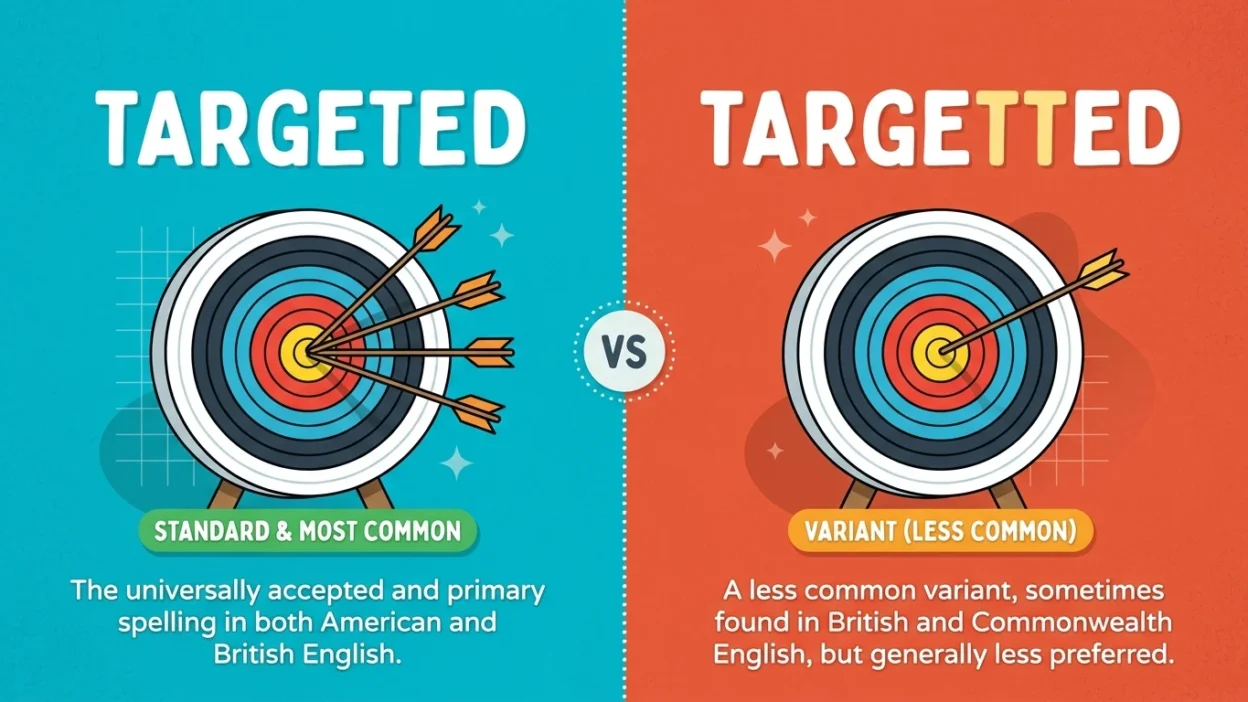
Targeted is the correct and widely accepted spelling in both American and British English.
It is the past tense and past participle of the verb target, meaning to direct something toward a particular person, group, or goal.
Targetted is a common misspelling because some writers mistakenly double the final t, following the spelling pattern of other English words.
Understanding the difference is simple once you know the spelling rule.
In this guide, you will learn why targeted is correct, how to use it in everyday sentences, and how to avoid common spelling mistakes.
Quick Answer: Targeted or Targetted?
Targeted is the correct spelling in both American and British English. It is the past tense and past participle of target. The spelling targetted is incorrect in standard modern English. For example, write “The campaign targeted young adults,” not “The campaign targetted young adults.”
Why Do People Confuse Targeted and Targetted?
People often confuse these spellings because English has many verbs that double their final consonant when adding -ed. For example, stop becomes stopped, and plan becomes planned.
However, English spelling rules do not require every verb ending in a consonant to double that consonant.
The verb target already ends in two consonant letters, g and t. When you add -ed, you simply keep the original spelling and add the ending.
- Correct: target → targeted
- Incorrect: target → targetted
The extra t in targetted is unnecessary. Although readers will usually understand what it means, it is best to use the standard spelling in formal, academic, and professional writing.
What Does Targeted Mean?
Targeted means directed toward a particular person, group, place, problem, or objective. It describes an action that has a specific focus rather than a general one.
It can function as the past tense of target or as a past participle used with helping verbs and in passive constructions.
Examples of Targeted in Sentences
- The company targeted customers who were interested in its new product.
- The school introduced targeted support for struggling students.
- The advertisement targeted young professionals.
- The government launched a targeted campaign against fraud.
- The new policy targeted the main causes of the problem.
In each example, targeted shows that an action was directed toward a specific audience or objective.
What Does Targetted Mean?
Targetted is a nonstandard spelling of targeted. It is generally considered a spelling mistake in contemporary standard English.
For example:
- Incorrect: The company targetted new customers.
- Correct: The company targeted new customers.
The intended meaning is usually clear, but the extra t makes the spelling incorrect. Use targeted in essays, business documents, reports, websites, and everyday communication.
Targeted vs Targetted: Comparison Table
| Feature | Targeted | Targetted |
|---|---|---|
| Spelling status | Correct standard spelling | Nonstandard misspelling |
| Meaning | Directed toward a specific focus | Intended to mean the same thing |
| American English | Correct | Incorrect |
| British English | Correct | Incorrect |
| Formal writing | Recommended | Avoid |
| Example | The message targeted parents. | The message targetted parents. |
The main difference is spelling, not meaning. If you want to express that an action was directed toward a particular audience or goal, use targeted.
When Should You Use Targeted or Targetted?
When to Use Targeted
Use targeted whenever you need the past tense or past participle of target.
It is suitable for academic writing, professional communication, marketing, journalism, healthcare, education, and everyday conversation.
Examples:
- Marketing: The business targeted customers in nearby areas.
- Education: The teacher targeted the students’ most common mistakes.
- Healthcare: The program targeted communities with limited access to care.
- Technology: The attackers targeted vulnerable computer systems.
- Business: The company has targeted a new market.
When to Avoid Targetted
Avoid targetted in standard English because it is not the accepted spelling.
If you see it in a document, correct it to targeted. If you are editing a website or proofreading a report, checking for this extra t is a simple way to improve accuracy.
12 Examples of Targeted vs Targetted in Sentences
The following examples show the correct spelling in different contexts.
| Incorrect or correct? | Example |
|---|---|
| Correct | The campaign targeted first-time voters. |
| Incorrect | The campaign targetted first-time voters. |
| Correct | The advertisement targeted a younger audience. |
| Incorrect | The advertisement targetted a younger audience. |
| Correct | The program targeted children who needed extra help. |
| Incorrect | The program targetted children who needed extra help. |
| Correct | The investigation targeted suspected financial fraud. |
| Incorrect | The investigation targetted suspected financial fraud. |
| Correct | The company has targeted international customers. |
| Incorrect | The company has targetted international customers. |
| Correct | The policy was targeted at reducing waste. |
| Incorrect | The policy was targetted at reducing waste. |
These examples reinforce the same rule: the correct spelling always has one t before the -ed ending.
Common Mistakes With Targeted and Targetted
Here are a few mistakes to watch for when writing this word.
1. Doubling the Final T
Incorrect: The company targetted local businesses.
Correct: The company targeted local businesses.
Do not add another t before -ed.
2. Assuming British English Uses Targetted
Some British English words use doubled consonants, such as travelled and cancelled. However, targeted is the standard spelling in British English too.
3. Treating Both Spellings as Equally Correct
The two forms are not interchangeable in standard writing. Use targeted consistently.
4. Forgetting the Spelling in Related Forms
The same base spelling appears in related words:
- target
- targets
- targeting
- targeted
For example: “The team is targeting a new audience” and “The team targeted a new audience.”
What Is an Easy Memory Trick for Targeted?
Remember this simple rule:
Target + ed = targeted.
The word target already has a t at the end. You do not need to add another one before -ed.
You can also remember this sentence:
“The team targeted its goal.”
The correct form has just one t immediately before -ed. If you write targetted, you have added an unnecessary letter.
American vs British English: Is Targeted Spelled Differently?
No. Targeted is the standard spelling in both American and British English.
Some words differ between the two varieties. For example, American English usually uses canceled, while British English commonly uses cancelled. Similarly, traveled is more common in American English, while travelled is standard in British English.
However, this difference does not apply to targeted.
| American English | British English |
|---|---|
| targeted | targeted |
| targeting | targeting |
| target | target |
Whether you are writing for readers in the United States, the United Kingdom, Canada, Australia, or elsewhere, targeted is the safe standard spelling.
What Are Some Similar Words to Targeted?
Learning related words can help you express the idea more precisely.
- Directed: Guided or aimed toward a particular person or purpose.
The message was directed at new customers. - Focused: Concentrated on a particular subject or objective.
The team focused on improving customer service. - Aimed: Intended to achieve a particular result.
The initiative aimed to reduce waste. - Specific: Clearly defined or limited to a particular thing.
The school provided specific help to students who needed it. - Tailored: Adapted to suit a particular person or situation.
The company created a tailored plan for each client.
These words are related to the idea of having a particular focus, but they are not always exact replacements for targeted. Choose the word that best matches your intended meaning.
Final Verdict: Targeted or Targetted?
The correct spelling is targeted, not targetted. This rule applies to both American and British English.
Use targeted when describing something directed toward a specific audience, person, problem, or goal. The spelling remains the same whether you are writing about advertising, education, business, healthcare, or technology.
Remember that the verb is spelled target, and its past tense is formed by adding -ed without doubling the final t.
Frequently Asked Questions
1. Is targeted or targetted correct?
Targeted is correct. Targetted is a nonstandard spelling and should be avoided in standard English writing.
2. Is targeted correct in British English?
Yes. Targeted is the standard spelling in British English, just as it is in American English.
3. Why is targeted not spelled targetted?
The verb target takes the ending -ed without doubling its final t. The correct form is targeted.
4. Is targetted ever acceptable?
You may encounter targetted as a typo or nonstandard variant, but it is not recommended in standard modern English. Use targeted instead.
5. What is the past tense of target?
The past tense of target is targeted. For example: “The campaign targeted local residents.”
6. Is it targeting or targetting?
Targeting is the correct spelling. Targetting is nonstandard. For example: “The company is targeting new customers.”
7. Does targeted have one T or two before -ed?
The correct spelling is targeted, with one t at the end of target before the -ed ending. Do not add an extra t.
Remember This
- Targeted = correct spelling.
- Targetted = nonstandard spelling.
- Both American and British English use targeted.
- The related form targeting also has only one t before its ending.
Conclusion
Choosing between targeted and targetted is straightforward once you remember the standard spelling rule. Targeted is the accepted form in modern English, and it describes something directed toward a particular person, group, problem, or goal. The spelling targetted adds an unnecessary letter and should be avoided in formal and everyday writing.
Whenever you write an email, school assignment, business report, or online article, use targeted. Remember that the base word is target, and you can form the past tense by adding -ed without doubling the final consonant. This small spelling detail will help make your writing clearer, more accurate, and more professional.

Patricia Mary is a devoted writer and contributor at Biblenast, passionate about sharing the message of faith through meaningful biblical content. She focuses on creating inspiring and thoughtful writings that encourage spiritual growth, reflection, and a deeper connection with God’s Word in everyday life.