
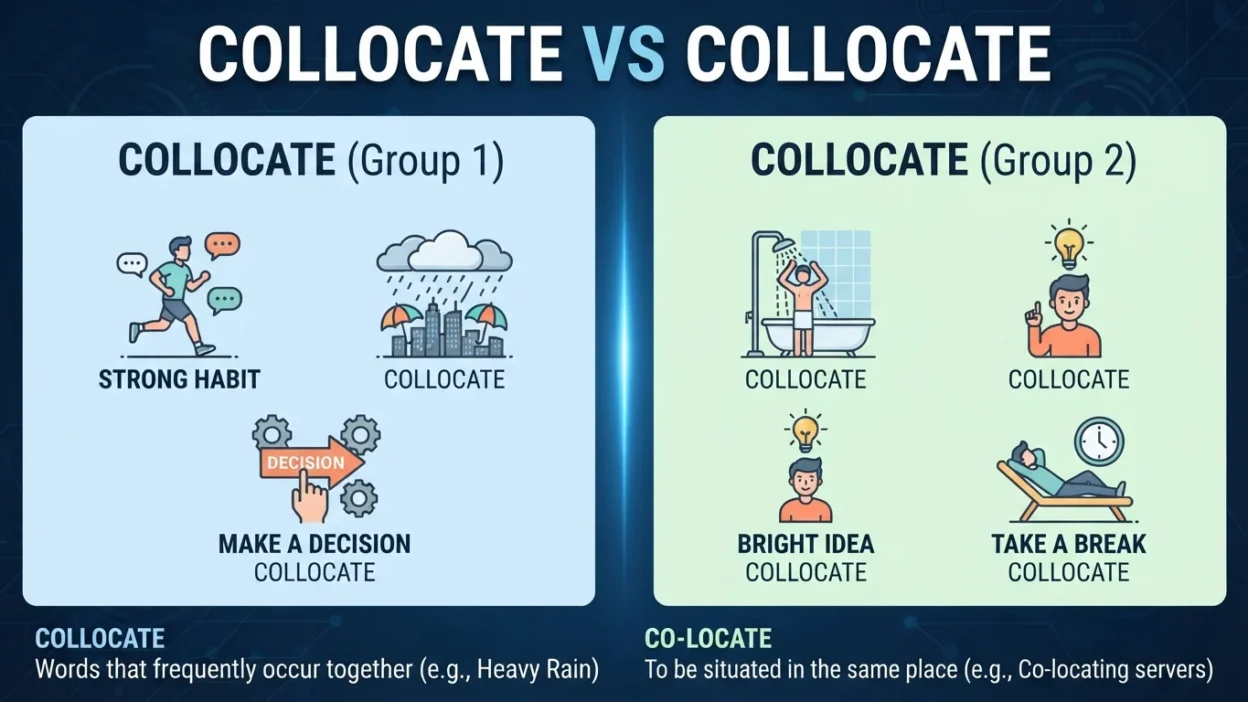
If you have ever hesitated between collocate vs colocate, you are not alone.
These two words look almost identical, and both are legitimate English words.
However, they are used in different contexts and carry different meanings.
Knowing the distinction can help you avoid an awkward spelling mistake in academic writing, professional communication, technical documents, or everyday English.
The confusion becomes even greater because collocate has more than one meaning, while colocate is a specialized term that appears frequently in business, technology, telecommunications, and real estate.
Although the words share the idea of things being together, their histories, meanings, and typical uses are not the same. Let’s break down the difference in a simple, practical way.
Quick Answer: Collocate vs Colocate
Collocate is the standard word when you mean that words commonly occur together, or that things are placed together in a particular location.
Colocate is a specialized spelling generally used to mean to locate two or more things together, particularly in technical, business, or telecommunications contexts.
| Word | Main meaning | Common context |
|---|---|---|
| Collocate | To place together; or words that commonly occur together | Linguistics, general English |
| Colocate | To locate or operate things together | Technology, business, telecommunications |
For language and vocabulary, collocate is the word you almost certainly need.
What Does “Collocate” Mean?
Collocate has two closely related uses in English.
First, as a verb, it can mean to place or arrange things together.
For example:
“The designers decided to collocate the two departments.”
Second, and more commonly in modern language studies, collocate refers to words that frequently appear together.
For example, strong and coffee can be described as collocates because “strong coffee” is a natural English combination.
Similarly:
- make a decision
- heavy rain
- deep sleep
- strong argument
- fast food
These are examples of common word collocations.
Collocate in linguistics
In linguistics, a collocation is a combination of words that commonly occur together in natural language.
For example:
“She made a decision.”
English speakers naturally say make a decision, rather than “do a decision.”
The words make and decision therefore have a strong collocational relationship.
This meaning is especially important for English learners because knowing individual vocabulary words is not always enough. Understanding which words naturally go together can make your English sound more fluent and idiomatic.
What Does “Colocate” Mean?
Colocate is a less common and more specialized word. It means to locate things together or in the same place.
The term is particularly common in technical and business contexts.
For example:
“The company plans to colocate its servers in a secure data center.”
Here, colocate means to place or maintain equipment together in a shared facility.
Another example:
“Several network providers colocate their equipment in the same building.”
In this context, the word has nothing to do with linguistic collocations. It describes physical or operational proximity.
Colocation in technology
One of the most common uses of colocate is in information technology.
Colocation, often shortened to colo, refers to a situation where an organization places its servers or other computing equipment in a specialized data center rather than maintaining them entirely on its own premises.
A colocation facility may provide:
- Physical security
- Electricity
- Cooling
- Internet connectivity
- Backup power
- Network infrastructure
- Equipment space
For example:
“The startup chose to colocate its servers to improve reliability and connectivity.”
In this technical context, colocate is the appropriate spelling.
Collocate vs Colocate: Comparison Table
| Feature | Collocate | Colocate |
|---|---|---|
| Basic idea | Occur or be placed together | Be located together |
| Common field | Linguistics and general English | Technology and business |
| Related noun | Collocation | Colocation |
| Common example | “These words collocate frequently.” | “The company will colocate its servers.” |
| Language learning | Very common | Rare |
| IT usage | Possible but not the usual term | Very common |
| Spelling | Double l | Single l |
The easiest way to distinguish the two is to consider context.
If you are talking about words occurring together, choose collocate.
If you are talking about equipment, companies, offices, or systems being located together, colocate may be the intended technical term.
Collocate as a Verb: Examples
Here are several examples of collocate in different contexts.
Linguistics
“The adjective ‘heavy’ commonly collocates with ‘rain.’”
“Certain verbs collocate naturally with particular nouns.”
“Students should learn which adjectives collocate with specific nouns.”
General placement
“The hospital decided to collocate several specialist services.”
“The organization plans to collocate its administrative teams.”
The linguistic sense is especially common in dictionaries, corpus linguistics, language teaching, and academic writing.
Colocate as a Verb: Examples
Colocate is more likely to appear in technical, corporate, or infrastructure-related writing.
“The company will colocate its networking equipment in a secure facility.”
“Several businesses colocate their servers at the same data center.”
“The two research teams decided to colocate their laboratories.”
“The provider allows customers to colocate hardware in its facilities.”
These examples emphasize shared physical location rather than the relationship between words.
Collocate vs Collocation
It is helpful to understand the relationship between collocate and collocation.
A collocate can be a word that commonly appears alongside another word.
A collocation is the combination or relationship between words.
For example:
“Heavy rain” is a common English collocation.
In this expression, heavy and rain are collocates.
Other common collocations include:
- Catch a cold
- Pay attention
- Take responsibility
- Break a promise
- Strong evidence
- Major problem
- Fast asleep
Learning collocations is an important part of developing natural English because native speakers tend to use familiar combinations automatically.
Colocate vs Co-locate
You may also encounter co-locate with a hyphen.
For example:
“The teams will co-locate in the new office.”
The forms colocate, co-locate, and related forms such as colocation can appear in technical and professional writing. Usage can vary by organization, industry, and style guide.
If you are writing for a particular company, publication, or technical audience, it is worth following that organization’s preferred style.
The important point is that colocate has a different specialized meaning from the linguistic term collocate.
American vs British English Differences
There is no major American-versus-British distinction that changes the fundamental meanings of collocate and colocate.
Both varieties of English use collocate in linguistic contexts.
For example:
“These words frequently collocate.”
The technical term colocate is also used in both American and British professional English, particularly in computing, telecommunications, and infrastructure discussions.
However, spelling preferences can vary between organizations, especially regarding co-locate versus colocate. When producing formal technical documents, consistency with the relevant style guide is more important than assuming that one national variety always uses one form.
Common Mistakes With Collocate and Colocate
1. Using “colocate” when discussing word combinations
This is a frequent mistake among English learners and writers unfamiliar with linguistic terminology.
Less appropriate:
“These two words colocate naturally.”
Better:
“These two words collocate naturally.”
When the subject is vocabulary or language, collocate is the standard choice.
2. Using “collocate” in a technical context without checking the intended terminology
In technology, colocate has a specific meaning involving shared physical or operational location.
For example:
“The company colocates its servers in a data center.”
Using collocate here could confuse readers because the double-l spelling strongly suggests the linguistic term.
3. Confusing “collocate” with “collocation”
These words are related but not identical.
- Collocate: a verb, or a word that commonly occurs with another word.
- Collocation: a natural or frequent combination of words.
For example:
“Fast” and “food” form a common collocation.
4. Assuming similar spelling means identical meaning
The two words share a general idea of things being together, but context matters.
Collocate is strongly associated with language and word relationships.
Colocate is strongly associated with shared physical or technical locations.
How to Remember the Difference
A simple memory trick can make this distinction easier.
Think of the extra L in collocate as standing for language.
COLLocate → Language
When discussing words that naturally occur together, think collocate.
For colocate, think:
CO + LOCATE → locate together
This is particularly useful when dealing with technical terms such as colocation facility, colocation data center, and colocated servers.
Why Collocations Matter in English
Understanding collocations is more than an academic exercise. They are essential for writing and speaking naturally.
A learner may know the words make, decision, do, and choice, but native usage determines which combinations sound natural.
We say:
“Make a decision.”
We generally do not say:
“Do a decision.”
Similarly, English speakers naturally use combinations such as:
- “Strong coffee”
- “Heavy traffic”
- “High temperature”
- “Deep concern”
- “Closely related”
- “Fully aware”
Learning these combinations improves vocabulary, fluency, writing style, and comprehension.
FAQs About Collocate vs Colocate
Is “collocate” or “colocate” correct?
Both are legitimate words, but they have different uses. Collocate is commonly used for words that naturally occur together, while colocate is commonly used for locating things together, especially in technical contexts.
What does collocate mean in linguistics?
In linguistics, collocate refers to a word that frequently occurs with another word. For example, “heavy” is a common collocate of “rain.”
What does colocate mean in IT?
In IT, colocate generally means placing servers, networking equipment, or other infrastructure in a shared facility. This is commonly associated with colocation data centers.
Is “colocate” one word or two?
Colocate is written as one word in many modern technical contexts. You may also encounter co-locate, particularly in certain professional or editorial styles.
What is the noun form of collocate?
The noun collocation describes a common or natural combination of words. For example, “make a decision” is a common English collocation.
What is the noun form of colocate?
The noun is colocation or co-location, depending on the style being followed. In technology, colocation commonly refers to housing equipment in a shared data center.
Are collocate and colocate pronounced the same?
They may be pronounced similarly, which contributes to the confusion. Their spelling and meanings, however, differ according to context.
Final Summary
The distinction between collocate vs colocate mainly comes down to context. Collocate is especially important in linguistics and English language learning, where it describes words that naturally or frequently occur together. Expressions such as “heavy rain,” “make a decision,” and “strong evidence” contain familiar collocations, and the words within those combinations can be described as collocates.
Colocate, meanwhile, is a specialized term meaning to locate or operate things together. It is particularly common in technology, telecommunications, business, and data-center discussions. Although both words involve the idea of things being together, they serve different purposes. Choosing the correct spelling makes your writing clearer and helps readers immediately understand what you mean.
Actionable Takeaway
When choosing between collocate vs colocate, look at what you are describing:
- Words occurring together → collocate
- Things or equipment located together → colocate
- A common word combination → collocation
- Shared technical infrastructure → colocation
If you are writing about vocabulary, grammar, or natural word combinations, choose collocate. If you are writing about servers, offices, facilities, or infrastructure sharing a location, colocate is generally the appropriate technical term.

John Robert is a passionate author and faith-driven writer who contributes insightful and inspiring biblical content to Biblenast. With a strong commitment to sharing God’s Word, he focuses on creating meaningful messages that encourage spiritual growth, reflection, and daily guidance. His work aims to connect readers with the timeless teachings of the Bible.