
Have you ever wondered whether you should say replicate vs duplicate when talking about making a copy?
The two words are closely related, and in everyday English, they can sometimes be used interchangeably.
However, they often emphasize different ideas.
Understanding that difference can help you choose the more precise word in writing, conversation, business, science, technology, and everyday situations.
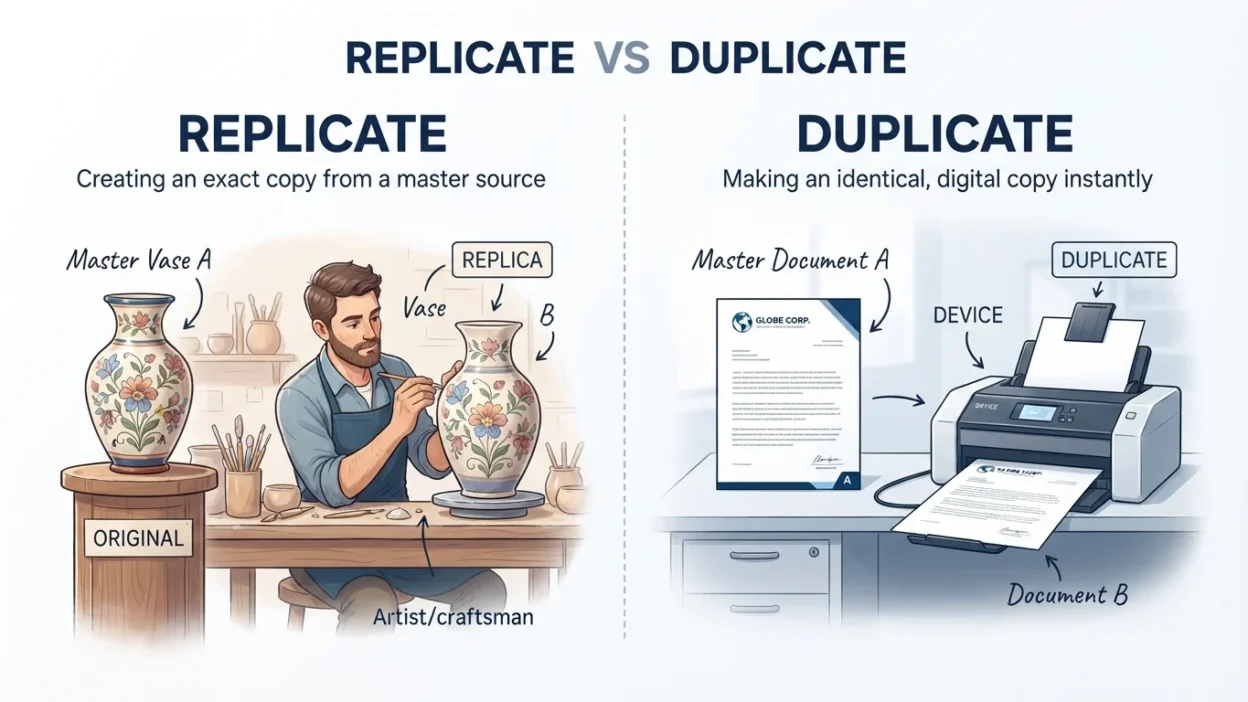
In simple terms, duplicate usually means making an additional copy of something, while replicate often means reproducing something so that it closely matches the original.
The distinction becomes especially important when talking about research, experiments, designs, processes, data, or results.
This guide explains the meanings, differences, examples, common mistakes, and practical usage of both words.
Quick Answer: Replicate vs Duplicate
Duplicate usually means to make an additional copy of something.
Replicate generally means to reproduce something, often by following the original model, process, or conditions.
For example:
- Duplicate the document = make another copy of the document.
- Replicate the experiment = perform the experiment again using the same or similar method.
- Duplicate a key = make a copy of a key.
- Replicate the design = reproduce the design closely.
So, duplicate focuses more on creating a copy, whereas replicate often focuses on reproducing something or achieving a similar result.
What Does Duplicate Mean?
Duplicate can function as both a verb and a noun, and it is also commonly used as an adjective.
As a verb, duplicate means to make an exact or nearly exact copy of something.
Examples:
- Please duplicate this report for the entire team.
- I need to duplicate the house key.
- The technician duplicated the file before making changes.
As a noun, a duplicate is a copy of something.
- Keep a duplicate of the receipt for your records.
- I accidentally received a duplicate of the invoice.
As an adjective, duplicate describes something that is an additional copy or identical version.
- The system detected a duplicate entry.
- We found duplicate files on the computer.
The central idea behind duplicate is therefore copying or creating an additional version.
What Does Replicate Mean?
Replicate also means to reproduce or make a copy of something, but it often carries a slightly different sense.
As a verb, replicate can mean to reproduce something closely, recreate a process, or produce a similar result.
Examples:
- Scientists attempted to replicate the experiment.
- The artist tried to replicate the original painting.
- The company wants to replicate its successful business model.
- Engineers successfully replicated the machine’s design.
In scientific and academic contexts, replicate has a particularly important meaning. Researchers may replicate a study or experiment to determine whether similar methods produce similar results.
The word can therefore emphasize reproduction of a process, method, design, effect, or outcome, rather than simply creating another physical copy.
Replicate vs Duplicate: Key Difference
The easiest way to remember the distinction is:
Duplicate = make another copy.
Replicate = reproduce something closely, often by repeating its method, structure, or characteristics.
Consider a research paper.
If you duplicate a research document, you are simply making another copy of the document.
If you replicate the research, you are conducting the research again, usually using the same or comparable methods.
This distinction becomes especially useful in professional and technical writing.
| Feature | Duplicate | Replicate |
|---|---|---|
| Basic meaning | Make a copy | Reproduce or recreate |
| Main focus | Copy or additional version | Reproduction of a thing, process, or result |
| Common with files | Very common | Less common |
| Common in research | Less common | Very common |
| Common with experiments | Possible, but unusual | Very common |
| Can refer to a process? | Sometimes | Yes |
| Can refer to a result? | Less natural | Common |
| Example | Duplicate the file | Replicate the experiment |
When Should You Use Duplicate?
Use duplicate when your main idea is that there is another copy of something.
1. Documents and files
- Duplicate the spreadsheet before editing it.
- I made a duplicate of the presentation.
- The computer created a duplicate file.
2. Keys and physical objects
- Can you duplicate this key?
- The manufacturer duplicated the original component.
3. Records and entries
- The database contains duplicate records.
- Please remove the duplicate customer entries.
4. Copies of information
- Keep a duplicate of your important documents.
- We need a duplicate invoice for our records.
In these situations, duplicate sounds natural because the emphasis is on an additional copy.
When Should You Use Replicate?
Use replicate when you mean to reproduce something closely, particularly a method, process, design, behavior, or result.
1. Scientific experiments
- Other researchers tried to replicate the experiment.
- The team replicated the study under different conditions.
2. Business strategies
- The company hopes to replicate its success in other markets.
- The manager developed a strategy that could be replicated across multiple branches.
3. Designs and models
- The engineer replicated the original structure.
- The manufacturer replicated the prototype.
4. Processes
- The software allows users to replicate the same workflow.
- The team successfully replicated the production process.
Here, replicate suggests reproduction with attention to the original characteristics or method.
Can Replicate and Duplicate Be Used Interchangeably?
Sometimes, yes.
In general conversation, the distinction can be quite flexible. For example, duplicate and replicate can both describe creating a copy of a design.
However, replacing one with the other can change the emphasis.
Compare:
- Duplicate the document.
- Replicate the experiment.
The first sentence asks someone to make another document copy. The second asks someone to perform an experiment again.
Saying duplicate the experiment is possible in some contexts, but replicate the experiment is much more natural in scientific and academic English.
Similarly, duplicate the file is more natural than replicate the file when you simply want another digital copy.
Replicate vs Duplicate in Research and Science
The distinction is especially important in scientific writing.
When researchers replicate an experiment, they repeat the experiment using the same or sufficiently similar procedures to see whether the findings can be reproduced.
For example:
Researchers attempted to replicate the original experiment.
This does not necessarily mean they copied the original experiment physically. It means they repeated the research procedure.
By contrast:
Researchers duplicated the dataset.
This means they made another copy of the data.
Therefore, in research contexts:
- Replicate a study → conduct it again to test whether similar findings can be obtained.
- Duplicate a dataset → create another copy of the dataset.
- Replicate a result → obtain a similar result through reproduction.
- Duplicate a document → make another copy of the document.
This distinction is useful for students, researchers, journalists, and anyone writing technical or academic content.
Replicate vs Duplicate in Business
Both words are common in business, but they often serve different purposes.
Duplicate is frequently used for administrative and digital tasks:
- duplicate an invoice
- duplicate a record
- duplicate a spreadsheet
- duplicate a report
Replicate is often used when discussing successful systems, strategies, or business models:
- replicate a successful strategy
- replicate a business model
- replicate a successful process
- replicate results across locations
For example:
Natural:
“The company wants to replicate its successful marketing strategy in other countries.”
Here, the company is not merely making a physical copy. It wants to reproduce the strategy and achieve comparable results.
Common Mistakes to Avoid
Mistake 1: Assuming the words always mean exactly the same thing
Although they overlap, their usual emphasis differs.
Instead of automatically choosing one, ask yourself:
Am I making another copy, or am I reproducing something more broadly?
Mistake 2: Using duplicate for scientific research
“Duplicate the experiment” may be understandable, but replicate the experiment is generally the more appropriate expression in scientific contexts.
Mistake 3: Using replicate for ordinary file copies
You could potentially say that a file was replicated, particularly in technical contexts, but duplicated is usually clearer when you simply mean that another copy was created.
Mistake 4: Thinking replicate always means an identical copy
Replication does not always require absolute identity. In research, for example, a replicated experiment can involve comparable procedures and conditions while still being performed independently.
Mistake 5: Confusing replicate with imitate
These words are related but not identical.
Imitate means to copy someone’s behavior, appearance, or style.
Replicate generally means to reproduce something closely.
For example:
- The child imitated his father’s accent.
- The engineer replicated the machine’s design.
American vs British English: Replicate vs Duplicate
There is no major American-versus-British difference in the basic meanings of replicate and duplicate. Both varieties of English use both words in broadly the same ways.
The more important difference is context and register, not geography.
In both American and British English:
- duplicate a document is natural.
- duplicate a file is natural.
- replicate an experiment is natural.
- replicate a successful process is natural.
Scientific, technical, and professional writing may use replicate frequently because the word is useful for describing reproducibility and repeated processes.
Synonyms and Related Words
Understanding related vocabulary can make the distinction even clearer.
Synonyms for Duplicate
Depending on context, alternatives include:
- copy
- reproduce
- clone
- double
- make a copy of
- make an additional version
Synonyms for Replicate
Possible alternatives include:
- reproduce
- recreate
- repeat
- re-create
- reproduce closely
- emulate
- reproduce the results
However, these words are not always interchangeable. The best choice depends on the exact meaning you want to communicate.
How to Remember the Difference
Use this simple memory trick:
Duplicate = another copy.
Replicate = reproduce the original thing, process, or result.
Think about a document and an experiment:
- You duplicate a document.
- You replicate an experiment.
Think about a business:
- You duplicate a file.
- You replicate a successful strategy.
This quick distinction will help you choose the right word in most everyday situations.
Frequently Asked Questions
Is replicate the same as duplicate?
Not always. Both can mean making a copy, but duplicate usually emphasizes an additional copy, while replicate often emphasizes reproducing something such as a process, design, experiment, or result.
Is it correct to say “duplicate an experiment”?
It is understandable, but replicate an experiment is generally more natural and precise, particularly in scientific and academic contexts.
Is it correct to say “replicate a file”?
It can be correct in some technical contexts, but duplicate a file is usually clearer when you simply mean creating another copy.
What is the difference between replicate and reproduce?
Both words can mean to make something again. Replicate often emphasizes reproducing something closely, especially a process, experiment, design, or result. Reproduce is broader and can refer to copying, recreating, or producing something again.
Can you replicate a person?
The word can be used in contexts involving biological replication, fictional or technological reproduction, or closely recreating someone’s appearance or characteristics. In ordinary situations, however, imitate or copy may be more appropriate depending on the intended meaning.
Which word is better for academic writing?
It depends on the context. Replicate is particularly useful when discussing repeated experiments, studies, methods, findings, or processes. Duplicate is appropriate when referring to an additional copy of a document, dataset, or other material.
Is “replicate” more formal than “duplicate”?
Not necessarily. Both words can be used in formal and informal English. Replicate may sound more technical or specialized in contexts such as science, engineering, and business strategy.
Final Summary
The difference between replicate vs duplicate is mainly about what you are reproducing. Duplicate usually means making another copy of something, such as a document, file, key, record, or invoice. Replicate often means reproducing something more broadly, such as an experiment, process, design, strategy, or result. Although the words overlap, choosing the one that matches your intended meaning makes your writing clearer and more precise.
A useful rule is simple: duplicate a copy, replicate a process or result. When you are talking about ordinary files or documents, duplicate will often be the natural choice. When you are talking about research, experiments, successful methods, designs, or outcomes, replicate is frequently more appropriate. Paying attention to context is more important than trying to treat the two words as completely interchangeable.
Actionable Takeaway
Before choosing between replicate and duplicate, ask yourself:
- Am I making another copy? → Use duplicate.
- Am I reproducing a process or experiment? → Use replicate.
- Am I reproducing a strategy, design, or result? → Replicate is often the better choice.
- Am I creating another file, record, or document? → Duplicate is usually clearer.
When in doubt, focus on the meaning you want the reader to understand rather than simply choosing the more formal-sounding word.

John Robert is a passionate author and faith-driven writer who contributes insightful and inspiring biblical content to Biblenast. With a strong commitment to sharing God’s Word, he focuses on creating meaningful messages that encourage spiritual growth, reflection, and daily guidance. His work aims to connect readers with the timeless teachings of the Bible.