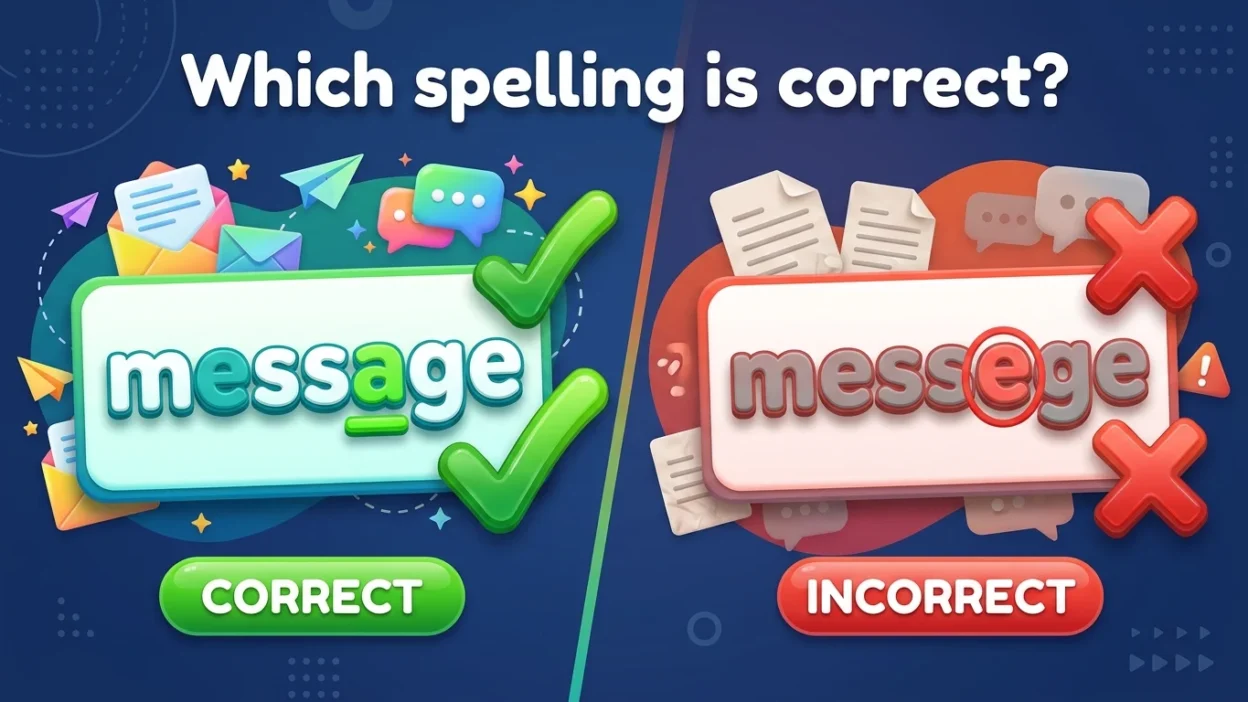
Are you unsure whether to write “message” or “messege”?
These words may look similar, but only one is the correct spelling in standard English.
If you are writing a text message, sending a professional email, or completing a school assignment, using the right spelling helps you communicate clearly and confidently.
The correct spelling is message, not messege.
The word message is a noun meaning a piece of information communicated to someone, and it can also be a verb meaning to send someone a message.
For example, you might say, “I received your message,” or “Please message me when you arrive.”
Although messege is a common spelling mistake, it is not an accepted standard English spelling.
Understanding why the error happens, learning how to spell the word correctly, and practicing it in everyday sentences can help you avoid this mistake in both formal and informal writing.
Quick Answer: Message or Messege?
Message is the correct spelling in standard English. Messege is a misspelling and should not be used in formal or informal writing. A message is information sent from one person to another, such as a text, email, note, or spoken communication. Remember the spelling: M-E-S-S-A-G-E.
Why Do People Confuse Message and Messege?
People often confuse message and messege because the words look almost identical. The difference is the vowel after the letters ss: the correct spelling uses a, not e.
The pronunciation can also contribute to the confusion. In many English accents, the unstressed vowel in message sounds similar to a short “uh” sound. This may make the correct vowel less obvious to English learners.
Here are the key points to remember:
- Message: The correct English spelling.
- Messege: An incorrect spelling.
- Reason for confusion: The similar appearance and the unstressed vowel sound.
Because spelling mistakes can happen even to fluent English speakers, it helps to memorize the correct form and check it when writing important messages.
What Does Message Mean?
Message is a noun that refers to information, a statement, or an idea communicated from one person or source to another. It can be delivered through speech, writing, electronic communication, or other methods.
Message as a Noun
As a noun, message refers to the information being communicated.
Examples:
- I received your message this morning.
- She left a message for her manager.
- His email contained an important message.
- The teacher sent a message to the parents.
A message can be short or long, personal or professional, and direct or indirect.
Message as a Verb
Message can also be used as a verb meaning to send someone a written or electronic message.
Examples:
- Please message me when you get home.
- I will message you the details tonight.
- She messaged her colleague about the meeting.
- You can message the support team for assistance.
The verb is commonly used in everyday digital communication, including texting, chat applications, and social media.
What Does Messege Mean?
Messege is a misspelling of message. It has no recognized standard meaning as an English word in ordinary writing.
For example:
Incorrect: “I sent you a messege yesterday.”
Correct: “I sent you a message yesterday.”
The mistake does not change the intended meaning in most situations, so readers may still understand what you want to say. However, spelling message correctly is important in professional emails, academic assignments, business communication, and published content.
If you see messege in a draft, correct it to message.
Message vs Messege: Comparison Table
| Feature | Message | Messege |
|---|---|---|
| Spelling status | Correct | Incorrect |
| Standard English word | Yes | No |
| Meaning | Information communicated to someone | No standard meaning |
| Part of speech | Noun and verb | Misspelling |
| Example | I received your message. | I received your messege. |
| Appropriate for formal writing | Yes | No |
The distinction is straightforward: always use message when referring to information that is communicated or to the act of sending someone a message.
When Should You Use Message or Messege?
There is no situation in standard English where messege should replace message. The correct choice is always message when you mean a piece of communication.
Use Message in Everyday Communication
Use message when referring to a text, note, email, notification, or other communication.
Examples:
- I sent a message to my friend.
- Your message made me smile.
- Did you get my message?
- Please leave a message after the tone.
Use Message in Professional Writing
The word is also appropriate in formal and workplace settings.
Examples:
- The manager sent a message about the updated schedule.
- We received your message and will respond shortly.
- Please include your contact details in the message.
- The company communicated its main message to customers.
Avoid Messege in All Standard Writing
Do not use messege in emails, schoolwork, reports, social media posts, or other writing. Even when the intended meaning is clear, it is still a spelling error.
12 Examples of Message Used Correctly in Sentences
Here are 12 practical examples to help you understand how to use message naturally.
- I received your message late last night.
- Please send me a message when you reach home.
- She left a message on my phone.
- The teacher sent a message to all the students.
- I forgot to reply to your message yesterday.
- He messaged me about the upcoming interview.
- The company sent a message confirming my appointment.
- Could you please message me the address?
- Her message explained everything clearly.
- I have an important message for you.
- The application notified me that a new message had arrived.
- Please check your messages before the meeting begins.
In every example, message is spelled with a after ss.
Common Spelling Mistakes to Avoid
Mistake 1: Writing Messege Instead of Message
Incorrect: “I will send you a messege.”
Correct: “I will send you a message.”
The correct spelling contains -sage, not -sege.
Mistake 2: Forgetting the Correct Vowel
Incorrect: M-E-S-S-E-G-E
Correct: M-E-S-S-A-G-E
Pay attention to the letter a in the middle of the word.
Mistake 3: Assuming the Wrong Spelling Is Acceptable in Texting
People sometimes make spelling errors in quick messages, but messege remains incorrect. Informal communication does not change the standard spelling.
Mistake 4: Confusing Message With Messenger
A message is the information being communicated. A messenger is a person or service that delivers it.
For example:
- “I received a message.”
- “The messenger delivered the message.”
These words are related but have different meanings.
Mistake 5: Forgetting the Double S
The correct spelling contains two s letters: me-ss-age. Remember both the double s and the a that follows them.
What Is an Easy Memory Trick for Message?
Use this simple spelling trick:
Message = MESS + AGE
Think of the word as two parts: MESS and AGE. The full spelling is M-E-S-S-A-G-E.
You can also remember the sentence:
“A message always has an A.”
This reminder helps you avoid writing messege by mistake.
If you are unsure while writing, say the letters aloud: “M-E-S-S-A-G-E.” Repeating the correct spelling a few times can help you remember it.
American vs British English: Is There a Difference?
There is no spelling difference between American and British English for the word message. Both varieties use the same spelling and meaning.
| Usage | American English | British English |
|---|---|---|
| Message | Correct | Correct |
| Messege | Incorrect | Incorrect |
| Text message | Correct | Correct |
| Leave a message | Correct | Correct |
| Message someone | Correct | Correct |
Some related words have different American and British spellings, such as color and colour, but message is not one of them.
Whether you are writing for an American, British, Australian, or other English-speaking audience, use message.
Similar Words You Should Know
Learning related words can improve your vocabulary and help you communicate more precisely.
- Messenger: A person or service that delivers a message.
- Messaging: The act or process of exchanging messages.
- Text: A written communication, especially one sent electronically.
- Notification: An alert that informs you about an event or update.
- Note: A short written piece of information.
- Communication: The process of sharing information, ideas, or feelings.
- Message board: A place or online platform where people post messages.
- Mismessage: A rare term that may refer to a wrongly communicated message, but it is not a common everyday substitute for message.
For example, you might receive a notification that someone has sent you a message. The notification alerts you, while the message contains the actual information.
Final Verdict: Message or Messege?
The correct spelling is message. The spelling messege is incorrect in standard English and should be avoided.
Use message as a noun when referring to information communicated to someone, such as a text, email, or note. You can also use it as a verb when describing the act of sending someone a message.
Remember these two details: the word contains a double s, followed by the letter a. The correct spelling is M-E-S-S-A-G-E.
Whether you are chatting with friends, writing a business email, or completing an academic assignment, using the correct spelling makes your writing clearer and more professional.
Frequently Asked Questions
1. Is it message or messege?
Message is correct. Messege is a spelling mistake and is not the standard English form.
2. How do you spell message correctly?
The correct spelling is M-E-S-S-A-G-E. Remember the double s followed by a.
3. What does message mean?
A message is information, an idea, or a statement communicated from one person or source to another. It can be delivered through text, email, speech, or other forms of communication.
4. Is messege a real English word?
No. Messege is not a standard English word with an accepted ordinary meaning. It is a misspelling of message.
5. Is message spelled the same in American and British English?
Yes. Both American and British English use the spelling message. There is no regional spelling variation for this word.
6. Can message be used as a verb?
Yes. Message can be a verb meaning to send someone a written or electronic communication. For example, “I will message you later.”
7. Why do people spell message as messege?
People may confuse the vowels because the unstressed sound in message is not always easy to identify from pronunciation alone. Remembering the correct spelling or using a spellchecker can help prevent the mistake.
Remember This
- Message is the correct spelling.
- Messege is incorrect.
- A message can be a noun or a verb.
- The correct spelling is M-E-S-S-A-G-E.
- American and British English use the same spelling.
Conclusion
The difference between message and messege is simple: only message is correct in standard English. It refers to information communicated through a text, email, note, conversation, or another method. It can also describe the act of sending someone a written or electronic communication.
Although messege may appear in casual writing because of typing errors or confusion about pronunciation, it should always be corrected to message. Remember to include the double s and the letter a that follows them. With this simple spelling rule, you can write confidently in personal conversations, professional emails, school assignments, and online communication.

John Robert is a passionate author and faith-driven writer who contributes insightful and inspiring biblical content to Biblenast. With a strong commitment to sharing God’s Word, he focuses on creating meaningful messages that encourage spiritual growth, reflection, and daily guidance. His work aims to connect readers with the timeless teachings of the Bible.