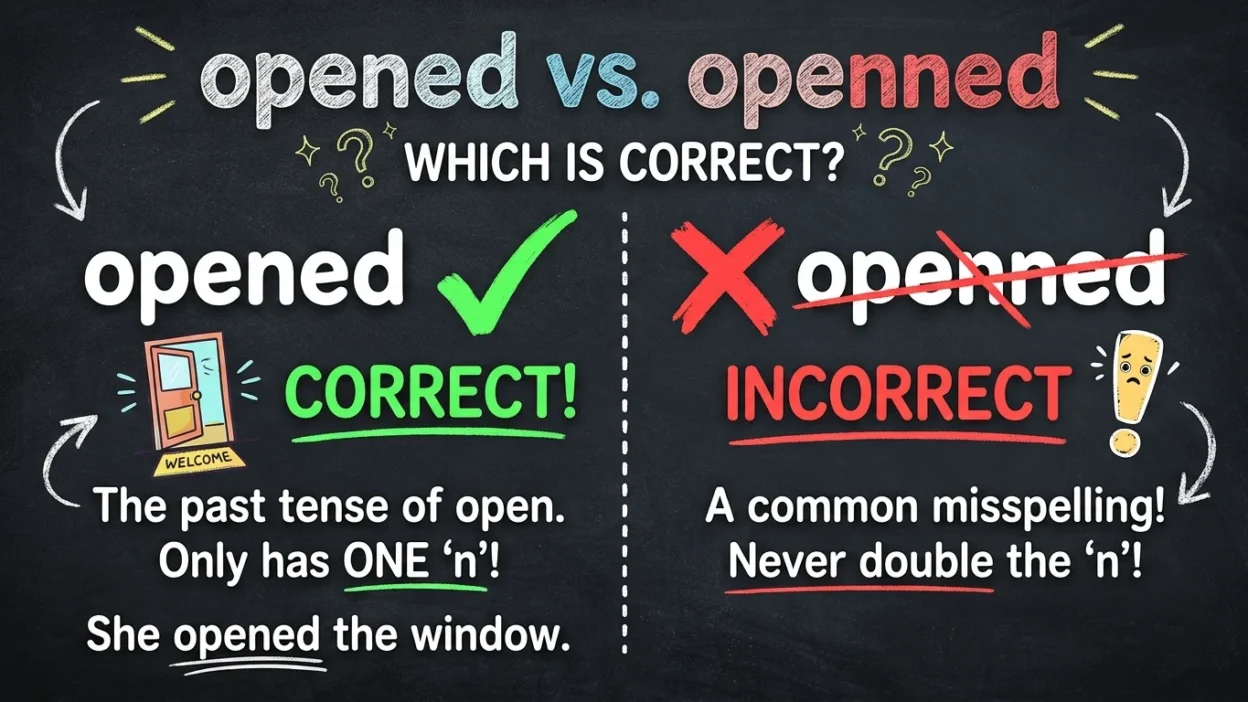
Have you ever wondered whether to write opened or openned?
Although both spellings may look reasonable, only one is correct in standard English.
The correct spelling is opened, with one “n” and the ending “ ed.”
The word “openned” is a common spelling mistake and should not be used in formal writing, school assignments, emails, or professional documents.
The confusion usually comes from the way English forms past-tense verbs. Some verbs double their final consonant before adding “-ed,” such as “stopped” and “planned.”
However, the verb “open” follows a different spelling pattern. You simply add “-ed” to form “opened.”
Understanding this rule will help you avoid similar mistakes and improve your everyday writing.
If you are describing a door that someone opened, a shop that began operating, or a message that you read, knowing the correct spelling makes your writing clearer and more accurate.
Quick Answer: Opened or Openned?
Opened is the correct spelling in standard English. It is the simple past tense and past participle of the verb “open.” Openned is incorrect because the word does not require a doubled “n” before the “-ed” ending. For example, write “She opened the door,” not “She openned the door.”
Why Do People Confuse Opened and Openned?
People often confuse these spellings because English sometimes requires doubling the final consonant when adding “-ed” to a verb.
For example:
- Stop → stopped
- Plan → planned
- Drop → dropped
Seeing these words may lead learners to assume that “open” should become “openned.” However, English spelling rules depend on the structure and stress pattern of a word.
The verb “open” has two syllables: o-pen. Its stress falls on the first syllable, not the final one. Therefore, the final “n” is not doubled when adding “-ed.”
Remember that spelling rules have exceptions, but “opened” is the standard form used in all varieties of English.
What Does “Opened” Mean?
Opened is the past tense and past participle of “open.” It describes an action involving making something accessible, uncovered, available, or no longer closed.
The exact meaning depends on the context.
Examples of “Opened” in Sentences
- She opened the window to let in fresh air.
- The manager opened the store at nine o’clock.
- He opened the letter carefully.
- The school opened a new library last month.
- I have opened your email.
In these sentences, “opened” describes a completed action or an action connected to the present.
It can also refer to opportunities or activities becoming available. For example, “The announcement opened new possibilities for the company.”
What Does “Openned” Mean?
Openned is a misspelling of “opened.” It has no separate standard meaning in modern English.
You may encounter it in informal online posts, typing errors, or writing by English learners. However, its appearance does not make it an accepted spelling.
Incorrect: He openned the box yesterday.
Correct: He opened the box yesterday.
If you are writing an essay, report, business email, social media post, or other English text, always use “opened.”
Opened vs Openned: Comparison Table
| Feature | Opened | Openned |
|---|---|---|
| Spelling status | Correct | Incorrect |
| Number of “n” letters | One | Two |
| Standard English usage | Yes | No |
| Grammatical role | Past tense and past participle | No standard grammatical role |
| Example | She opened the door. | She openned the door. |
| Suitable for formal writing | Yes | No |
The main difference is spelling accuracy. Both forms may be intended to express the same action, but only “opened” is correct.
When Should You Use “Opened” or “Openned”?
When to Use “Opened”
Use “opened” whenever you need the past tense or past participle of the verb “open.”
Use it when describing:
- Physical actions: She opened the cupboard.
- Businesses beginning operations: The restaurant opened last week.
- Letters or messages being accessed: I opened the email.
- New opportunities becoming available: The project opened new doors for graduates.
- Events or meetings beginning: The speaker opened the meeting with a short introduction.
When to Avoid “Openned”
Avoid “openned” in standard English writing because it is a spelling error.
Do not use it in:
- Academic assignments
- Professional emails
- Business reports
- Published articles
- Formal letters
- Exams and language tests
If your spellchecker identifies “openned” as incorrect, replace it with “opened.”
12 Examples of “Opened” in Everyday English
Here are practical examples showing how to use the correct spelling in different situations.
- She opened the door slowly.
The door was previously closed. - I opened my book to page twenty.
The action involved making the book accessible at a particular page. - The bank opened a new branch downtown.
A new business location began operating. - He opened the gift with excitement.
He removed the wrapping or covering. - They opened the meeting with a welcome speech.
The meeting began with an introductory speech. - The museum opened its doors to visitors.
Visitors were allowed to enter. - I have opened the document you sent me.
The document has been accessed. - The flowers opened in the morning sunlight.
The flowers unfolded. - She opened a savings account last year.
She established an account with a bank. - The discussion opened my mind to new ideas.
The discussion helped me consider different perspectives. - The new road opened yesterday.
The road became available for public use. - He opened the conversation by asking a question.
He started the conversation.
Notice that “opened” works in many contexts, but its spelling remains unchanged.
Common Mistakes to Avoid
Even though “opened” is a simple word, several common errors can appear in everyday writing.
Mistake 1: Doubling the Final “N”
Incorrect: She openned the package.
Correct: She opened the package.
The verb “open” does not require a doubled consonant before “-ed.”
Mistake 2: Assuming Every Verb Follows the Same Rule
Incorrect assumption: Every verb ending in a consonant doubles that consonant before “-ed.”
Correct understanding: Consonant doubling depends on spelling patterns, syllable structure, and stress.
Compare:
- Hop → hopped
- Open → opened
- Visit → visited
- Plan → planned
Mistake 3: Using “Openned” in Formal Documents
Incorrect: The company openned a new office.
Correct: The company opened a new office.
Always proofread important documents to catch this error.
Mistake 4: Confusing Past Tense With Past Participle
“Opened” serves as both the simple past tense and the past participle.
- Simple past: She opened the window.
- Present perfect: She has opened the window.
- Past perfect: She had opened the window.
You do not need a different spelling for these grammatical forms.
Memory Trick: How to Remember “Opened”
A simple way to remember the correct spelling is:
Open + ed = Opened
Keep the original word “open” intact and add “-ed” to the end. Do not add another “n.”
You can also remember this sentence:
“I open the door today, and I opened it yesterday.”
The spelling of “open” stays the same before the past-tense ending.
Practising this sentence a few times can help you remember the correct form naturally.
American vs British English: Is There a Difference?
There is no spelling difference between American and British English for this word.
Both varieties use opened as the correct spelling.
| Variety of English | Correct spelling | Example |
|---|---|---|
| American English | Opened | The store opened early. |
| British English | Opened | The shop opened early. |
| Australian English | Opened | The office opened at nine. |
| Canadian English | Opened | The library opened yesterday. |
Words surrounding “opened” may vary by region. For example, Americans often say “store,” while British speakers commonly say “shop.” However, the spelling of “opened” remains the same.
“Openned” is not a standard British alternative or an accepted American spelling.
Similar Words and Their Correct Past-Tense Forms
Understanding related words can help you recognize when a final consonant should be doubled.
| Base verb | Correct past tense | Incorrect form |
|---|---|---|
| Open | Opened | Openned |
| Stop | Stopped | Stoped |
| Plan | Planned | Planed, when intended as the past tense of “plan” |
| Hop | Hopped | Hoped, when intended as the past tense of “hop” |
| Visit | Visited | Visitted |
| Listen | Listened | Listenned |
| Happen | Happened | Happenned |
| Travel | Traveled / Travelled | Varies by regional spelling |
These examples show why it is important to learn the spelling of each verb rather than applying one rule to every word.
Notice that “planed” and “hoped” are real English words, but they have different meanings from “planned” and “hopped.”
Final Verdict: Opened or Openned?
Opened is always the correct choice in standard English. It is the past tense and past participle of “open,” and it is used in American, British, Australian, and Canadian English.
“Openned” is a misspelling and should be avoided in both formal and informal writing.
When you need to describe a door being opened, a business beginning operations, or a document being accessed, use “opened.” Remember the simple formula: open + ed = opened.
Frequently Asked Questions
1. Is “opened” or “openned” correct?
“Opened” is correct. “Openned” is a misspelling because the verb “open” does not double its final “n” before adding “-ed.”
2. Why is “opened” spelled with one “n”?
The verb “open” has its main stress on the first syllable. Its spelling does not require doubling the final consonant when forming the past tense, so the correct form is “opened.”
3. Is “openned” ever acceptable in English?
No. “Openned” is not an accepted standard spelling. Use “opened” in schoolwork, professional writing, and everyday communication.
4. What is the past tense of “open”?
The simple past tense of “open” is “opened.” For example, “She opened the window yesterday.”
5. Is “opened” the past participle of “open”?
Yes. “Opened” functions as both the simple past tense and the past participle. For example, “He opened the door” and “He has opened the door.”
6. Do Americans and British people spell “opened” differently?
No. American and British English both use “opened.” Neither variety recognizes “openned” as a standard alternative.
7. Why is “stopped” correct but “openned” incorrect?
“Stop” follows a consonant-doubling pattern when adding “-ed,” producing “stopped.” “Open” does not follow that pattern, so it becomes “opened.”
Remember This
- Opened: Correct spelling.
- Openned: Incorrect spelling.
- Past tense: She opened the door.
- Past participle: She has opened the door.
- Regional differences: None; American and British English both use “opened.”
The easiest rule is to keep “open” unchanged and add “-ed.”
Conclusion
Choosing between “opened” and “openned” is straightforward once you understand the correct spelling. “Opened” is the standard form used to describe something becoming accessible, uncovered, or available. It functions as both the simple past tense and the past participle of “open.” In contrast, “openned” is a spelling mistake and has no accepted role in standard English. Although some verbs double their final consonant before adding “-ed,” the verb “open” does not. Remembering this difference will help you write more accurately and avoid a common mistake.
For everyday communication, academic assignments, and professional documents, always use “opened.” Practise writing simple sentences such as “I opened the door” or “She has opened the email” until the spelling becomes natural. A small spelling improvement can make your English clearer, more confident, and easier for others to understand.

John Robert is a passionate author and faith-driven writer who contributes insightful and inspiring biblical content to Biblenast. With a strong commitment to sharing God’s Word, he focuses on creating meaningful messages that encourage spiritual growth, reflection, and daily guidance. His work aims to connect readers with the timeless teachings of the Bible.