
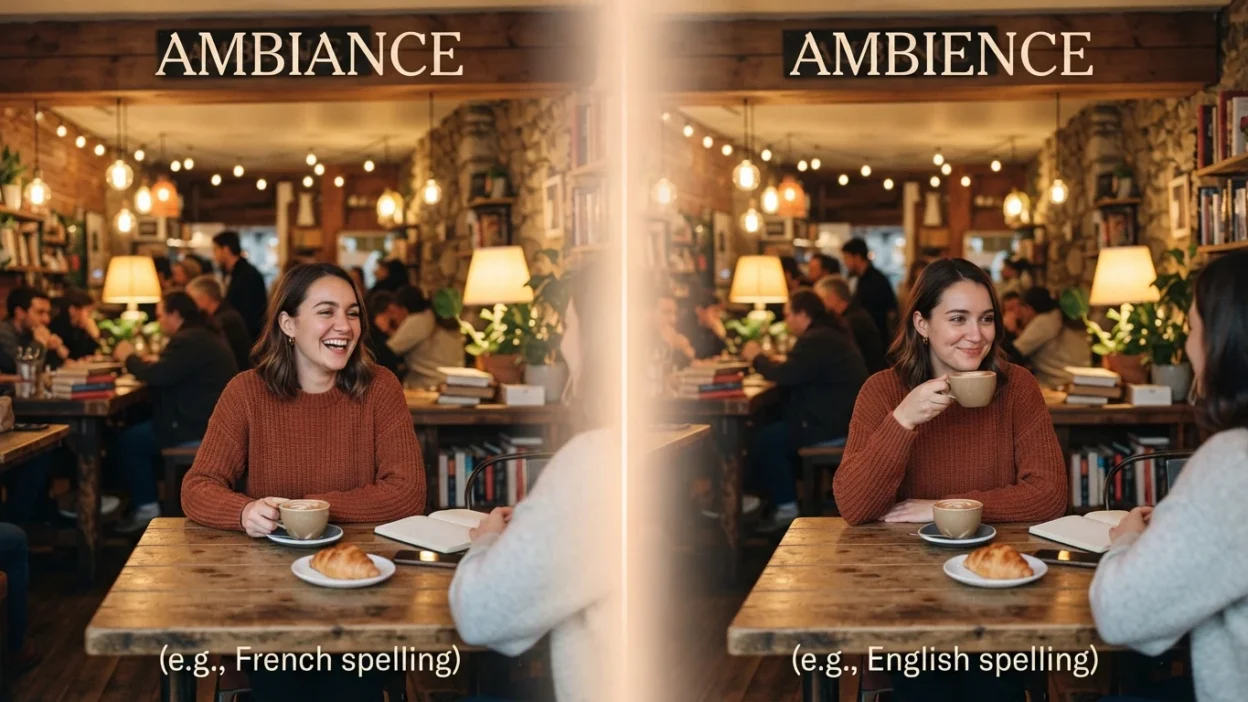
Have you ever wondered whether the correct spelling is ambiance vs ambience? You are not alone.
These two words look and sound almost identical, and both are commonly used when describing the atmosphere or mood of a place.
if you are writing about a cozy restaurant, a stylish hotel, a peaceful home, or the feeling created by an event, choosing the right spelling can sometimes be confusing.
The good news is that ambiance and ambience have essentially the same meaning.
The main difference is regional spelling: ambiance is more common in American English, while ambience is traditionally preferred in British English.
Understanding this small distinction can help you write more naturally and confidently, especially when adapting your writing for a particular audience.
Quick Answer: Ambiance vs Ambience
Ambiance and ambience are spelling variants of the same word. Both mean the overall atmosphere, mood, or character of a place or situation.
- Ambiance is more common in American English.
- Ambience is more common in British English.
- Both forms are correct.
- Neither spelling changes the meaning or pronunciation significantly.
For most general writing, you can use either one, but matching the spelling to your intended variety of English is a smart choice.
What Does Ambiance Mean?
Ambiance refers to the atmosphere or overall feeling created by a particular environment. It can be influenced by lighting, music, decoration, colors, furniture, sounds, smells, and even the behavior of the people present.
For example, a restaurant may have dim lighting, soft music, elegant furniture, and quiet conversation. Together, these features create a particular ambiance.
The word is especially common when people describe places where atmosphere matters.
Examples include:
- The restaurant has a warm and welcoming ambiance.
- The candles created a romantic ambiance.
- The hotel is known for its luxurious ambiance.
- The café has a relaxed ambiance that attracts students.
- Soft lighting gives the room a peaceful ambiance.
In simple terms, ambiance is the feeling a setting gives you.
What Does Ambience Mean?
Ambience has the same basic meaning as ambiance. It describes the atmosphere, mood, or character of a particular place or environment.
For example:
The quiet ambience of the library made it easy to concentrate.
Here, ambience describes the peaceful atmosphere of the library.
The spelling ambience is particularly familiar in British English and is often seen in British publications, websites, and formal writing.
More examples include:
- The café has a charming ambience.
- The hotel offers a relaxing ambience.
- The garden creates a tranquil ambience.
- The restaurant’s elegant ambience impressed the guests.
- The soft music added to the romantic ambience.
So, when comparing ambiance vs ambience, there is no meaningful difference in definition.
Ambiance vs Ambience: The Main Difference
The biggest difference is spelling preference rather than meaning.
| Feature | Ambiance | Ambience |
|---|---|---|
| Meaning | Atmosphere or mood | Atmosphere or mood |
| Pronunciation | Essentially the same | Essentially the same |
| American English | More common | Less common |
| British English | Used | More traditional/common |
| Meaning difference | None | None |
| Part of speech | Noun | Noun |
| Example | The restaurant has a cozy ambiance. | The restaurant has a cozy ambience. |
The important point is that both forms are legitimate. You do not need to treat one as a misspelling of the other.
Is Ambiance or Ambience More Common in American English?
Ambiance is generally the preferred spelling in American English.
An American writer might naturally write:
The restaurant has a sophisticated ambiance.
The spelling with -ance is widely accepted in American dictionaries and contemporary American usage.
That does not mean ambience is incorrect in the United States. You may still encounter it, particularly in literature, hospitality writing, lifestyle publications, or writing influenced by British usage.
If your audience is primarily American, however, ambiance is usually the safer default.
Is Ambiance or Ambience More Common in British English?
In British English, ambience is traditionally more common.
A British writer may write:
The restaurant’s elegant ambience made the evening memorable.
Both ambience and ambiance can be understood by British readers, but ambience fits established British spelling conventions more naturally.
This distinction is similar to other spelling differences between American and British English, such as:
- color / colour
- favorite / favourite
- center / centre
- theater / theatre
These differences generally reflect regional conventions rather than differences in meaning.
Where Did the Word Come From?
Both spellings are connected to the French word ambiance, which refers to an atmosphere or surrounding environment.
English adopted the term to describe the distinctive character or mood of a place. Over time, English developed two commonly used spellings: ambiance and ambience.
The spelling ambiance stays closer to the French form, while ambience developed as an English spelling variant.
This history explains why both forms can appear in dictionaries and edited writing today.
When Should You Use Ambiance?
Use ambiance when you want to describe the atmosphere of a place, event, or setting, particularly if you are writing for an American audience.
For example:
- The hotel creates a luxurious ambiance.
- The fireplace gives the room a cozy ambiance.
- The wedding venue had a romantic ambiance.
- The restaurant’s modern ambiance attracted younger customers.
It is especially useful in descriptions related to:
- Restaurants
- Hotels
- Interior design
- Weddings
- Events
- Travel
- Hospitality
- Retail
- Entertainment
When Should You Use Ambience?
Use ambience when writing for a British English audience or when your publication follows British spelling conventions.
For example:
- The pub has a friendly ambience.
- The countryside provides a peaceful ambience.
- The theatre’s traditional ambience adds to its charm.
- The boutique has a sophisticated ambience.
The choice is primarily about regional style and consistency.
Ambiance vs Atmosphere: Are They the Same?
Ambiance and atmosphere are close synonyms, but they are not always interchangeable in every context.
Atmosphere is the broader and more common word. It can describe the general feeling of a place, event, or situation.
Ambiance tends to emphasize the sensory and aesthetic qualities that create that feeling.
For example:
The atmosphere at the meeting was tense.
This sounds natural because atmosphere can describe an emotional or social environment.
By contrast:
The restaurant’s ambiance was elegant and intimate.
Here, ambiance works particularly well because the sentence focuses on the deliberate design and sensory character of a physical setting.
Related words include:
- atmosphere
- mood
- environment
- setting
- character
- tone
- feeling
- vibe
- surroundings
Examples of Ambiance and Ambience in Sentences
Here are examples showing how naturally either spelling can be used:
- The candles created a romantic ambiance.
- The café has a relaxed ambience.
- The hotel’s luxurious ambiance impressed visitors.
- The quiet ambience made the room feel peaceful.
- Soft music improved the restaurant’s ambiance.
- The garden has a calming ambience.
- Warm colors give the bedroom a cozy ambiance.
- The old building retains its traditional ambience.
Notice that changing ambiance to ambience does not change the meaning.
Common Mistakes to Avoid
One common mistake is assuming that one spelling is correct and the other is wrong. That is not the case.
Another mistake is switching between the two spellings within the same piece of writing without a reason. While readers will understand both, inconsistent spelling can make polished content look less carefully edited.
For example, if you are writing an American English article, it is better to consistently use:
ambiance
rather than alternating between ambiance and ambience.
Other mistakes include:
- Treating ambience as a completely different word
- Assuming ambiance is always the only correct spelling
- Using both spellings randomly in the same document
- Confusing ambiance with emotional atmosphere in contexts where atmosphere is more natural
- Overusing the word in promotional writing
Which Spelling Should You Choose?
Your choice should depend on your audience.
| Audience or Style | Recommended Spelling |
|---|---|
| United States | Ambiance |
| United Kingdom | Ambience |
| General international audience | Either |
| American SEO content | Ambiance |
| British SEO content | Ambience |
| Formal British publication | Ambience |
| Formal American publication | Ambiance |
If you are writing for an international audience, either spelling is understandable. Consistency matters more than trying to establish one version as universally correct.
Why Do People Search “Ambiance vs Ambience”?
People usually search this phrase because they encounter both spellings and want to know whether they have different meanings.
The confusion is understandable because English contains many regional spelling variations.
When two words look different but sound almost identical, it is natural to wonder whether there is a subtle distinction.
In this case, there is not a significant difference in meaning. The searcher’s main decision is simply which regional spelling fits the context.
For content creators, students, marketers, bloggers, and professionals, knowing this distinction is useful because spelling conventions can affect the consistency and credibility of written communication.
Ambiance vs Ambience in SEO and Content Writing
For SEO, both spellings can be useful because people search for both versions.
However, writers should avoid awkwardly repeating both forms throughout an article simply to capture keywords.
Search engines increasingly prioritize helpful content and natural language rather than mechanical keyword repetition.
A better approach is to:
- Choose the spelling appropriate for your target audience.
- Use related terms naturally.
- Answer the reader’s actual question.
- Include useful examples.
- Explain the American and British distinction.
- Maintain consistent spelling.
Related search terms include ambiance meaning, ambience meaning, ambiance definition, ambience definition, atmosphere meaning, and difference between ambiance and ambience.
Ambiance vs Ambience in Everyday Writing
In everyday conversation, most people will understand either spelling immediately.
For instance, if someone says:
I love the ambiance of this café.
The listener understands that they mean the café’s atmosphere.
Likewise:
I love the ambience of this café.
The meaning remains exactly the same.
The difference becomes more noticeable in written communication, especially when following a particular national style guide or publication standard.
FAQs About Ambiance vs Ambience
Is ambiance or ambience correct?
Both are correct. They are spelling variants of the same noun meaning atmosphere, mood, or character of a place or setting.
Is ambiance American or British?
Ambiance is more strongly associated with American English, although it is also used elsewhere. British English traditionally favors ambience.
Is ambience British English?
Yes. Ambience is the more traditional and commonly preferred British English spelling.
Do ambiance and ambience mean the same thing?
Yes. There is no important difference in meaning between the two spellings.
Can I use ambience in American English?
Yes. American readers will understand ambience, although ambiance is generally the more common American spelling.
Can I use ambiance in British English?
Yes. British readers will understand ambiance, but ambience may fit British spelling conventions better.
What is another word for ambiance?
Common alternatives include atmosphere, mood, environment, setting, character, tone, and vibe.
Which spelling should I use in an American article?
Use ambiance if you are following standard American English conventions. The key is to remain consistent throughout your article.
Final Summary
When it comes to ambiance vs ambience, there is no major difference in meaning. Both words describe the atmosphere, mood, character, or overall feeling created by a place or environment.
The distinction is mainly regional spelling. Ambiance is generally preferred in American English, while ambience is traditionally preferred in British English.
If you are writing for an American audience, choose ambiance. If your readers are primarily in the United Kingdom, ambience is usually the better choice.
For international readers, either spelling is acceptable. Most importantly, use one form consistently and focus on clear, natural writing.
Actionable Takeaway
Before publishing your next article, check your target audience and choose the appropriate spelling.
American audience → ambiance. British audience → ambience. International audience → either, but stay consistent.

Patricia Mary is a devoted writer and contributor at Biblenast, passionate about sharing the message of faith through meaningful biblical content. She focuses on creating inspiring and thoughtful writings that encourage spiritual growth, reflection, and a deeper connection with God’s Word in everyday life.