Knowing whether to use will or would in an if clause can be confusing, especially because both words are used to talk about future situations, possibilities, willingness, and hypothetical events.
The key is understanding that will and would do not normally work the same way after if. In standard English, conditional sentences follow specific patterns.
The good news is that the rule becomes much easier once you recognize the type of conditional you are using.
If you are writing an email, preparing for an English exam, or simply trying to sound more natural in conversation, this guide will show you when to use will and would in an if clause, when exceptions are possible, and which common mistakes to avoid.
Quick Answer: Will or Would in an If Clause?
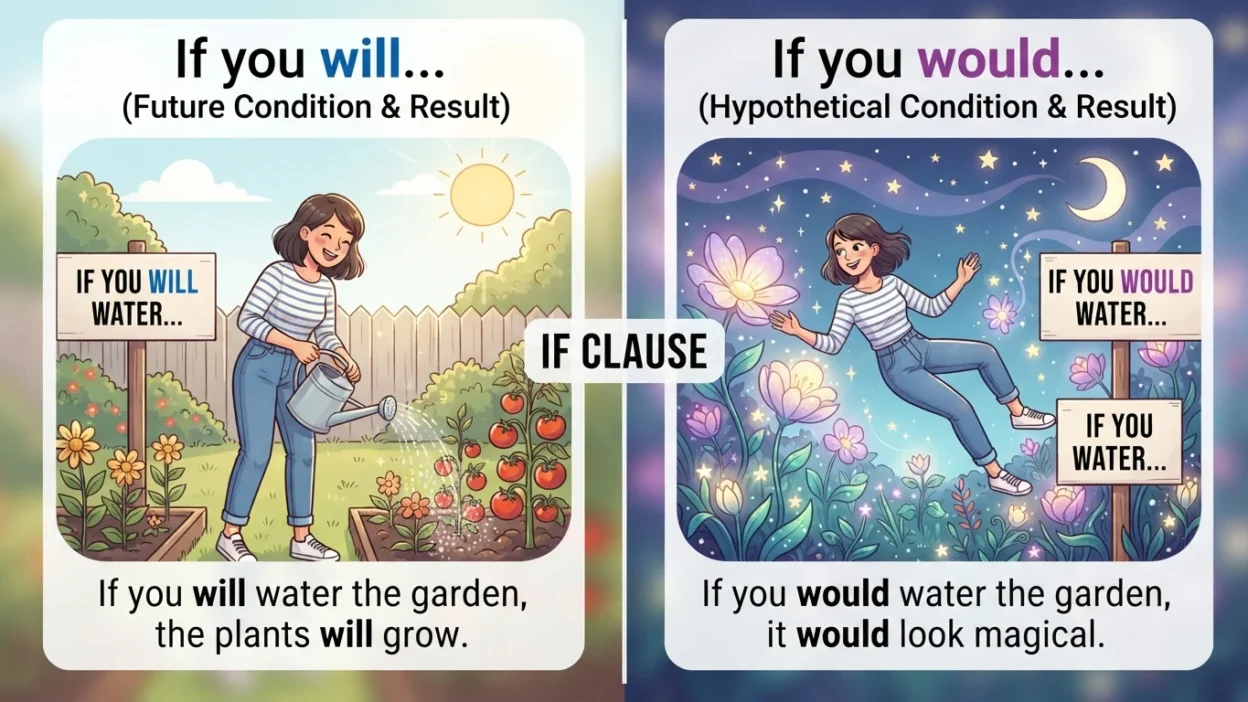
In most conditional sentences, will is not normally used immediately after if to express a simple future result.
- Correct: If it rains, I will stay home.
- Correct: If I had more time, I would travel more.
- Usually incorrect: If it will rain, I will stay home.
- Usually incorrect: If I would have more time, I would travel more.
However, will can appear after if when it expresses willingness, refusal, insistence, or a deliberate action rather than simply marking future time.
What Does “Will or Would in an If Clause” Mean?
An if clause, also called a conditional clause, introduces a condition. It tells us what must happen, might happen, or could have happened for another event to occur.
For example:
If I finish early, I will call you.
Here, if I finish early is the condition, while I will call you is the result.
The important point is that English normally uses a present tense in the if clause when talking about a real or possible future condition.
The general pattern is:
If + present simple, will + base verb
Examples:
- If she arrives early, we will start the meeting.
- If you study tonight, you will feel more prepared tomorrow.
- If they invite me, I will go.
- If the weather improves, we will go outside.
For hypothetical or unlikely situations, English generally uses:
If + past simple, would + base verb
Examples:
- If I had more money, I would buy a new car.
- If she lived closer, she would visit more often.
- If we knew the answer, we would tell you.
When Should You Use “Will” in an If Clause?
Although will is generally avoided in ordinary future if clauses, there are important exceptions.
1. Will Means Willingness
When will means be willing to, it can follow if.
For example:
- If you will listen to me, I can explain the problem.
- If he will cooperate, we can finish the project.
- If you will wait for a moment, I’ll check the information.
Here, will does not simply mean future time. It expresses willingness or readiness.
Compare:
If you listen to me, I will explain the problem.
This means listening is the condition.
If you will listen to me, I will explain the problem.
This can suggest, “If you are willing to listen…”
2. Will Can Express Refusal
Will can also describe someone’s refusal or persistent behavior.
For example:
- If the child will not eat, don’t force him.
- If she won’t cooperate, we’ll need another solution.
- If he will keep interrupting, the meeting cannot continue.
In these sentences, will/won’t describes behavior, willingness, or refusal rather than ordinary future time.
3. Will Can Express Insistence
Sometimes will after if emphasizes that someone insists on doing something.
For example:
- If you will insist on paying, I won’t stop you.
- If he will continue ignoring the warnings, there may be consequences.
This use is less common in everyday English but is grammatically acceptable.
When Should You Use “Would” in an If Clause?
The most important rule is that would normally belongs in the result clause, not the if clause, when talking about hypothetical situations.
The standard second conditional pattern is:
If + past simple, would + base verb
Examples:
- If I were you, I would apologize.
- If she had enough money, she would buy the house.
- If they knew about the problem, they would help.
- If we lived nearby, we would visit more often.
So avoid:
❌ If I would have enough money, I would travel.
Use:
✅ If I had enough money, I would travel.
This distinction is one of the most common conditional grammar problems for English learners.
Will vs Would in Conditional Sentences
The easiest way to understand the difference is to look at the relationship between the condition and the result.
| Situation | If Clause | Result Clause | Example |
|---|---|---|---|
| Real or possible future | Present simple | Will | If I finish, I will call. |
| Hypothetical/unlikely present or future | Past simple | Would | If I had time, I would help. |
| Unreal past | Past perfect | Would have + past participle | If I had known, I would have helped. |
| Willingness | Will may be possible | Depends on context | If you will listen, I’ll explain. |
| Refusal | Will/won’t may be possible | Depends on context | If he won’t cooperate, we’ll leave. |
This table shows why simply memorizing “never use will or would after if” is too simplistic. The meaning and structure of the sentence matter.
The Four Main Conditional Patterns
Understanding conditional types makes the will or would in an if clause question much easier.
Zero Conditional
The zero conditional describes general truths, facts, or things that regularly happen.
If + present simple, present simple
Examples:
- If you heat ice, it melts.
- If people don’t sleep enough, they feel tired.
- If water reaches 100°C, it boils.
We normally do not need will or would here.
First Conditional
The first conditional describes a real or possible future situation.
If + present simple, will + base verb
Examples:
- If it rains, we will stay inside.
- If you work hard, you will improve.
- If she calls, I will answer.
Notice that will belongs in the main clause, not the ordinary if clause.
Second Conditional
The second conditional describes an imaginary, unlikely, or hypothetical situation.
If + past simple, would + base verb
Examples:
- If I won the lottery, I would travel around the world.
- If he were here, he would know what to do.
- If we had more space, we would adopt another pet.
Third Conditional
The third conditional discusses an unreal situation in the past—something that did not happen.
If + past perfect, would have + past participle
Examples:
- If I had studied harder, I would have passed the exam.
- If she had left earlier, she would have caught the train.
- If they had known, they would have acted differently.
Why Do People Say “If I Would…”?
English learners often hear phrases such as “If I would…” and assume they are always grammatically wrong.
They are not always wrong.
For example:
If you would just give me a chance, I could explain.
Here, would can communicate willingness or a polite request. It does not simply create a hypothetical conditional.
Another example is:
If he would stop complaining, we could get some work done.
This can mean that the speaker wants him to be willing to stop or criticizes his repeated behavior.
However, in ordinary second conditional sentences, use the past form in the if clause:
❌ If I would know the answer, I would tell you.
✅ If I knew the answer, I would tell you.
Common Mistakes With Will and Would
Mistake 1: Using “Will” for Every Future Condition
❌ If I will finish early, I will call you.
✅ If I finish early, I will call you.
The first sentence uses will unnecessarily in the condition.
Mistake 2: Using “Would” After Every “If”
❌ If I would have more time, I would exercise.
✅ If I had more time, I would exercise.
The second conditional uses the past simple in the condition.
Mistake 3: Confusing Future and Hypothetical Situations
Compare:
If I have enough money, I will buy it.
This presents having enough money as a realistic possibility.
If I had enough money, I would buy it.
This presents the situation as hypothetical or unlikely.
The choice between will and would can therefore change the speaker’s intended meaning.
Mistake 4: Ignoring the Meaning of “Will”
Consider:
If you will wait here, I’ll be back soon.
This is possible because will means something like “are willing to.”
It is different from:
If you arrive early, I’ll meet you.
Here, arrive is simply a future condition.
American vs British English: Is There a Difference?
The basic conditional rules are essentially the same in American and British English.
Both varieties normally use:
- If + present simple + will for likely future conditions.
- If + past simple + would for hypothetical conditions.
- If + past perfect + would have for unreal past situations.
There can be differences in style, frequency, and politeness. British English may sometimes use constructions with will that sound more formal or deliberate, particularly when will expresses willingness or insistence.
For learners, however, the safest approach is to focus on meaning rather than dialect. If you are expressing a normal future condition, avoid putting will immediately after if.
How to Choose Between Will and Would
When you are unsure, ask yourself three questions:
Question 1: Is the condition realistically possible?
If yes, you probably need the first conditional:
If + present simple → will
Example:
If she comes, I will talk to her.
Question 2: Is the situation imaginary or unlikely?
If yes, use the second conditional:
If + past simple → would
Example:
If she came, I would talk to her.
Question 3: Does “will” mean willingness or refusal?
If yes, will may correctly appear in the if clause.
Example:
If she will cooperate, we can solve the problem.
This means something close to “If she is willing to cooperate…”
Practical Examples You Can Copy
Here are several natural conditional sentences:
- If you study, you will pass the test.
- If you studied more, you would feel more confident.
- If I see him, I will tell him.
- If I saw him, I would tell him.
- If they arrive early, we will begin.
- If they arrived early, we would begin.
- If I had known about the meeting, I would have attended.
- If you will wait a moment, I’ll help you.
- If he won’t listen, there is nothing we can do.
- If you would be willing to help, I would appreciate it.
Notice how the meaning changes depending on the conditional structure.
A Simple Memory Trick
Remember this pattern:
Real possibility → If + present → will
If I have time, I will help.
Hypothetical possibility → If + past → would
If I had time, I would help.
Imaginary past → If + past perfect → would have
If I had had time, I would have helped.
And remember the exception:
Will after if can be correct when it means willingness, refusal, insistence, or deliberate behavior.
This simple framework will prevent most mistakes.
FAQs About Will or Would in an If Clause
1. Can I use “will” after “if”?
Yes, but not usually to express an ordinary future condition. Will can follow if when it expresses willingness, refusal, insistence, or deliberate behavior.
2. Can I use “would” after “if”?
Yes, in certain contexts, but normally not in a standard second conditional. For example, would can express willingness or politeness in phrases such as “If you would wait.”
3. Is “If I would” grammatically wrong?
Not always. It can be correct when would expresses willingness or a polite request. But “If I would have more money” is incorrect for a standard hypothetical condition. Say “If I had more money.”
4. Should I say “If it will rain”?
Usually, no. Say “If it rains, I will…” when talking about a possible future event.
5. Should I say “If I would go”?
Usually, no. For a hypothetical situation, say “If I went, I would…”
6. What is the easiest rule for learners?
Use if + present, will for likely future conditions and if + past, would for hypothetical situations.
7. Is the rule the same in American and British English?
Yes. The fundamental conditional structures are the same in both varieties, although some will constructions expressing willingness or insistence may vary in style and frequency.
8. How can I avoid conditional mistakes?
Identify whether the situation is real, hypothetical, or unreal in the past. Then choose the appropriate conditional pattern rather than choosing will or would based only on the word if.
Summary
The choice between will or would in an if clause becomes much simpler when you identify the type of conditional sentence. For a normal future possibility, use the present simple after if and will in the main clause: “If I finish early, I will call you.” For a hypothetical or unlikely situation, use the past simple after if and would in the result clause: “If I had more time, I would travel.”
The main exception is that will can appear after if when it expresses willingness, refusal, insistence, or deliberate behavior. Similarly, would can sometimes appear after if when it has a special meaning, such as willingness or polite insistence. The most useful strategy is therefore to focus on what the verb means in context, not simply memorize a rule that says will or would can never follow if.
Actionable Takeaway
Before writing a conditional sentence, quickly check:
- Real future possibility? Use if + present simple + will.
- Imaginary or unlikely situation? Use if + past simple + would.
- Unreal past? Use if + past perfect + would have.
- Will means willingness, refusal, or insistence? It may be correct after if.
- Would means hypothetical result? It normally belongs in the main clause.
With these patterns in mind, you can use will and would naturally and confidently in everyday English, academic writing, and professional communication.

John Robert is a passionate author and faith-driven writer who contributes insightful and inspiring biblical content to Biblenast. With a strong commitment to sharing God’s Word, he focuses on creating meaningful messages that encourage spiritual growth, reflection, and daily guidance. His work aims to connect readers with the timeless teachings of the Bible.