Choosing between compared to vs as compared to can feel surprisingly confusing. Both expressions are used when we want to examine similarities or differences between two people, things, situations, or ideas.
In many everyday sentences, they can even appear interchangeable, which makes it difficult to know if one is more grammatically correct than the other.
The good news is that you usually do not need to worry about making a serious grammatical mistake. Compared to is the more concise and widely preferred expression, while as compared to is also grammatical but can sound more formal, deliberate, or wordy on the sentence.
Understanding the small difference in tone and usage can help you write more naturally and confidently.
Quick Answer: Compared To vs As Compared To
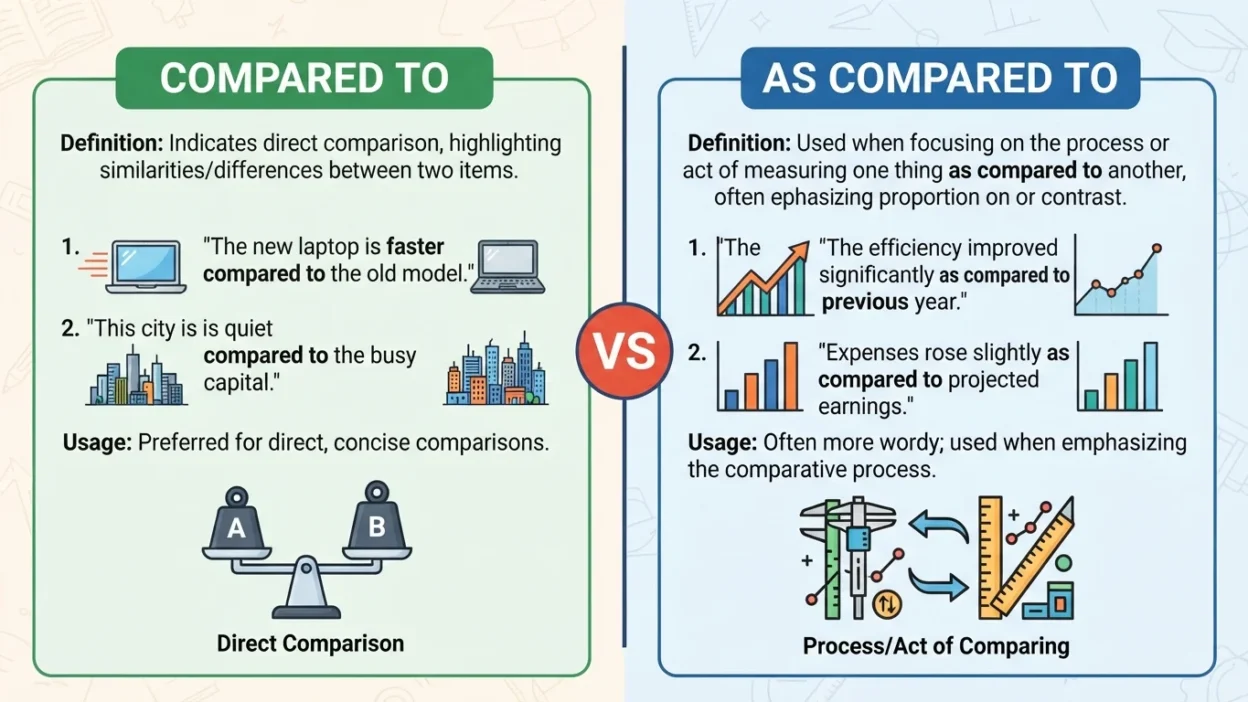
Compared to and as compared to are both used to show a comparison.
- Compared to is shorter, more common, and usually the best choice for everyday writing.
- As compared to is also correct and may emphasize the act or basis of comparison.
- In most sentences, replacing as compared to with compared to makes the wording more concise.
- Neither expression is inherently wrong when used correctly.
Example:
“Compared to last year, sales have increased.”
“As compared to last year, sales have increased.”
Both sentences are grammatical, but the first sounds more natural and streamlined.
What Does “Compared To” Mean?
Compared to means “when examined in relation to” or “when contrasted with” another person, object, amount, or situation.
It is commonly used to highlight a difference or similarity.
For example:
- Compared to John, Mike is taller.
- This year’s expenses are lower compared to last year.
- The new model is lighter compared to the previous version.
- Compared to other cities, this one is relatively affordable.
The phrase can introduce either a positive, negative, or neutral comparison.
Although compared to often introduces differences, it can also point out similarities.
Examples of “Compared To”
- “The apartment is spacious compared to our old home.”
- “She looks younger compared to her sister.”
- “This book is short compared to the previous one.”
- “Winter temperatures are mild compared to those in northern regions.”
- “The updated software is easier to use compared to the older version.”
The exact meaning depends on what follows the comparison.
What Does “As Compared To” Mean?
As compared to has essentially the same basic meaning as compared to. It introduces a point of comparison and tells readers that two things are being evaluated in relation to each other.
For example:
- “The company’s profits increased as compared to last year.”
- “The new system is more efficient as compared to the old one.”
- “The population is relatively small as compared to neighboring cities.”
The construction is grammatical, but many writers consider it unnecessarily wordy when compared to would communicate the same idea.
This does not mean as compared to should never be used. It can be appropriate when the writer wants to give the comparison a slightly more formal or explicit feel.
Compared To vs As Compared To: Key Difference
The main difference is style and emphasis rather than basic meaning.
| Feature | Compared to | As compared to |
|---|---|---|
| Basic meaning | Makes a comparison | Makes a comparison |
| Grammar | Correct | Correct |
| Length | Shorter | Longer |
| Tone | Natural and direct | More formal or wordy |
| Everyday usage | Very common | Less common |
| Business writing | Preferred in most cases | Sometimes used |
| Academic writing | Common | Acceptable, but often unnecessary |
| Best general choice | Yes | Use when stylistically appropriate |
In most modern writing, compared to is the safer choice because it is concise and easy to read.
Is “Compared To” Grammatically Correct?
Yes. Compared to is grammatically correct and extremely common in standard English.
For example:
“Compared to last month, traffic has increased.”
The phrase can appear at the beginning or later in a sentence.
At the beginning
“Compared to 2025, the company has hired more employees.”
In the middle
“The company has hired more employees compared to 2025.”
Both constructions work, although the sentence can sometimes be improved by using than or another comparison structure, depending on what you are trying to say.
Is “As Compared To” Grammatically Correct?
Yes, as compared to is also grammatical.
For example:
“The cost is significantly lower as compared to the previous year.”
However, some editors would simplify this to:
“The cost is significantly lower compared to the previous year.”
Or, depending on the intended comparison:
“The cost is significantly lower than in the previous year.”
This illustrates an important writing principle: grammatical does not always mean optimal. Good writing often favors the clearest and most economical expression.
When Should You Use “Compared To”?
Use compared to when you want your writing to sound concise, natural, and straightforward.
It works particularly well in:
- Everyday conversation
- Blog posts
- News writing
- Business communication
- General academic writing
- Reports
- Marketing content
- Informal correspondence
For example:
“Compared to the old website, the new design is much easier to navigate.”
This sounds clean and natural.
When Can “As Compared To” Be Useful?
Although as compared to is often more verbose, it can still have a place in formal or analytical writing.
It may be useful when the comparison itself is being highlighted as an analytical frame.
For example:
“The results should be interpreted as compared to the baseline established at the beginning of the study.”
Here, the wording may feel more deliberate because the writer is emphasizing the basis against which the results should be evaluated.
Still, always ask whether the extra words add meaning. If they do not, compared to is usually preferable.
Compared To vs Than
One common source of confusion is the difference between compared to and than.
Generally, than is used in direct comparative constructions:
- Sarah is taller than Emma.
- This car is faster than that one.
- Today’s temperature is lower than yesterday’s.
Compared to establishes a broader relationship:
- Compared to Emma, Sarah is tall.
- Compared to the old car, this one is faster.
- Compared to yesterday, today’s temperature is lower.
Both forms can be correct, but they are structured differently.
Compared To vs Compared With
Another interesting distinction is between compared to and compared with.
Traditional style guides sometimes suggest that compare to is used when pointing out similarities, while compare with is used for examining similarities and differences.
For example:
- “The poet compared her voice to music.”
- “The researcher compared the two studies with one another.”
However, modern English frequently uses compared to and compared with in overlapping ways. The distinction is not always rigid in contemporary usage.
The most important consideration is clarity.
Common Mistakes to Avoid
1. Using “as compared to” everywhere
“As compared to” is not incorrect, but using it repeatedly can make your writing unnecessarily heavy.
Wordy:
“As compared to last year, our sales have improved.”
More concise:
“Compared to last year, our sales have improved.”
2. Confusing “compared to” with “than”
Avoid forcing than into a sentence where a comparison phrase is needed.
Incorrect or awkward:
“Compared to John is taller than Mike.”
Better:
“Compared to Mike, John is taller.”
3. Creating unclear comparisons
Make sure the things being compared are logically compatible.
Unclear:
“Compared to the previous version, the software’s users are happier.”
This may be grammatically understandable, but the comparison can sound logically uneven because users are being compared indirectly with software.
Better:
“Compared to users of the previous version, current users are more satisfied.”
4. Overcomplicating simple sentences
If a simple expression works, there is usually no advantage in making it longer.
Instead of:
“As compared to the previous model, this model consumes less energy.”
Use:
“Compared to the previous model, this model consumes less energy.”
American English vs British English
There is no major American-versus-British grammar difference that makes compared to correct in one variety and as compared to incorrect in the other.
Both expressions occur in American and British English.
That said, compared to is generally the more concise and natural choice in contemporary English on both sides of the Atlantic.
British English may also commonly use compared with, particularly in formal contexts, but American English uses that construction as well.
The key point is that this is primarily a matter of style, register, and sentence structure, not a strict national grammar rule.
Real-Life Examples
Here are some natural examples:
Business
“Compared to last quarter, revenue increased by 12%.”
Education
“Compared to last semester, students performed better on the final exam.”
Technology
“The latest phone is thinner compared to the previous model.”
Health and fitness
“Walking regularly can improve fitness compared to remaining inactive.”
Travel
“Compared to major tourist destinations, this town is relatively quiet.”
Everyday conversation
“This restaurant is much cheaper compared to the one downtown.”
Formal writing
“The findings were analyzed as compared to the original baseline.”
Notice how compared to tends to feel more direct, while as compared to can create a more formal or analytical tone.
Which One Should You Use?
If you are unsure, choose compared to.
It is concise, widely understood, and suitable for most contexts.
Use as compared to when you have a specific stylistic reason for emphasizing the comparison or when it fits naturally into a formal construction.
A useful editing test is simple:
Can I remove “as” without changing the meaning?
If the answer is yes, compared to will often be the cleaner choice.
Compared To vs As Compared To: Quick Decision Guide
| If you want to… | Best choice |
|---|---|
| Sound natural | Compared to |
| Keep writing concise | Compared to |
| Write a blog article | Compared to |
| Write everyday English | Compared to |
| Make a straightforward comparison | Compared to |
| Emphasize a formal comparison | As compared to can work |
| Avoid unnecessary words | Compared to |
| Write analytical material | Either, depending on context |
Frequently Asked Questions
Is “compared to” correct English?
Yes. Compared to is grammatically correct and widely used in modern English.
Is “as compared to” grammatically correct?
Yes. As compared to is also grammatically correct, although it can sound more formal or wordy than necessary.
Which is better: compared to or as compared to?
In most situations, compared to is the better choice because it is shorter, clearer, and more natural.
Is “compared to” formal English?
Yes. Compared to can be used in formal writing, including business, academic, and professional contexts.
Can I use “compared to” and “as compared to” interchangeably?
Often, yes. They generally communicate the same basic comparison, but their style and emphasis can differ.
Is “compared with” better than “compared to”?
Not necessarily. Both are accepted in modern English. The best choice depends on the sentence and intended meaning.
Do Americans and British people use these phrases differently?
Both varieties use compared to and as compared to. There is no major grammatical rule separating American and British English here.
Should I avoid “as compared to”?
You do not need to avoid it completely. Simply avoid using it when compared to communicates the same idea more naturally.
Final Summary
When deciding between compared to vs as compared to, remember that the two expressions have essentially the same core meaning: they introduce a comparison between two things.
Compared to is shorter, more direct, and generally the preferred option in everyday, professional, academic, and online writing. As compared to is grammatical but may sound more formal or unnecessarily wordy when no additional emphasis is needed.
The best writing is not simply about following rigid grammar rules. It is about choosing language that communicates your clearly and naturally.
When you are editing a sentence, start with compared to and consider as compared to only when its added formality or emphasis serves a purpose.
Actionable Takeaway
Before publishing your sentence, ask yourself:
- Am I making a straightforward comparison? → Use compared to.
- Does the sentence need a more deliberate analytical tone? → As compared to may work.
- Does “as” add any useful meaning? → If not, remove it.
- Are the things being compared logically parallel? → If not, rewrite the sentence.
For most readers and most situations, compared to is the simple, natural choice.

John Robert is a passionate author and faith-driven writer who contributes insightful and inspiring biblical content to Biblenast. With a strong commitment to sharing God’s Word, he focuses on creating meaningful messages that encourage spiritual growth, reflection, and daily guidance. His work aims to connect readers with the timeless teachings of the Bible.