If you have ever paused while writing a message and wondered whether to use yea vs yeah, you are not alone.
These two words look and sound somewhat similar, but they have different meanings, histories, and uses.
Choosing the right one depends largely on whether you are expressing agreement, answering informally, or referring to a formal “yes” or vote.
The difference becomes especially important in professional writing, academic work, social media, and everyday conversation.
Yeah is common in casual modern English, while yea is much more formal, traditional, and specific.
This guide explains the difference between yea and yeah, shows how to use each naturally, and clears up common spelling and pronunciation confusion.
Quick Answer: Yea vs Yeah
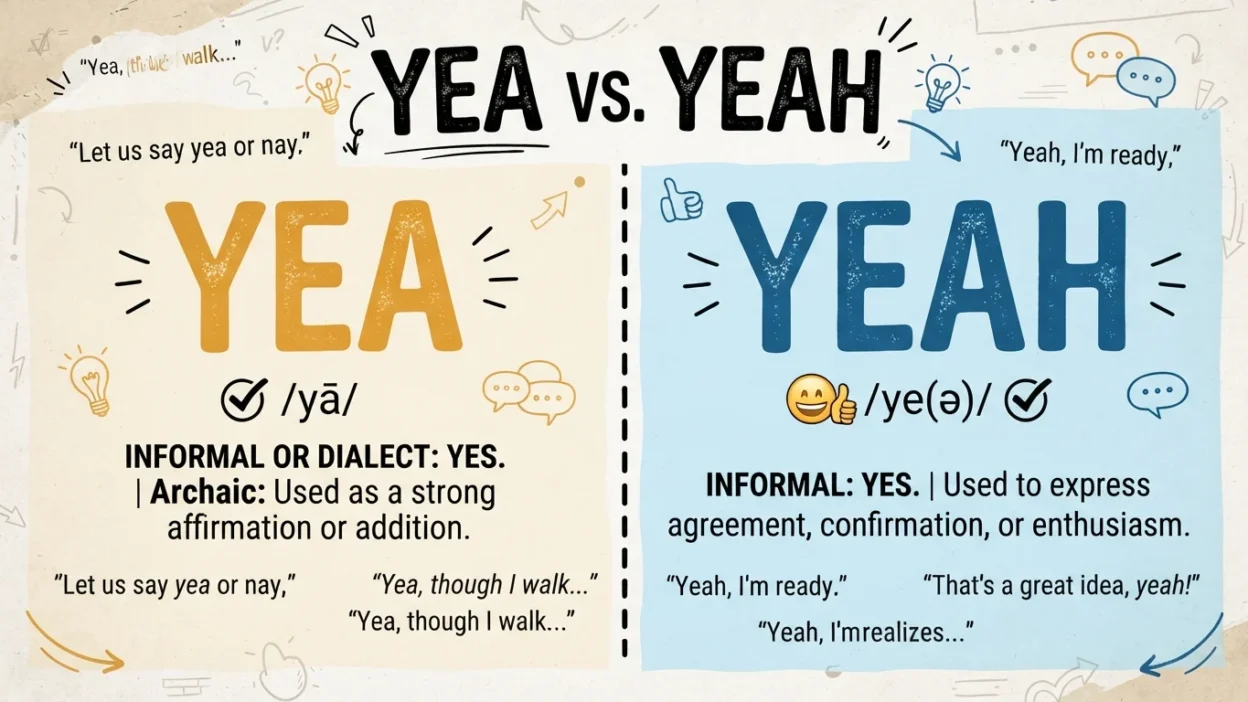
Yea means “yes,” especially in formal, traditional, or voting contexts. For example, “The vote was 30 yea and 10 nay.”
Yeah is an informal way of saying “yes” or showing agreement. For example, “Yeah, I’d love to go.”
In everyday conversation, yeah is usually the correct choice. Use yea when you mean a formal or emphatic “yes,” particularly in voting or traditional expressions.
What Does “Yea” Mean?
Yea is an old or formal word meaning yes, indeed, or in favor. It has been used in English for centuries and is still found in formal contexts today.
One of its most recognizable uses is in voting. When people vote on a proposal, “yea” can indicate that a person supports it, while “nay” indicates opposition.
For example:
- “The motion passed with 42 yea votes.”
- “Those in favor should vote yea.”
- “The members voted yea on the proposal.”
Yea can also appear in older literary or religious language. In such contexts, it may mean “indeed” or “even.”
For example:
“Yea, though I walk through the valley…”
Here, yea has a traditional meaning closer to “indeed” or “yes, even.”
Yea as a Formal “Yes”
Think of yea as a more formal or old-fashioned version of “yes.” However, it is not normally used in ordinary texting.
You would generally write:
- “Yeah, I agree.” ✅
- “Yea, I agree.” ❌ in casual modern English
Unless you intentionally want an archaic, humorous, or formal tone, yea usually sounds unusual in everyday conversation.
What Does “Yeah” Mean?
Yeah is an informal form of yes. It is extremely common in spoken English and casual writing.
People use it to:
- Agree with someone
- Answer a question
- Confirm information
- Show understanding
- Express enthusiasm
- Continue a conversation naturally
Examples include:
- “Yeah, that sounds good.”
- “Yeah, I understand.”
- “Yeah, I already finished it.”
- “Yeah, you’re right.”
- “Yeah! Let’s go.”
Because yeah reflects natural speech, it appears frequently in text messages, social media posts, chats, emails between friends, and informal conversations.
Yea vs Yeah: The Main Difference
The easiest way to remember the distinction is to connect each word with its typical setting.
| Word | Meaning | Typical Use | Tone | Example |
|---|---|---|---|---|
| Yea | Yes; in favor | Voting, formal, traditional | Formal/old-fashioned | “The motion received 20 yea votes.” |
| Yeah | Yes | Everyday conversation | Casual/informal | “Yeah, I can help you.” |
| Yes | Yes | General use | Neutral/formal | “Yes, I understand.” |
| Yay | Expression of joy | Celebration | Enthusiastic | “Yay! We won!” |
| Nay | No; against | Formal voting/traditional | Formal/old-fashioned | “Five voted nay.” |
This table also reveals an important point: yea and yay are not the same word.
Yea vs Yeah vs Yay
These three words are frequently confused because they can sound similar in certain contexts.
Yeah means yes in informal English.
Yay expresses happiness, excitement, or celebration.
Compare these examples:
- “Yea, I approve the proposal.” — formal/traditional
- “Yeah, I approve the proposal.” — casual
- “Yay! The proposal passed!” — excitement
If you are celebrating good news, yay is probably what you want.
If you are casually agreeing, use yeah.
If you are recording a formal vote, yea may be appropriate.
Examples of “Yea” in Sentences
Here are some natural examples of yea:
- “The final vote was 25 yea and 8 nay.”
- “The committee members voted yea on the amendment.”
- “The proposal received more yea votes than nay votes.”
- “Those voting yea should raise their hands.”
- “The senator cast a yea vote.”
- “Yea, even in difficult times, hope can remain.”
Notice that most modern examples of yea are connected to voting or formal language.
Examples of “Yeah” in Sentences
Yeah is much more common in everyday communication.
- “Yeah, I’ll meet you after work.”
- “Yeah, that makes sense.”
- “Yeah, I remember her.”
- “Yeah, you can borrow my book.”
- “Yeah, I think we should try it.”
- “Yeah! That’s exactly what I was thinking.”
- “Oh, yeah, I almost forgot.”
These sentences sound natural because yeah fits conversational English.
When Should You Use “Yea”?
Use yea when the context calls for a formal or traditional “yes.”
Common situations include:
Formal Voting
This is probably the most important modern use.
- “The bill passed with 60 yea votes.”
- “The chair asked members to vote yea or nay.”
Traditional or Literary Writing
Yea can appear in older texts, poetry, religious writing, or deliberately formal language.
Historical Context
When discussing historical voting practices or reproducing traditional language, yea may be appropriate.
In ordinary writing, however, replacing every “yes” with “yea” can make your sentence sound unnatural.
When Should You Use “Yeah”?
Use yeah when you are writing the way people normally speak in informal situations.
It works well in:
- Text messages
- Social media
- Friendly emails
- Casual conversations
- Online chats
- Informal dialogue
- Personal writing
For example:
“Yeah, I’ll call you later.”
This sounds natural and relaxed.
In a formal business report, however, you would normally choose yes rather than yeah.
Is “Yea” More Formal Than “Yeah”?
Yes, but there is an important qualification.
Yea is not simply the formal version of yeah in every situation. It is also an older word with specialized uses, particularly in voting.
For most formal writing, yes is the better choice.
Compare:
- Casual: “Yeah, I agree.”
- Neutral: “Yes, I agree.”
- Formal/traditional: “Yea, I approve.”
The second sentence is generally the safest choice for professional communication.
American vs British English: Yea and Yeah
There is no major American-versus-British spelling difference between yea and yeah. Both varieties of English recognize these words.
However, usage and tone can vary according to context and speaker.
Yeah is widely used in both American and British informal speech. You may hear variations such as “yeah,” “yep,” “yup,” or “yes” depending on the speaker and situation.
Yea remains associated with formal voting, traditional language, and older English in both varieties.
One useful distinction is that neither American nor British English generally treats yea as the normal everyday replacement for “yeah.”
Common Mistakes With Yea and Yeah
Understanding a word is one thing; knowing when not to use it is equally important.
Mistake 1: Using “Yea” in Every Casual Conversation
Writing “Yea, I’ll be there” in a text message is not necessarily grammatically impossible, but it can sound old-fashioned or unusual.
Better:
“Yeah, I’ll be there.”
Mistake 2: Confusing “Yea” With “Yay”
Remember:
- Yea = yes/in favor
- Yeah = informal yes
- Yay = excitement
So:
“Yea! We won!” ❌
If you mean excitement, write:
“Yay! We won!” ✅
Mistake 3: Using “Yeah” in Formal Reports
“Yeah” is conversational. In academic papers, formal reports, business documents, and professional correspondence, yes is usually more appropriate.
Mistake 4: Assuming “Yea” Is Always More Polite
Yea is not simply a more polite version of yeah. It can sound archaic or ceremonial outside its traditional contexts.
Yea or Yeah: Which One Should You Choose?
Use this simple decision guide:
Are you casually saying yes?
→ Use yeah.
Are you recording or describing a formal vote?
→ Use yea.
Are you writing a formal or professional sentence?
→ Usually use yes.
Are you celebrating or expressing excitement?
→ Use yay.
This approach eliminates most confusion.
Why Do People Confuse Yea and Yeah?
The confusion comes partly from pronunciation and partly from spelling.
English contains many words that sound similar but perform different grammatical or communicative functions. Since yea and yeah can both be associated with “yes,” people sometimes treat them as interchangeable.
Modern communication makes the issue even more noticeable. Texting encourages informal spellings, while historical and formal texts preserve older vocabulary.
The key is to focus on meaning and context, rather than pronunciation alone.
Is “Yea” Still Used Today?
Yes. Although yea is much less common than yes or yeah in ordinary conversation, it has not disappeared.
You may encounter it in:
- Legislative voting
- Parliamentary contexts
- Historical documents
- Religious or literary writing
- Formal expressions
- Traditional phrases
So, while yea may sound old-fashioned in everyday speech, it still has legitimate modern uses.
Can “Yeah” Be Used in Professional Writing?
Sometimes, but context matters.
A professional interview transcript, marketing campaign, social media post, or conversational article might intentionally use yeah to create a natural voice.
However, in formal reports, academic writing, legal documents, and official correspondence, yes is usually preferable.
The goal is not to avoid yeah completely. Instead, use it where an informal conversational tone is appropriate.
Frequently Asked Questions About Yea vs Yeah
1. Is “yea” the same as “yeah”?
Not exactly. Both can express agreement, but yea is traditionally formal or old-fashioned and is commonly associated with voting, while yeah is an informal form of “yes.”
2. Is “yeah” grammatically correct?
Yes. Yeah is a standard informal English word meaning “yes.” It is especially common in conversation and casual writing.
3. Is “yea” still used in English?
Yes. It is still used, particularly in formal voting terminology, historical writing, and traditional or literary contexts.
4. Should I write “yea” or “yeah” in a text?
Usually yeah. If you are casually agreeing with someone, “yeah” is the natural modern choice.
5. What is the difference between yea and yay?
Yea means yes or indicates approval, while yay expresses happiness or excitement. For example, “yea or nay” relates to voting, while “Yay!” expresses celebration.
6. Is “yea” more formal than “yeah”?
Generally, yes, but yea also has an old-fashioned or specialized character. For ordinary formal writing, yes is usually better.
7. What is the opposite of “yea”?
In formal voting language, the opposite of yea is nay, meaning no or against.
8. Can I use “yeah” in an essay?
It depends on the essay. In formal academic writing, yes is usually preferable. In dialogue, quotations, or informal personal writing, yeah can be appropriate.
Final Summary
The difference between yea vs yeah is mainly about meaning, context, and tone. Yeah is the everyday informal way to say “yes,” making it the natural choice for conversations, texts, and casual online communication. Yea, meanwhile, is an older and more formal term that is particularly associated with voting, approval, and traditional language.
When you are unsure, think about the situation rather than the spelling. If you are casually agreeing with a friend, choose yeah. If you are describing a formal vote, choose yea. If you are writing professionally and simply need to say “yes,” the neutral word yes is usually your safest option.
Actionable Takeaway
Use this quick rule whenever you hesitate:
- Yeah → casual “yes”
- Yea → formal/traditional “yes” or a vote in favor
- Yes → neutral or formal everyday English
- Yay → excitement or celebration
- Nay → formal/traditional “no” or a vote against
Remembering these four distinctions will help you sound natural, accurate, and confident in both everyday and professional English.

John Robert is a passionate author and faith-driven writer who contributes insightful and inspiring biblical content to Biblenast. With a strong commitment to sharing God’s Word, he focuses on creating meaningful messages that encourage spiritual growth, reflection, and daily guidance. His work aims to connect readers with the timeless teachings of the Bible.