The words accomplishment vs achievement are often used interchangeably, and in everyday English, that is usually acceptable.
Both words describe something you successfully complete or attain after putting in effort.
However, there is a subtle difference in emphasis that can help you choose the more precise word.
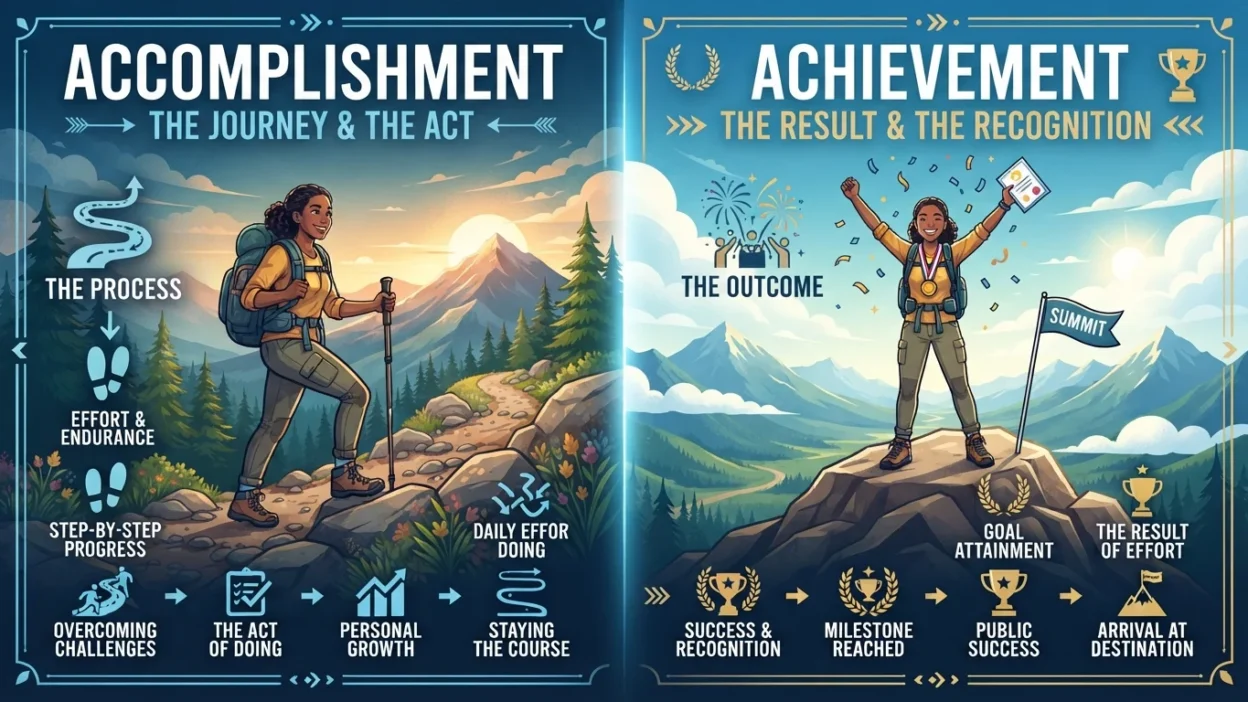
Generally, an accomplishment is something you successfully complete, carry out, or bring to a desired result,
while an achievement often emphasizes reaching a goal, succeeding after effort, or accomplishing something noteworthy.
Understanding this distinction is especially useful when writing a résumé, application, personal statement, performance review, or professional profile.
Quick Answer: Accomplishment vs Achievement
Accomplishment usually refers to something you successfully completed or managed to do.
Achievement often refers to a successful result or goal that required effort, skill, or determination.
For example:
- “Completing the project on time was a major accomplishment.”
- “Winning the national competition was a major achievement.”
The two words overlap considerably, but achievement can sound more significant or goal-oriented, while accomplishment can emphasize successful completion.
What Does Accomplishment Mean?
An accomplishment is something you successfully do, complete, or bring about. It can be personal, professional, academic, or practical.
The word often focuses on the successful completion of a task or objective.
Examples of accomplishment
- Completing a difficult course
- Learning a new language
- Finishing a large work project
- Organizing a successful event
- Improving a company’s customer service process
- Completing a marathon
- Raising money for a charity
For example:
“Finishing my degree while working full-time was a significant accomplishment.”
Here, the emphasis is on successfully completing something that required considerable effort.
Accomplishment in everyday English
An accomplishment does not necessarily have to be famous or impressive to everyone. Something can be a personal accomplishment because it represents meaningful progress for the person who achieved it.
For example:
“Learning to drive was a major accomplishment for me.”
This may not be a major public achievement, but it can still be an important personal accomplishment.
What Does Achievement Mean?
An achievement is something successfully attained, especially after effort, ability, persistence, or overcoming difficulties.
The word frequently emphasizes reaching a goal or producing a notable result.
Examples of achievement
- Winning an academic award
- Becoming the top salesperson
- Breaking a sports record
- Earning a degree
- Publishing a book
- Reaching a professional milestone
- Developing a successful product
For example:
“Winning the scholarship was one of her greatest achievements.”
The word achievement makes the successful outcome particularly prominent.
Achievement can describe personal success
Achievement is not limited to awards or publicly recognized accomplishments.
For example:
“Recovering my confidence was an important personal achievement.”
In this sentence, the achievement is meaningful because of the effort and personal growth involved.
Accomplishment vs Achievement: Key Difference
The difference is mainly one of emphasis, rather than a strict grammatical rule.
Accomplishment tends to highlight successful completion or something you managed to do.
Achievement tends to highlight success in reaching a goal or attaining a meaningful result.
Compare these sentences:
“Completing the research report was an accomplishment.”
This focuses on successfully finishing the report.
“Discovering a new solution was an achievement.”
This emphasizes the significance of the result.
In many contexts, either word could work without changing the basic meaning.
Accomplishment vs Achievement Comparison Table
| Feature | Accomplishment | Achievement |
|---|---|---|
| Basic meaning | Something successfully completed or done | Something successfully attained or achieved |
| Main emphasis | Completion or successful performance | Success, attainment, or notable result |
| Can be personal? | Yes | Yes |
| Can be professional? | Yes | Yes |
| Can describe a goal? | Yes | Yes |
| Often used on résumés? | Yes | Yes |
| Suggests recognition? | Not necessarily | Sometimes |
| Common related idea | Completing something | Reaching something |
The distinction is flexible, so context matters more than trying to follow a rigid rule.
Accomplishment vs Achievement Examples
Seeing the words in realistic sentences makes the difference easier to understand.
Examples with accomplishment
- “Completing the renovation in three months was an impressive accomplishment.”
- “Learning Spanish was a personal accomplishment.”
- “Managing the team during a difficult period was a significant accomplishment.”
- “Finishing the marathon was one of his proudest accomplishments.”
- “The successful launch of the website was a major accomplishment for the company.”
These examples generally focus on something successfully completed or managed.
Examples with achievement
- “Winning the championship was her greatest achievement.”
- “Graduating with honors was an important academic achievement.”
- “The invention was a remarkable scientific achievement.”
- “Reaching one million customers was a major business achievement.”
- “His promotion to director was a significant career achievement.”
These examples tend to highlight a successful outcome, milestone, or notable accomplishment.
Accomplishment vs Achievement on a Résumé
Both words are useful when describing professional experience, but achievement is particularly common when emphasizing measurable results.
Compare:
Accomplishment:
“Successfully managed a team of 10 employees.”
Achievement:
“Increased team productivity by 25% while managing a team of 10 employees.”
The second version gives the reader a measurable result.
When writing a résumé, focus less on whether something is technically an accomplishment or achievement and more on what you did and what happened as a result.
Useful résumé language includes:
- Increased
- Improved
- Reduced
- Completed
- Developed
- Created
- Led
- Designed
- Delivered
- Exceeded
- Implemented
- Achieved
A strong résumé statement often combines an action with a measurable outcome.
Personal Accomplishment vs Personal Achievement
Both phrases are natural, but they can carry slightly different emphasis.
A personal accomplishment may describe something meaningful that you successfully completed.
“Learning to play the piano was a personal accomplishment.”
A personal achievement may emphasize reaching a meaningful goal or overcoming a challenge.
“Performing at the concert was a personal achievement.”
There is no sharp dividing line between the two. Native speakers frequently use them interchangeably.
Common Mistakes to Avoid
1. Assuming the words are completely different
One common mistake is believing that accomplishment and achievement can never replace each other.
In reality, their meanings overlap considerably.
For example:
“Graduating from university was a great accomplishment.”
and
“Graduating from university was a great achievement.”
Both sentences are correct and natural.
2. Thinking achievement always means a public award
An achievement does not have to involve a trophy, prize, promotion, or public recognition.
Personal growth can also be an achievement.
“Building the confidence to speak in public was a major achievement.”
3. Using accomplishment only for small things
An accomplishment can be extremely significant.
“Leading the company through a major crisis was an extraordinary accomplishment.”
The word does not automatically suggest that something was minor.
4. Focusing too much on the distinction
If you are unsure which word to choose, consider the overall meaning of the sentence rather than trying to find an absolute rule.
In many situations, both choices are grammatically correct.
Which Word Is More Formal?
Both accomplishment and achievement are standard English words and can be used in formal writing.
However, the best choice depends on context.
Achievement is especially common when discussing:
- Awards
- Milestones
- Academic success
- Career progress
- Records
- Significant results
Accomplishment works especially well when discussing:
- Completed projects
- Successful tasks
- Personal goals
- Skills
- Responsibilities
- Things you managed to do
Neither word is inherently more formal than the other.
American vs British English
There is no major American-versus-British English difference in the basic meanings of accomplishment and achievement.
Both varieties of English commonly use both words.
For example, an American speaker might say:
“Graduating from college was a major achievement.”
A British speaker could say:
“Graduating from university was a major achievement.”
The difference in this example is primarily college/university usage, not the word achievement itself.
Likewise, both American and British English use phrases such as:
- personal achievement
- academic achievement
- career achievement
- professional accomplishment
- major accomplishment
So you can confidently use either word in American or British English.
How to Choose Between Accomplishment and Achievement
When deciding between the two, ask yourself what you want to emphasize.
Choose accomplishment when you want to stress:
- Successfully completing something
- Successfully handling a task
- Completing a difficult project
- Something you managed to do
- Personal progress or success
Choose achievement when you want to stress:
- Reaching a goal
- Attaining a milestone
- A significant result
- Recognition or distinction
- Success after considerable effort
For example:
“Completing the training program was an accomplishment.”
But:
“Earning the highest score in the training program was an achievement.”
The difference is subtle but useful.
Related Words and Synonyms
Understanding related vocabulary can make your writing more precise.
Synonyms for accomplishment
Depending on context, you might use:
- success
- completion
- attainment
- feat
- triumph
- result
- fulfillment
- milestone
Synonyms for achievement
Possible alternatives include:
- success
- accomplishment
- attainment
- milestone
- feat
- distinction
- triumph
- realization
These words are not always interchangeable, so consider the exact context before replacing one with another.
Frequently Asked Questions
Is accomplishment the same as achievement?
They have very similar meanings and are often interchangeable. Accomplishment can emphasize successfully completing or doing something, while achievement can emphasize reaching a goal or attaining a notable result.
Which is better: accomplishment or achievement?
Neither word is universally better. Choose accomplishment when completion or successful performance is important, and achievement when reaching a goal or significant result is the main focus.
Is graduating an accomplishment or an achievement?
It can be either. “Graduating was a great accomplishment” emphasizes successfully completing the process, while “Graduating was a great achievement” emphasizes the successful outcome.
Can an accomplishment be a personal goal?
Yes. A personal accomplishment can be anything meaningful that you successfully complete or manage to do, such as learning a skill, completing a course, or overcoming a difficult challenge.
Are achievements always impressive?
Not necessarily. An achievement can be personal and meaningful even if it is not impressive to everyone else.
Which word is better for a résumé?
Both can work. Achievement is often useful for highlighting measurable results and milestones, while accomplishment is useful for describing successful projects, responsibilities, and completed work.
Is “personal accomplishment” correct?
Yes. “Personal accomplishment” is a common and natural phrase for something meaningful that an individual successfully does or completes.
Are accomplishment and achievement synonyms?
They are near-synonyms. Their meanings overlap substantially, but achievement can place slightly more emphasis on attainment or a notable result, while accomplishment can emphasize successful completion or performance.
Summary
The difference between accomplishment vs achievement is subtle rather than absolute. An accomplishment generally describes something you successfully do, complete, or manage, while an achievement often highlights reaching a goal, attaining a milestone, or producing a noteworthy result. Because their meanings overlap, both words can be correct in many of the same sentences.
When choosing between them, think about the emphasis you want to create. Use accomplishment when successful completion or performance is important, and use achievement when the goal, result, milestone, or significance is more important. In résumés and professional writing, the strongest approach is to describe the action and show its result rather than relying on either word alone.
Actionable Takeaway
Remember this simple distinction:
Accomplishment = something you successfully did or completed.
Achievement = something you successfully reached or attained.
When writing about your experience, ask: “Am I emphasizing what I completed, or the result I reached?” That answer can help you select the more natural word. And when both seem appropriate, choose the one that makes your sentence clearer and more specific.

John Robert is a passionate author and faith-driven writer who contributes insightful and inspiring biblical content to Biblenast. With a strong commitment to sharing God’s Word, he focuses on creating meaningful messages that encourage spiritual growth, reflection, and daily guidance. His work aims to connect readers with the timeless teachings of the Bible.